
Understanding How a Heat Pump Works: A Comprehensive Guide
A heat pump is a device that extracts heat from one environment and transfers it to another. The concept of a heat pump has been around for centuries, and its application in modern times can be seen in refrigerators and air conditioners. In this article, we will delve into the world of heat pumps, exploring their different types, functionality, and how they work.
Types of Heat Pumps
Before we dive into the inner workings of a heat pump, it’s essential to understand the various types of heat pumps that exist:
- Refrigerators: These are household appliances that use heat pumps to cool food and drinks.
- Air Conditioners: Air conditioners also employ heat pumps to provide cooling and heating services for homes and businesses.
- Compressing Heat Pump: This type of heat pump uses a compressor to compress the refrigerant, increasing its temperature and pressure.
- Absorbing Heat Pump: Absorbing heat pumps use a liquid that absorbs heat from the surroundings and releases it back into the system.
- Phase Change Heat Pump: Phase change heat pumps utilize the phase transition of a substance (such as water or salt) to absorb and release heat.
- Thermoelectric Heat Pump: Thermoelectric heat pumps use thermoelectric materials to convert heat energy into electrical energy.
- Geothermal Heat Pump: Geothermal heat pumps harness heat from the earth to provide heating, cooling, and hot water services.
- Ranque-Hilsch Tube Heat Pump: Ranque-Hilsch tube heat pumps utilize a specialized tube with fins that absorb and release heat.
How a Heat Pump Works
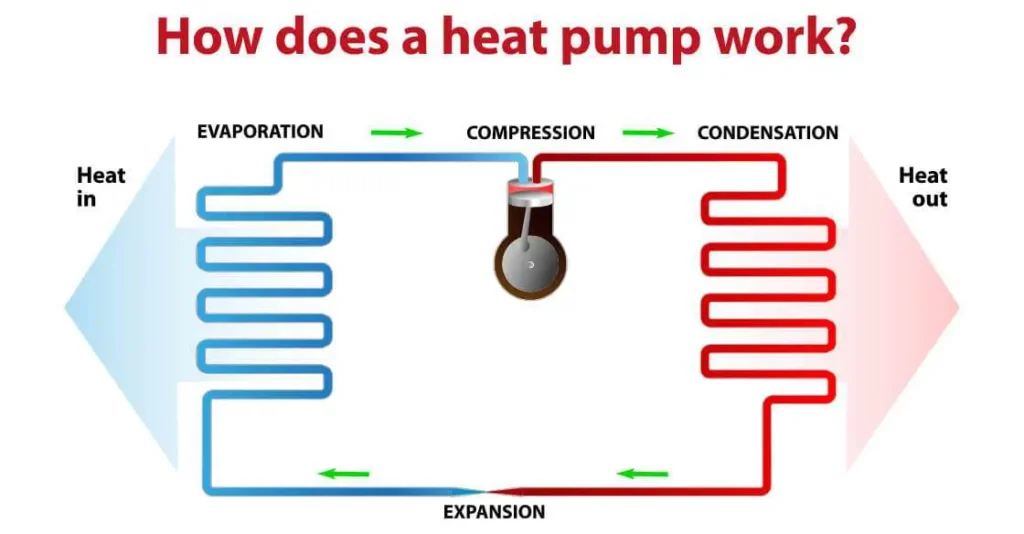
A heat pump is essentially a closed-loop system that uses a special fluid (called refrigerant) that can exist in both liquid and gaseous states, depending on temperature and pressure conditions. The closed loop consists of the following components:
- Compressor: This component compresses the refrigerant, raising its temperature and pressure.
- Condenser: This part releases heat from the hot refrigerant gas to the surrounding environment.
- Expansion valve: This valve reduces the pressure of the refrigerant, allowing it to expand and become cold.
- Evaporator: This component absorbs heat from the cold refrigerant, cooling down the surroundings.
The entire process can be visualized in more detail by referring to the ENEA’s PDF publication on the subject.
Working Principle
Here’s a step-by-step explanation of how a heat pump works:
- Refrigerant: The refrigerant is pumped into the compressor, where it’s compressed and its temperature rises.
- Condensation: The hot refrigerant gas is released to the condenser, where it loses heat to the surroundings.
- Expansion: The refrigerant then passes through the expansion valve, reducing its pressure and allowing it to expand and cool down.
- Evaporation: Finally, the cold refrigerant absorbs heat from the evaporator, cooling down the surroundings.
Applications of Heat Pumps
Heat pumps are used in a variety of applications, including:
- Heating Systems: Heat pumps can provide heating services for homes, businesses, and industries.
- Cooling Systems: Air conditioners use heat pumps to provide cooling services for buildings and homes.
- Refrigeration: Refrigerators and freezers employ heat pumps to maintain low temperatures.
Heat pumps offer several benefits over traditional heating and cooling systems:
- Energy Efficiency: Heat pumps can be more energy-efficient than traditional systems, especially in mild climates.
- Environmental Benefits: By reducing the need for fossil fuels, heat pumps contribute to a cleaner environment.
- Longer Equipment Life: The compressor in heat pumps is typically more durable and requires less maintenance.
Innovative Applications of Heat Pumps
Heat pumps are not just limited to traditional heating and cooling applications. Researchers are exploring innovative ways to utilize heat pumps:
- Thermal Energy Storage: Heat pumps can be used to store thermal energy for later use.
- Space Heating: Heat pumps can provide space heating services in buildings, especially in regions with mild winters.
- Air Conditioning Systems: Heat pumps can be integrated into air conditioning systems to provide both cooling and heating.
Challenges and Limitations
While heat pumps offer several benefits, there are also challenges and limitations:
- Cost: Heat pumps can be more expensive than traditional heating and cooling systems.
- Efficiency: Heat pumps require the energy input to transfer heat; they are not self-sustaining systems.
- Scalability: Large-scale applications of heat pumps may face technical challenges.
Future Directions
As research and development continue, we can expect to see more innovative applications of heat pumps:
- Advanced Materials: New materials with improved thermal conductivity will enable more efficient heat transfer.
- Solar Integration: Heat pumps can be integrated with solar panels to provide both heating and cooling services.
- Smart Grids: Heat pumps can be optimized for smart grid systems, enabling real-time monitoring and control.
Conclusion
In conclusion, a heat pump works by using less energy to transfer heat than it would take to produce it. Understanding how they work is crucial for efficient use in different environments and applications. As technology advances, we can expect to see more innovative applications of heat pumps, leading to increased efficiency and reduced environmental impact.


