
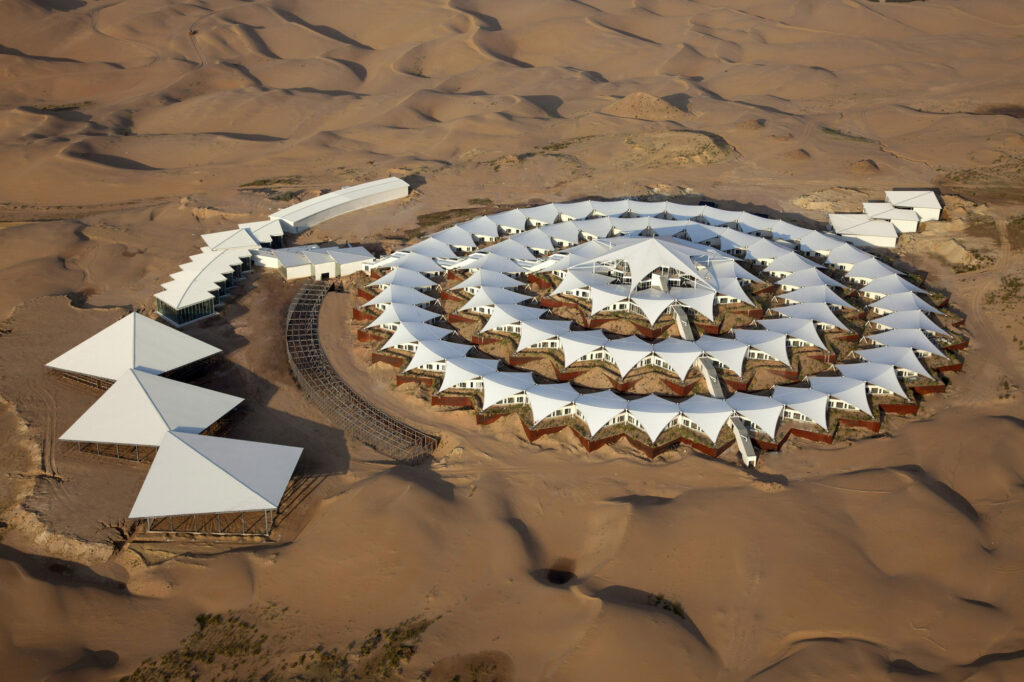
As we gaze out at the vast expanse of the Chinese desert, it’s hard not to wonder about the future of humanity. With a population that’s rapidly expanding and urbanizing, finding solutions to environmental degradation and resource management has become a pressing concern. In an effort to address these challenges, Chinese developers have been working on innovative projects like Hotel Lotus – a sustainable city built in one of the harshest environments on Earth.
A Challenge Worth Taking On
When discussing human rights and living conditions of the Chinese people, we enter a complex and sensitive minefield. Balancing the needs of a rapidly growing population with environmental concerns is a delicate task. It’s like trying to find a needle in a haystack – except the haystack is on fire, and the needle represents a sustainable future.
The Birth of Hotel Lotus
Located 800 kilometers from Beijing, Hotel Lotus was designed by PLaT Architects as a prefabricated building with low environmental impact. This innovative structure is more than just a hotel – it’s a beacon of hope for a sustainable future. By adapting to the extreme conditions of the Xiangshawan Desert, China has created a unique solution that respects the environment while addressing the needs of its rapidly growing population.
A Prefabricated Paradise
The Hotel Lotus occupies an area of 30,000 square meters, consisting of prefabricated modules made of steel that will be planted in the sand. These modules are designed to withstand the harsh desert conditions, with a windproof structure that doesn’t need a foundation – just a few supporting walls to ensure its integrity. The exterior finish is achieved using a mixture of desert sand, giving it a pleasant appearance while respecting the environment.
The Power of Autogeneration
One of the most exciting aspects of Hotel Lotus is its energy consumption. To establish an 800-kilometer-long power grid, the hotel will autogenerate its electricity needs, and even water won’t need pipes. This innovative system reduces the carbon footprint of the city, making it a model for sustainable development.
The Net-Zero Desert City Project
Hotel Lotus is part of the “Net-Zero Desert City” project, which translates to “Desert City without Network”. This ambitious initiative aims to create a city that doesn’t need a power grid or water infrastructure – a true marvel of modern engineering. By harnessing the power of autogeneration and using local materials, China has created a sustainable model for urban development.
A Historical Context
The idea of creating a new city in the desert dates back to ancient times. The Chinese have always been innovative and resourceful in their approach to architecture and urban planning. However, with the rapid growth of China’s population, there was a need for more sustainable solutions. Hotel Lotus represents a significant step forward in this journey.
A Sustainable Future
As we look out at the vast expanse of the Chinese desert, it’s clear that the future of humanity depends on our ability to innovate and adapt. Hotel Lotus is a beacon of hope – a shining example of what can be achieved when we work together to create a sustainable future. By embracing cutting-edge technology and innovative design, we can build cities that respect the environment while meeting the needs of our rapidly growing population.
The Importance of Sustainability
Sustainability has become a pressing concern in today’s world. As the global population continues to grow, it’s essential that we find ways to reduce our carbon footprint and protect the environment. Hotel Lotus represents a significant step forward in this journey, showcasing innovative solutions for sustainable development.
Lessons from Hotel Lotus
Hotel Lotus teaches us several valuable lessons about sustainability:
- Innovation is key: By embracing cutting-edge technology and innovative design, we can create solutions that respect the environment while meeting the needs of our rapidly growing population.
- Adaptability is essential: The hotel’s structure was designed to withstand the harsh desert conditions, showcasing the importance of adaptability in urban development.
- Sustainable materials matter: The use of local materials and prefabricated modules made of steel demonstrates the importance of sustainable materials in building design.
Conclusion
Hotel Lotus is more than just a city – it’s a symbol of hope for a sustainable future. As we continue to push the boundaries of innovation and sustainability, we must remember that every small step counts. Whether it’s in the desert or in our own backyards, every effort towards creating a better world is worth taking.
Frequently Asked Questions
Q: What inspired the design of Hotel Lotus?
A: The hotel was designed to respect the environment while addressing the needs of a rapidly growing population. By adapting to the extreme conditions of the Xiangshawan Desert, China has created a unique solution that balances sustainability with urbanization.
Q: How does Hotel Lotus generate electricity?
A: Hotel Lotus will autogenerate its electricity needs using an 800-kilometer-long power grid. This innovative system reduces the carbon footprint of the city and makes it a model for sustainable development.
Q: What materials are used in the construction of Hotel Lotus?
A: The hotel is built using prefabricated modules made of steel, which will be planted in the sand. The exterior finish is achieved using a mixture of desert sand, giving it a pleasant appearance while respecting the environment.
Q: How does Hotel Lotus conserve water?
A: Since the hotel doesn’t need pipes for water supply, it conserves water by autogenerating its electricity needs and using local materials.
Q: What is the Net-Zero Desert City project?
A: The “Net-Zero Desert City” project aims to create a city that doesn’t need a power grid or water infrastructure – a true marvel of modern engineering. Hotel Lotus is part of this ambitious initiative.
Q: When was work on Hotel Lotus started?
A: Work on Hotel Lotus began in March 2013.
Q: Who designed the hotel?
A: The hotel was designed by PLaT Architects.
Q: What inspired the name “Hotel Lotus”?
A: The name of the structure is inspired by its flower-like shape when viewed from above, giving it a pleasant appearance while respecting the environment.
Q: Why is Hotel Lotus significant in terms of sustainable development?
A: Hotel Lotus represents a significant step forward in sustainable urban development. By harnessing the power of autogeneration and using local materials, China has created a model for sustainable city planning.
Q: What lessons can be learned from Hotel Lotus?
A: Hotel Lotus teaches us the importance of innovation, adaptability, and sustainability in urban development. As we continue to push the boundaries of what is possible, we must remember that every small step counts towards creating a better world.


