
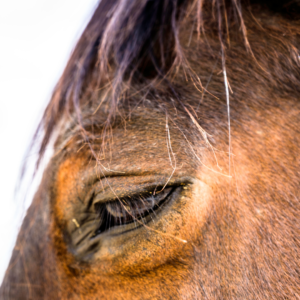
The Horse’s Eye: Characteristics and Curiosities
As we gaze at a horse, its expressive eyes convey emotions and attentiveness. However, few people know about the unique characteristics of a horse’s eye that influence its behavior and reactions. By understanding these features, we can better connect with horses and develop a more empathetic relationship.
What makes a horse’s eye special?
The horse’s eye is surprisingly large in proportion to its body size, making it one of the largest among mammals. Its diameter is even twice that of humans, allowing it to capture optimal light and wide-angle vision, even when scanning for potential threats.
The shape of the globe and crystalline structure contributes to this remarkable ability. The flattened shape enables horses to focus on both nearby and distant objects simultaneously. This unique feature allows them to maintain situational awareness, especially in situations where they need to balance attention between immediate needs (e.g., eating) and more distant concerns (e.g., potential threats or other horses).
The pupil of a horse’s eye is also elongated, allowing it to cover more ground with a single glance. However, there’s an important caveat: a horse’s vision is not frontal-facing, as they have limited peripheral vision in the back, roughly 60 degrees.
How sharp is a horse’s vision?
Determining how sharp a horse’s vision is can be challenging, as it depends on breed and individual differences. Generally speaking, horses possess relatively good visual acuity compared to other mammals, with about 2/3 of human vision capabilities. Nevertheless, their perception of movement far surpasses that of humans.
Horses are capable of detecting up to 20-25 images per second, whereas humans can only process around 15-18 frames per second. This increased sensitivity to motion helps explain why horses might appear nervous or skittish when startled by sudden movements.
Color vision in horses
Humans and horses both possess color vision, but with some variations. Horses tend to perceive colors more effectively than humans do, especially the yellow and green spectrum. However, their color perception is not identical to ours, as they may see certain hues differently.
The reason for this disparity lies in the environment in which horses typically live, where green vegetation is prevalent and red and blue colors might be less common. As a result, horses have evolved to focus more on these dominant colors in their surroundings.
At night, however, the horse’s eye excels, thanks to its large retina area, allowing for excellent low-light vision. This is comparable to that of cats, which are renowned for their nocturnal abilities.
Tapetum lucidum: The reflective layer
One explanation for a horse’s exceptional nighttime vision lies in the presence of a reflective layer called tapetum lucidum on its retina. This specialized membrane helps reflect light back onto the photoreceptors, effectively enhancing low-light sensitivity.
The absence of this layer can lead to decreased night vision abilities, making it essential for horses to gradually acclimate to changing lighting conditions when entering dark environments.
Horse’s memory and spatial awareness
While many people are familiar with a horse’s ability to navigate and remember routes, few know about the remarkable capabilities of their visual memory. A horse’s visual intelligence enables them to construct mental maps of their surroundings, including the layout of objects, paths, and obstacles.
This impressive cognitive feature is essential for horses’ survival, as it allows them to anticipate potential hazards or locate food sources efficiently.
Curiosities of a horse’s eye
Here are some additional fascinating facts about the horse’s eye:
- The brain processes visual information differently in each hemisphere, with one side responsible for processing movement and the other focused on static objects.
- Horses have a small depression above their eye socket that can be used to absorb shocks or injuries. This “sac” allows them to cushion potential trauma.
The importance of understanding a horse’s eye
Recognizing the unique characteristics of a horse’s eye is crucial for building trust and rapport with these magnificent animals. By acknowledging their exceptional visual abilities, we can better communicate with horses and foster more harmonious relationships.
When working with horses, maintaining eye contact is vital to prevent misinterpretation or inappropriate behavior. Furthermore, being aware of a horse’s body language, including rotational eye movements, can help detect potential anxiety or uncertainty.
Frequently Asked Questions
- What determines the acuity of a horse’s vision?
- A horse’s visual acuity depends on breed and individual differences.
- How does a horse perceive movement?
- Horses are more sensitive to motion than humans, with up to 20-25 images per second processed by their brains.
- Can horses see colors like humans do?
- While horses possess color vision, their perception is not identical to ours, especially in the yellow and green spectrum.
- What is tapetum lucidum and why does it matter for a horse’s night vision?
- Tapetum lucidum is a reflective layer on a horse’s retina that enhances low-light sensitivity by reflecting light back onto photoreceptors.
- How do horses construct mental maps of their surroundings?
- Horses use visual memory to create cognitive maps, including the layout of objects, paths, and obstacles.
- What is the significance of a horse’s eye depression above its socket?
- This small depression can be used to absorb shocks or injuries, providing cushioning for potential trauma.
- How can understanding a horse’s eye improve human-horse relationships?
- By recognizing and appreciating a horse’s unique visual abilities, humans can build trust and foster more harmonious interactions.
By embracing the complexities of a horse’s eye and its remarkable capabilities, we can deepen our understanding of these incredible animals and develop stronger, more empathetic relationships.


