
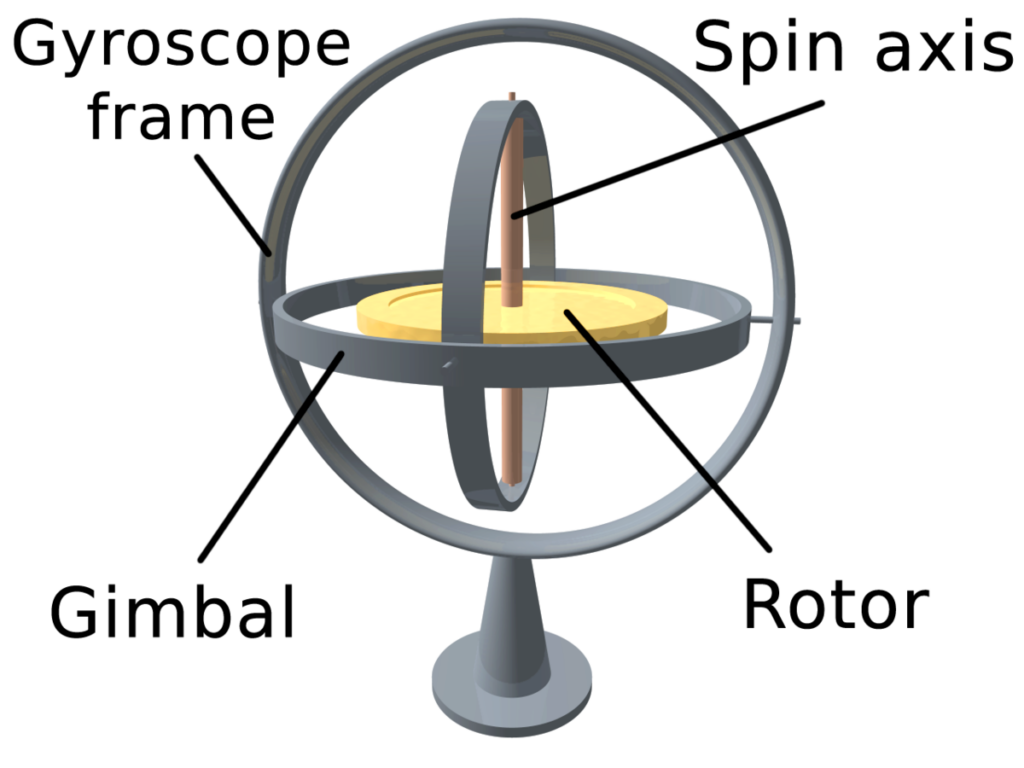
In the world of physics, there exist objects that defy gravity with ease and agility. One such object is the gyroscope, a device that seems to have a magic power but is actually explained by mathematical formulas and fundamental physical principles. Despite its mysterious nature, the gyroscope remains an intriguing and useful tool.
The Birth of Gyrosensors
Developed by French physicist Jean Bernard Léon Foucault in 1852 while studying Earth’s rotation, the gyroscope has been used to create objects that we use without realizing their presence inside them. Examples include bicycles, airplanes, and even smartphones.
Foucault’s invention was a significant milestone in the history of physics, as it provided evidence for the Earth’s rotation and laid the foundation for the development of modern navigation systems. The gyroscope’s ability to maintain its orientation and axis while rotating around its own axis made it an essential tool for scientists and engineers.
How Gyrosensors Work
At the heart of this “magic” lies a fundamental physical principle: the conservation of angular momentum. A system tends to maintain its orientation and axis, much like a gyroscope does when it rotates around its own axis.
To better understand this concept, imagine a spinning top. When it’s stationary, it will eventually fall onto one side due to gravity, but if you spin it on its axis, it will remain balanced even with minimal surface contact.
In an ideal world without friction, the gyroscope would continue to rotate indefinitely around its own axis. However, in reality, the presence of friction and air resistance slows down the rotation, causing the gyroscope to eventually come to rest.
Gyroscopic Effects in Our Daily Lives
We experience gyroscopic effects all around us. During a car brake, the tires screech as the vehicle’s rotation slows down and tries to maintain its original direction. Similarly, the bussola on an airplane uses gyros to stabilize the aircraft during flight. In space exploration, gyros are used in telescopes like the Hubble Space Telescope to precisely point towards targets.
Gyroscopic effects also play a crucial role in everyday activities such as biking and surfing. When you ride a bike or surfboard, you need to maintain your balance and orientation to avoid falling. The gyroscopic effect helps you do just that by providing a sense of stability and control.
Electronic Gyrosensors
Modern electronic gyrosensors measure minute variations in angular velocity and convert them into electrical signals that can be amplified and processed by a microcontroller. These sensors help pilots stabilize aircraft during flight.
You don’t have to be an astronaut to experience the power of electronic gyrosensors, as we see on our everyday smartphones. These devices not only enhance gaming experiences but also enable features like gesture recognition and smartphone stabilization.
Smartphone Gyroscopes: The Unsung Heroes
Inside your smartphone lies a tiny but mighty gyroscope that helps you navigate through unfamiliar environments with ease. When walking, the device detects movement along three axes (X, Y, Z) to provide accurate location tracking and orientation. This feature is essential for various apps, such as those providing turn-by-turn directions.
Beyond gaming and augmented reality, smartphone gyroscopes have practical applications in everyday life. They can detect whether you’re driving a car, riding a bicycle, or walking by analyzing the device’s movement patterns.
Gyroscopic Effects on Smartphone Sensors
Smartphone sensors are designed to work together to provide an accurate and seamless user experience. The gyroscope works alongside other sensors such as accelerometers and magnetometers to create a 3D map of the user’s surroundings.
When you walk or run, your smartphone’s sensors detect movement patterns along three axes (X, Y, Z) to provide accurate location tracking and orientation. This feature is essential for various apps, such as those providing turn-by-turn directions.
Applications of Gyrosensors
Gyrosensors have a wide range of applications in various industries, including:
- Aerospace: Gyrosensors are used in aircraft and spacecraft to stabilize and navigate during flight.
- Autonomous Vehicles: Gyrosensors are used in self-driving cars to detect movement patterns and provide accurate location tracking.
- Gaming: Gyrosensors enhance gaming experiences by providing precise control and motion detection.
- Robotics: Gyrosensors are used in robots to detect movement patterns and provide accurate orientation and navigation.
- Smart Home Devices: Gyrosensors are used in smart home devices such as voice assistants and security cameras to detect movement patterns and provide accurate location tracking.
Conclusion
In conclusion, gyrosensors are fascinating devices that may seem mysterious but rely on well-understood physical principles. From smartphones to spacecraft, these sensors play crucial roles in modern technology. By understanding how they work and their applications, we can better appreciate the complexity and beauty of our technological world.
Frequently Asked Questions (FAQs)
Q: What is a gyroscope used for?
A: Gyrosensors are used in various applications, including navigation systems, stabilization devices, gaming, and gesture recognition.
Q: How do electronic gyrosensors work?
A: Electronic gyrosensors measure minute variations in angular velocity and convert them into electrical signals that can be amplified and processed by a microcontroller.
Q: What is the significance of gyroscopic effects in everyday life?
A: Gyroscopic effects are essential for stabilization systems, navigation, and gaming experiences.
Q: How do smartphone gyroscopes enhance user experience?
A: Smartphone gyroscopes help detect movement patterns to provide accurate location tracking, orientation, and improve overall user experience.
Q: Can I use a gyroscope for other purposes besides smartphones?
A: Yes, gyrosensors can be used in various applications such as navigation systems, stabilization devices, gaming, and gesture recognition.
Q: How does the conservation of angular momentum affect a gyroscope’s behavior?
A: The conservation of angular momentum causes a system to maintain its orientation and axis when it rotates around its own axis.
Q: What is the history of gyroscopes?
A: Gyrosensors were developed by French physicist Jean Bernard Léon Foucault in 1852 while studying Earth’s rotation.


