
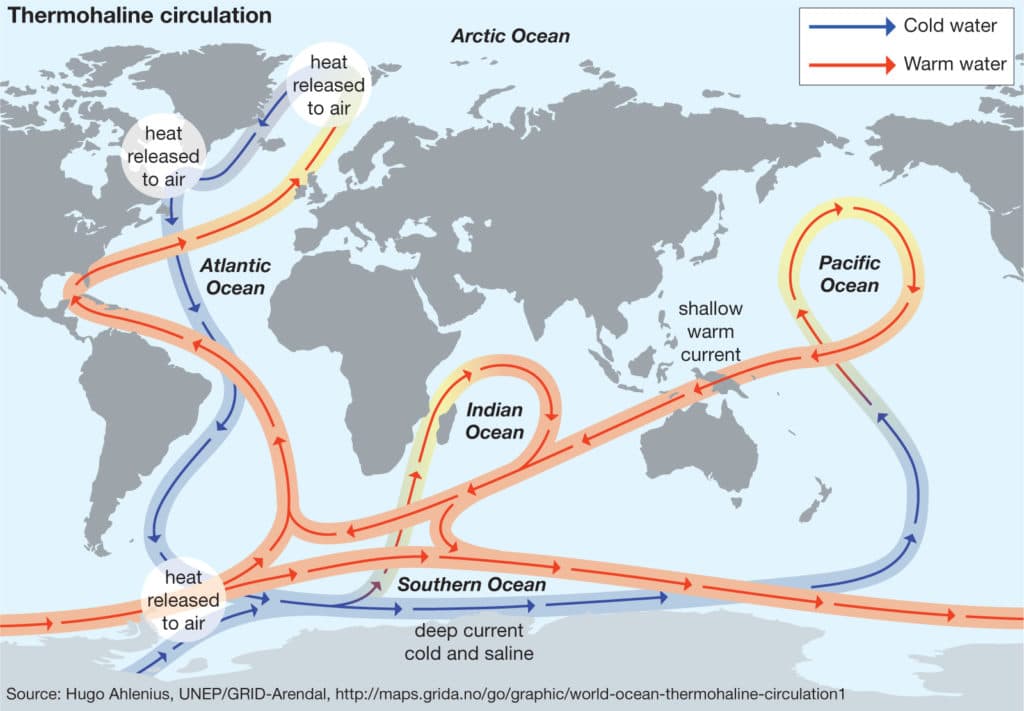
As we discuss climate, it’s often said, “It’s all about the Gulf Stream,” but what exactly is this ocean current and how does it influence our weather? Let’s start in the Gulf of Mexico and explore this powerful force.
What is the Gulf Stream?
The Gulf Stream and the North Atlantic Current are powerful ocean currents that “circle” in the Northern Hemisphere. In reality, they travel through the North Atlantic Ocean and are part of the global thermohaline circulation system. The Gulf Stream’s primary function is to regulate Earth’s climate by transporting heat from the equatorial region towards higher latitudes.
Where does the Gulf Stream originate from?
The Gulf of Mexico is where the Gulf Stream originates and brings warm tropical water to the North Atlantic Ocean. As it travels north, the water cools down when it approaches the Arctic Circle, and this cycle begins anew with other currents that cool and warm. The Gulf Stream’s journey starts in the subtropics, near the equator, where the sun’s rays heat up the surface waters of the ocean.
The warmer surface waters then sink to deeper depths due to their lower density compared to colder waters above. As these denser waters sink, they create a conveyor belt effect that carries warmth towards higher latitudes. The Gulf Stream plays a vital role in this process, as it supplies warm water that helps moderate the climate of regions like Portugal, Spain, France, Ireland, and Britain.
The Gulf Stream’s Journey
As the warm water from Mexico advances, it maintains its velocity and then collides with colder waters that travel at slower speeds. This collision causes the velocity to decrease as the latitude increases, and the faster-moving masses tend to move east. The Gulf Stream follows this trajectory due to a combination of factors, including:
- Coriolis force: The Earth’s rotation axis deflects the water to the right in the Northern Hemisphere.
- Wind patterns: Trade winds from the equator push the water towards higher latitudes.
Temperature of the Gulf Stream
While we’re more interested in the temperatures of countries influenced by the Gulf Stream, what really matters is how it warms these regions. In times of global warming, other climate-altering factors need to be studied in-depth. The Gulf Stream’s temperature decreases as it travels northward due to the increased mixing with colder waters.
Warm ocean currents like the Gulf Stream become even denser when they rise towards the north and lose heat to the atmosphere. This cooling causes them to sink, which occurs near Greenland where the current reverses direction and returns to lower latitudes, those from which the Gulf Stream originated.
Rallentation of the Gulf Stream
The slowing down of the Gulf Stream is a fact, partly physiological and partly more so. We can imagine it as a conveyor belt that can slow down or stop when it reaches the North Atlantic region and the area is already “saturated” with freshwater that dilutes high-salinity currents from the south.
It’s essential to understand how these dynamics of slowing work because if our conveyor belt were to come to a complete halt, things would go wrong. For Italy, with its Mediterranean climate, it won’t be too bad, but for Northern European countries, this could translate into extremely rigid winters.
Recently, two studies have shown that the Gulf Stream has weakened in recent years, likely due to global warming, and seems to have reached levels not seen since at least 1600 AD. This suggests unpredictable climate changes are on the horizon, thanks to the Gulf Stream and other factors as well.
You might also find these articles about the upward current and the Trade Winds interesting:
Follow me for more updates on Twitter, Facebook, Google+, and Instagram
Why is the Gulf Stream Important?
The Gulf Stream plays a crucial role in regulating Earth’s climate by transporting heat from the equatorial region towards higher latitudes. This process helps moderate the climate of regions like Portugal, Spain, France, Ireland, and Britain.
However, recent research suggests that the Gulf Stream has weakened in recent years, likely due to global warming, which could have significant implications for Northern European countries’ climates.
The Impact on Climate
The weakening of the Gulf Stream could lead to:
- Rigid winters: The loss of warmth from the Gulf Stream could cause extreme cold snaps and prolonged periods of frost.
- Increased precipitation: Changes in atmospheric circulation patterns could lead to more frequent and intense rainfall events.
- Sea-level rise: Melting glaciers and ice sheets could contribute to sea-level rise, leading to coastal erosion and flooding.
What Can We Do?
Understanding the role of the Gulf Stream in regulating Earth’s climate is essential for predicting future changes. Scientists can study:
- Ocean currents: Researchers can monitor ocean currents and their impact on regional climates.
- Climate models: Computer simulations can help predict the effects of a weakened Gulf Stream on global temperatures and precipitation patterns.
Conclusion
The Gulf Stream plays a vital role in regulating Earth’s climate by transporting heat from the equatorial region towards higher latitudes. However, recent research suggests that it has weakened in recent years, likely due to global warming. This could have significant implications for Northern European countries’ climates, leading to extreme cold snaps and prolonged periods of frost.
Understanding the impact of a weakened Gulf Stream on climate change is crucial for predicting future changes and developing strategies to mitigate its effects.
Frequently Asked Questions
- What causes the Gulf Stream to weaken?: The weakening of the Gulf Stream is likely due to global warming, which leads to increased melting of glaciers and ice sheets.
- How does the Gulf Stream affect Northern European climates?: The loss of warmth from the Gulf Stream could cause extreme cold snaps and prolonged periods of frost in countries like Germany, France, and Britain.
- Can we do anything about a weakened Gulf Stream?: Understanding the impact of a weakened Gulf Stream on climate change is crucial for predicting future changes and developing strategies to mitigate its effects.
By studying the Gulf Stream’s role in regulating Earth’s climate, we can better understand the complexities of climate change and develop effective solutions to address this pressing global issue.


