
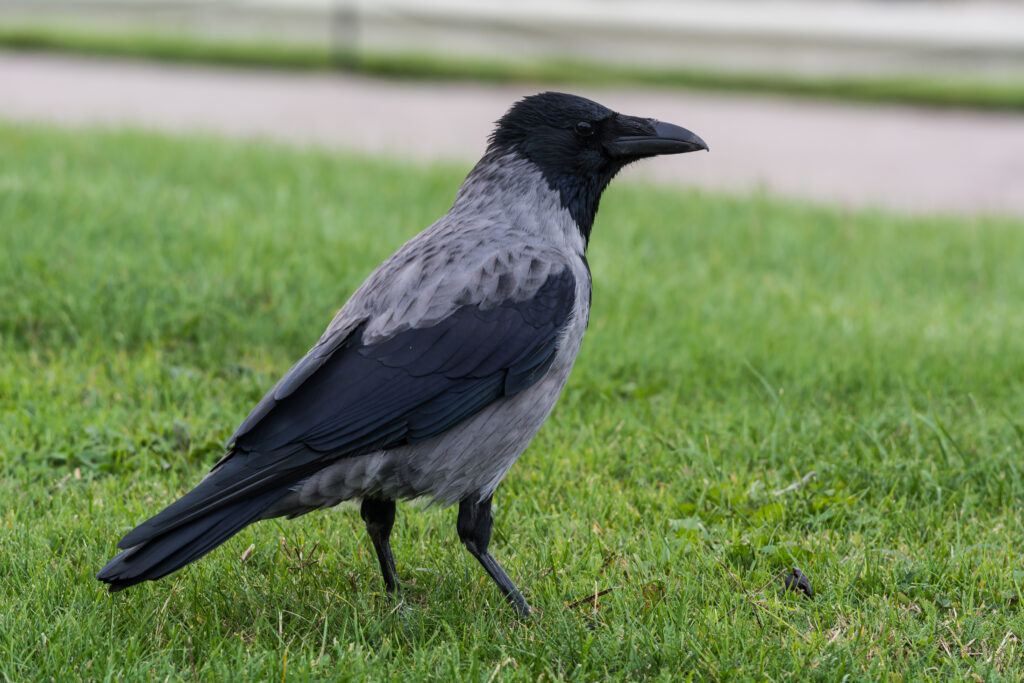
As we stand amidst the lush greenery of a partially shaded area, we often find ourselves surrounded by birds that have adapted to our surroundings with remarkable resilience. Among these, the grey crow stands out as an intriguing creature that has captured the imagination of humans for centuries. In this article, we will delve into the world of the grey crow, exploring its habits, characteristics, and symbolism.
Grey Crow vs. Black Crow: What’s the Difference?
The grey crow and black crow are two species of corvids found in Italy, with the grey crow being more widespread across Europe, including Portugal and the UK. As we journey further east, we find the black crow making its presence known in China, Korea, Japan, and other parts of the Far East. Interestingly, there are instances where these two species overlap, resulting in hybrid birds that challenge our understanding of their distinct characteristics.
Grey Crow: A Study of Its Physical Characteristics
The grey crow is a medium-sized bird with a length of approximately 50 cm (20 inches), a wing span of up to 1 meter (3.3 feet), and a weight of around 0.5 kg (1.1 pounds). This bird’s plumage features a distinctive graying color, with the head, throat, wings, and tail being darker than the body. The beak is black and slightly curved.
The Grey Crow: A Forager and Opportunistic Eater
Unlike many other birds, the grey crow does not primarily feed on seeds or fruits. Instead, it preys on carrion, dead animals, and even human waste. This behavior is a testament to its adaptability and ability to thrive in various environments.
The Grey Crow: A Symbol of Mystery and Power
In many cultures, the grey crow has been associated with mystery, power, and wisdom. In Celtic mythology, this bird was linked to the goddess of war, while in Native American folklore, it was seen as a shape-shifter with the ability to take on various forms.
The Grey Crow: A Cautionary Tale
Unfortunately, the grey crow’s presence can also be detrimental to humans. Its foraging habits often lead to conflicts over food resources, and its scavenging behavior can result in significant losses for farmers.
The Grey Crow vs. Pavon: A Tale of Pride and Disappointment
In a legendary story, a grey crow is said to have coveted the plumage of a majestic pavon, boasting that it could adorn itself with the feathers of the noble bird. However, upon attempting to infiltrate a group of pavons, the grey crow was shunned by its peers for its unrefined behavior.
Grey Crow vs. Corvo: A Study of Similarity and Distinction
While the grey crow shares similarities with corvids, such as the common crow and the Eurasian magpie, it can be distinguished from these birds through its distinctive plumage features. The grey crow’s grayish coloration, in contrast to the black or dark brown hues of its corvid counterparts, makes it a unique specimen.
The Grey Crow: A Call to Action
In Italy, the grey crow’s call is easily recognizable as a series of harsh, guttural sounds – “craaak craaak craaak.” This vocalization serves multiple purposes, including territorial marking and communication. For those interested in mimicking this distinctive call, there are specialized tools available.
Grey Crow: Sightings and Behavior
In Italy, the grey crow is a common sight, often found in urban areas. Its migratory patterns bring it to our shores from Europe, where it has adapted to human environments with remarkable resilience. As spring approaches, the grey crow begins constructing its nests, typically using branches from sturdy trees.
Grey Crow: A Cultural Icon
In various cultures, the grey crow has been associated with spiritual and mystical themes. In Native American folklore, this bird is said to possess supernatural powers, while in Celtic mythology, it was linked to the goddess of war. The grey crow’s symbolism remains enigmatic, reflecting both its connection to the divine and its darker aspects.
The Impact of Human Activity on Grey Crow Populations
Human activity has a significant impact on grey crow populations, with habitat destruction, pollution, and hunting being major threats. Conservation efforts are necessary to protect these birds and their habitats, ensuring their continued presence in our ecosystem.
Grey Crow: A Window into the Past
The grey crow’s presence can provide valuable insights into past human activities, such as agriculture and waste management. By studying the bird’s behavior and habitat use, we can gain a better understanding of how humans have impacted the environment over time.
Conclusion
In conclusion, the grey crow is a complex and multifaceted species that has captured the imagination of humans for centuries. Its adaptability, intelligence, and symbolic significance make it an intriguing subject of study. By exploring the world of the grey crow, we can gain a deeper understanding of this enigmatic bird and its place in our natural world.
Frequently Asked Questions
- What is the difference between a grey crow and a black crow?
The grey crow has a distinctive graying plumage, while the black crow features a dark brown or glossy black coloration. - Is it possible to confuse a grey crow with a common crow?
While both birds share similarities, the grey crow’s grayish hue and distinctive beak shape set it apart from its corvid cousins. - What is the purpose of the grey crow’s call?
The grey crow’s call serves multiple purposes, including territorial marking, communication, and even mimicry. - Can I attract a grey crow to my yard?
By providing food sources, such as carrion or human waste, you may be able to attract a grey crow to your yard. - Is the grey crow a beneficial species?
While its presence can have negative impacts on human activities, the grey crow plays an essential role in maintaining ecosystem balance.
Recommended Reading
- “The Corvids: Intelligent Birds of the World” by John Marzluff and Tony Angell
- “The Secret Life of Crows and Ravens” by John M. Marzluff and Tony Angell
- “The Symbolism of Birds” by Margaret Macdonald


