
Introduction to the Golgi Apparatus
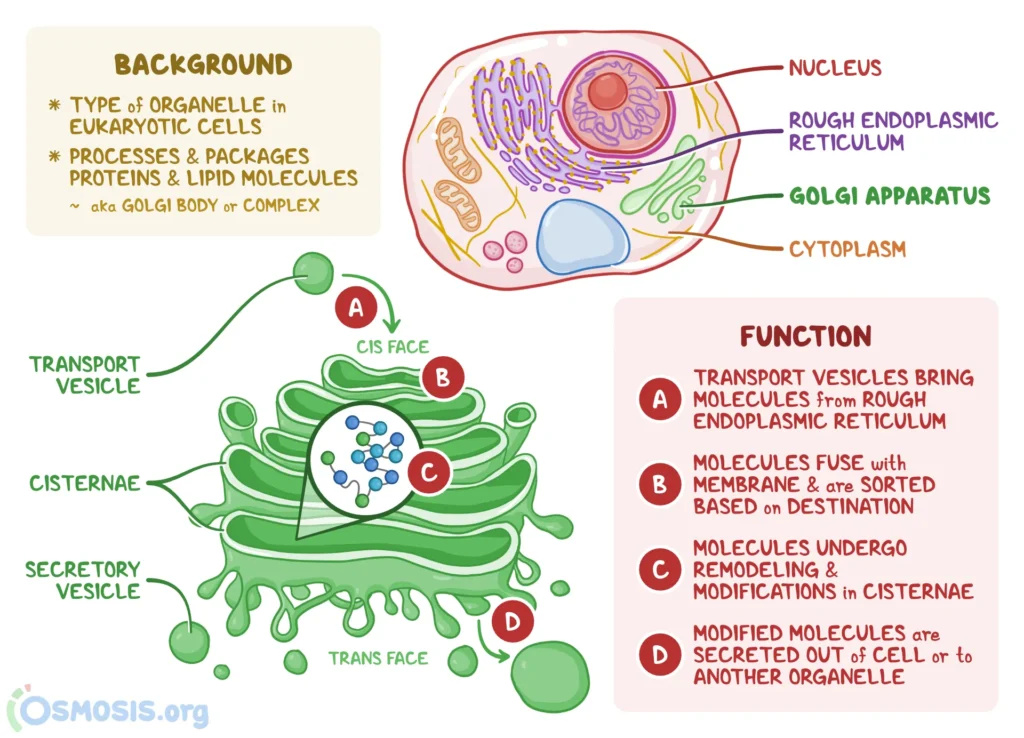
The Golgi apparatus is a complex organelle found in cells of animals, plants, and fungi. It plays a crucial role in modifying, sorting, and packaging proteins and lipids for secretion or use within the cell. In this article, we’ll delve into the structure, function, and significance of the Golgi apparatus.
Where is the Golgi Apparatus Located?
The Golgi apparatus is typically found near the nucleus of a cell and consists of multiple flattened cisternae stacked on top of each other. This organelle is usually located in a region of the cytoplasm called the paranuclear area, which can be identified using silver staining techniques.
The Discovery of the Golgi Apparatus
The discovery of the Golgi apparatus dates back to 1898 when Camillo Golgi, an Italian physician and microscopist, first observed it in tissue sections. Golgi’s discovery led to a greater understanding of cellular structure and function.
Function of the Golgi Apparatus
The primary function of the Golgi apparatus is to modify, sort, and package proteins and lipids for secretion or use within the cell. It accomplishes this by:
- Rielaboration (modifying) proteins through glycosylation and lipidation
- Selective export (transporting) of proteins to specific destinations within the cell
- Immagazzinando (storing) other molecules until they are needed or require excretion
Other Functions of the Golgi Apparatus
The Golgi apparatus is involved in various cellular processes, including:
- Lipid synthesis and modification
- Glycoprotein synthesis
- Formation of lysosomes
Tendineo Apparato del Golgi (Golgi-Tendon Organ)
A specialized type of Golgi apparatus found in muscles, the tendineo apparatus is responsible for detecting muscle tension during contraction. It plays a crucial role in reflex responses.
Structure of the Golgi Apparatus
The structure of the Golgi apparatus consists of three main components:
- Vesicles
- Cisternae
- Vacuoles
Vesicles: These are small, membrane-bound sacs that transport molecules to and from the Golgi apparatus. They have a diameter of 80-100 nanometers.
Cisternae: These are flattened, membrane-bound structures where glycosylation and lipidation occur. There are typically four to seven cisternae in human cells.
Vacuoles: These are large, membrane-bound sacs that contain stored molecules. They can fuse with other vacuoles or the plasma membrane to form secretion granules.
Cellular Distribution of the Golgi Apparatus
The Golgi apparatus is found in many animal cell types, including nerve cells, muscle cells, and epithelial cells.
Types of Cells Containing the Golgi Apparatus:
- Neurons
- Muscle cells
- Epithelial cells
Functions of the Golgi Apparatus in Different Cell Types:
- In neurons, the Golgi apparatus is involved in the synthesis and modification of neurotransmitters.
- In muscle cells, it plays a crucial role in detecting muscle tension during contraction.
- In epithelial cells, it helps to transport molecules across the cell membrane.
Other Organelles Related to the Golgi Apparatus:
- Endoplasmic reticulum (ER)
- Lysosomes
- Peroxisomes
Interactions with Other Cellular Components:
The Golgi apparatus interacts with other cellular components, such as:
- Ribosomes
- Cytoskeleton
- Lipid droplets
Transport Mechanisms:
Molecules transported by the Golgi apparatus can be classified into three categories:
- Transported proteins (e.g., enzymes, receptors)
- Transported lipids (e.g., cholesterol, triglycerides)
- Transported carbohydrates (e.g., glycogen)
Cellular Significance of the Golgi Apparatus:
The Golgi apparatus plays a crucial role in maintaining cellular homeostasis and facilitating communication between different parts of the cell.
Frequently Asked Questions
- What is the primary function of the Golgi apparatus?
- The primary function of the Golgi apparatus is to modify, sort, and package proteins and lipids for secretion or use within the cell.
- Where is the Golgi apparatus typically located in a cell?
- The Golgi apparatus is usually found near the nucleus of a cell and consists of multiple flattened cisternae stacked on top of each other.
- Who discovered the Golgi apparatus?
- Camillo Golgi, an Italian physician and microscopist, first observed the Golgi apparatus in tissue sections in 1898.
- What is the tendineo apparatus del Golgi (Golgi-tendon organ)?
- A specialized type of Golgi apparatus found in muscles, responsible for detecting muscle tension during contraction.
- How many cisternae are typically present in human cells?
- Four to seven cisternae are usually present in human cells.
- What is the purpose of vacuoles in the Golgi apparatus?
- Vacuoles contain stored molecules and can fuse with other vacuoles or the plasma membrane to form secretion granules.
- Is the Golgi apparatus found in plant cells?
- Yes, the Golgi apparatus is also found in plant cells.
- Can the Golgi apparatus be used as a diagnostic tool for diseases?
- The Golgi apparatus can provide insights into cellular functions and may be used as a diagnostic tool for certain diseases.
Conclusion
In conclusion, the Golgi apparatus is a vital organelle that plays a crucial role in cellular processes such as protein modification, sorting, and secretion. Its structure and function are intricate, involving multiple components and processes. Further research on this complex organelle will continue to advance our understanding of cellular biology.
Future Research Directions:
- Understanding the mechanisms underlying Golgi apparatus function
- Investigating the role of the Golgi apparatus in disease
- Elucidating the interactions between the Golgi apparatus and other cellular components
References:
- Alberts, B., Johnson, A., Lewis, J., Raff, M., Roberts, K., & Walter, P. (2002). Molecular biology of the cell (5th ed.). New York, NY: Garland Science.
- Lodish, H. F., Berk, A., Matsudaira, P., Kaiser, C. A., Krieger, M., Scott, M. P., … & Zipursky, S. L. (2000). Molecular cell biology (4th ed.). New York, NY: W.H. Freeman and Company.
- Alberts, B., Johnson, A., Lewis, J., Raff, M., Roberts, K., & Walter, P. (2015). Molecular biology of the cell (6th ed.). New York, NY: Garland Science.
By exploring the fascinating world of the Golgi apparatus, we gain a deeper understanding of cellular biology and its intricate mechanisms. Further research on this complex organelle will continue to advance our knowledge and appreciation of the incredible machinery that exists within every living cell.


