
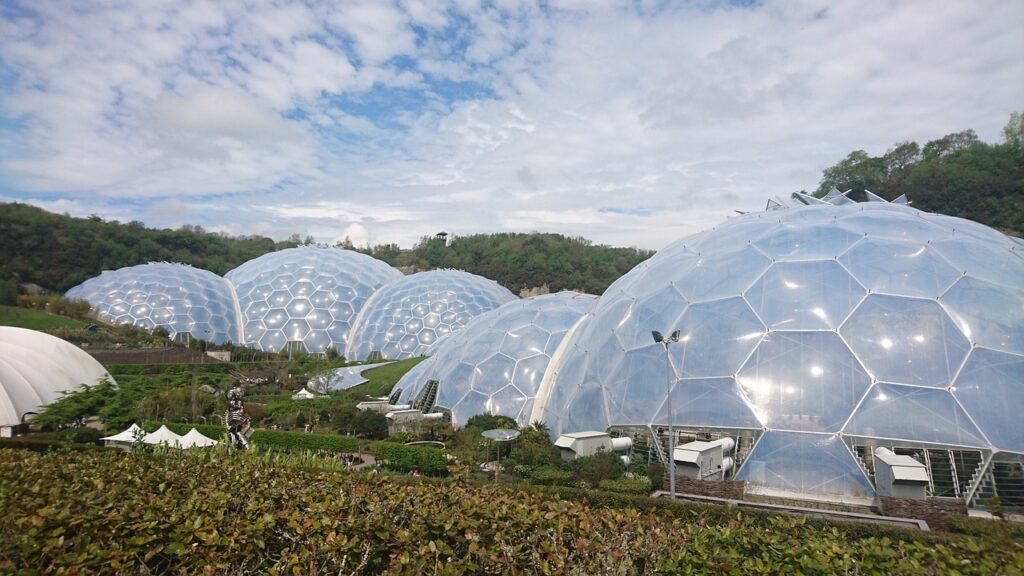
Are you intrigued by the mysterious structure that appears to be a spaceship, yet it’s not harmful and can be useful? It’s time to uncover the secrets of geodesic domes. Not of extraterrestrial origin, but a marvel of engineering, architecture, and geometry.
What Are Geodesic Domes?
If you’ve seen one, you’re probably curious about this enigmatic structure. Let’s take a step back for those who haven’t laid eyes on it yet. A geodesic dome is the only human-built structure that becomes proportionally more resistant as its size increases. It’s an engineering marvel!
Imagine a sphere with horizontal beams connected by geodetic lines, the shortest paths that connect two points on a surface and lie on the surface itself. These lines form triangles that “glue” together to give the dome its local strength.
Characteristics of Geodesic Domes
These structures have several remarkable features:
• Increased resistance: As the size increases, so does its resistance.
• Optimal volume-to-weight ratio: Among all linear elements-based structures, geodesic domes maximize this ratio.
• Strength despite appearance: Don’t let their fragile look fool you; they’re much stronger than they appear.
Designing a Geodesic Dome from Scratch
Creating one from scratch is not easy. There are no standard designs available, and every dome must be designed from zero based on desired dimensions, materials, and shape. But don’t worry, there are convenient kits for building one yourself, along with instructions to save you time.
When designing a geodesic dome, it’s essential to consider several factors:
• Materials: Choose materials that can withstand the elements and provide structural integrity.
• Shape: The shape of the dome will affect its strength and stability. A spherical or elliptical shape is ideal for maximizing resistance.
• Size: The size of the dome determines its level of resistance and functionality.
The Purpose of Geodesic Domes
Geodesic domes have a purpose beyond being an art piece. They offer several advantages:
• Resistance: More resistant as size increases.
• Speed of construction: Can be built quickly with lightweight materials and few people working on it.
• Aerodynamics: Withstand strong winds and even hurricanes.
• Solar heating: Install windows throughout the dome for easy solar heating.
Potential Applications
Geodesic domes can be used in various locations, including:
• Research laboratories: Protect equipment and researchers from harsh environments.
• Polar regions: House research facilities or provide shelter for scientists.
• Greenhouses: Create a tropical environment for plants to thrive.
• Public events: Accommodate large crowds at concerts and festivals.
Geodesic Domes on Amazon: Your Backyard Haven
On Amazon, you can find geodesic domes perfect for creating an igloo in your backyard. This dome features a sturdy plastic ABS frame, thick PVC screen, entrance door with hinge, and two triangular windows that can be sealed. With proper treatment and stitching, it can withstand wind tests.
Another product on Amazon is designed specifically for kids’ playgrounds in the backyard. It’s resistant, easy to assemble, and affordable.
Benefits of Geodesic Domes
Geodesic domes offer several benefits over traditional buildings:
• Energy efficiency: They provide natural insulation and can be solar-heated.
• Durability: Geodesic domes are more resistant to weather conditions than traditional buildings.
• Portability: Many geodesic domes are designed for easy transportation and setup.
Frequently Asked Questions
- What is the history of geodesic domes?
Geodesic domes were designed by Richard Buckminster Fuller and first built in 1948. - How do geodesic domes work?
They’re constructed using a network of horizontal beams connected by geodetic lines, forming triangles that provide local strength. - What are the benefits of geodesic domes?
They offer increased resistance, optimal volume-to-weight ratio, and can be aerodynamic and solar-heated. - Can I build my own geodesic dome?
Yes, there are kits available with instructions to help you design and build one yourself. - Where can I buy geodesic domes?
Amazon offers a variety of geodesic domes for different purposes, including backyard use and research applications. - How do I assemble a geodesic dome?
Assembling a geodesic dome requires patience and attention to detail, but many kits come with instructions to make it easier. - What are the potential risks associated with geodesic domes?
While geodesic domes are generally safe, improper design or construction can lead to structural issues. - Can geodesic domes be used for commercial purposes?
Yes, geodesic domes have been used in various commercial applications, including research laboratories and greenhouses.
Real-World Applications of Geodesic Domes
Geodesic domes are being used in various real-world applications:
• Research stations: Geodesic domes provide a safe and efficient environment for scientists to conduct their work.
• Military bases: Geodesic domes can be used as shelters or command centers due to their strength and durability.
• Public buildings: Geodesic domes can be used as public gathering spaces, such as concert halls or event venues.
Conclusion
Geodesic domes are an engineering marvel that deserves attention. They’re not just a curiosity; they have practical applications in various fields. Whether you’re looking to create a greenhouse or a backyard haven, geodesic domes are worth exploring.
With their unique design and numerous benefits, geodesic domes are becoming increasingly popular among architects, engineers, and DIY enthusiasts alike. Their potential for use in research, commercial, and residential applications makes them an exciting area of study and development.


