
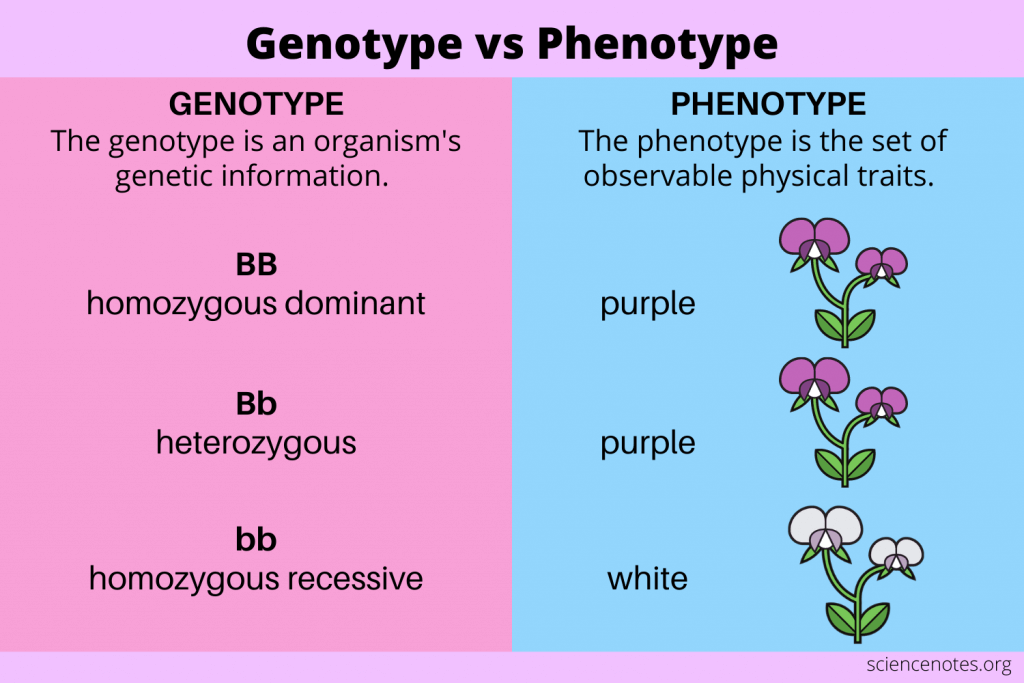
As we navigate the complexities of life, it’s easy to get confused between genotype and phenotype. These two concepts are intricately linked but distinct, each with its own significance in understanding us and our surroundings.
Genotype: The Genetic Blueprint
The genotype is the sum total of all genes that make up an individual’s DNA. It encompasses the genetic makeup, genetic architecture, and genetic constitution of a being – whether it’s an animal or a plant. Each gene contributes to the development, physiology, and functional maintenance of the organism, sometimes working collaboratively, other times individually.
The genotype interacts with its environment in determining the phenotype, but it doesn’t define it alone. For instance, two individuals with the same genotype may not necessarily have the same phenotype, as seen in identical twins or within close social circles.
Phenotype: The Expressive Form
We’ve already touched on the concept of phenotype earlier. In simple terms, the phenotype is the sum of all observable characteristics an organism exhibits – from morphology to developmental patterns and biochemistry to physiology, including behavior.
The genotype defines the potential for a range of phenotypes, which are also influenced by internal and external environments. The regulation of these connections involves complex mechanisms of epigenetics – processes that modify gene expression to influence both individual and generational traits.
Epigenetic Influence on Genotype-Phenotype Interactions
Epigenetic factors play a crucial role in shaping the interactions between genotype and phenotype. These modifications can occur through various means, including DNA methylation, histone modification, and non-coding RNA regulation. Epigenetic changes can influence gene expression without altering the underlying DNA sequence, which can have significant implications for an organism’s development, behavior, and response to environmental stimuli.
HCV Genotypes: Understanding the Viral Variants
For Hepatitis C Virus (HCV), genotype refers to one of six distinct viral variants identified over time, each with variations in its genome that range from moderate to extensive. These genotypes have significant implications for treatment approaches and understanding the virus’s behavior.
Studies have shown that Genotype 1 is prevalent globally, while specific regions exhibit higher prevalence rates of other genotypes. For instance, genotype 1a is widespread in North America, genotype 1b is more common in Europe, genotype 2 in Japan and Taiwan, genotype 3 predominantly in India, genotype 4 in the Middle East and Africa, genotype 5 in Southern Africa, and genotype 6 in Southeast Asia.
Extended Phenotype: Exploring the Concept
The Extended Phenotype is a term coined by biologist Richard Dawkins in his 1982 book. It explores how organisms can exhibit traits beyond their immediate biology due to environmental influences, thereby expanding our understanding of phenotype.
Dawkins’ work builds upon his earlier book, “The Selfish Gene,” where he argued that genes are the primary drivers of evolution and that they indeed play a central role in shaping life’s complexities. Dawkins’ theory posits that organisms can exhibit traits not solely determined by their genetic makeup but also by environmental factors.
Implications of Extended Phenotype
Dawkins’ concept of the Extended Phenotype highlights the complexity of phenotypic expression, which extends beyond the organism itself to include its environment and social interactions. This perspective underscores the interconnectedness of life and encourages us to consider how organisms adapt and evolve in response to their surroundings.
Conclusion
Understanding genotype and phenotype not only enriches our comprehension of biological systems but also provides valuable insights into human diversity and adaptation. By exploring these concepts, we can better grasp how genetic information interacts with environmental factors to shape who we are – both as individuals and within our communities.
Moreover, the interplay between genotype and phenotype underscores the importance of considering epigenetic factors in understanding life’s complexities. This perspective highlights the intricate dance between an organism’s genetic makeup and its environment, emphasizing that neither factor operates independently of the other.
FAQs
- What is the difference between genotype and phenotype?
-
The genotype refers to an individual’s complete DNA makeup, while the phenotype encompasses all observable characteristics of that individual.
-
How does genotype influence phenotype?
-
The genotype provides a genetic blueprint, but it’s also shaped by environmental factors, leading to variations in observed traits among individuals with the same genotype.
-
What is epigenetics and how does it affect genotype-phenotype interactions?
-
Epigenetics involves processes that modify gene expression based on internal and external conditions, which can influence both individual and generational traits.
-
Can two people with the same genotype have different phenotypes?
-
Yes, due to factors like genetic variations among individuals within a population and effects of environmental conditions.
-
What is the significance of understanding HCV genotypes for treatment purposes?
-
Knowing an individual’s viral genotype can help healthcare providers tailor more effective treatment strategies.
-
How does the Extended Phenotype concept expand our understanding of phenotype?
-
It acknowledges that phenotypic traits are not solely determined by biology but also influenced by environmental factors, broadening our perspective on what it means to be human or an organism.
-
What role do genes play in evolution according to Richard Dawkins’ theory?
-
Genes are the primary drivers of evolutionary change, Dawkins argues, highlighting their central role in life’s complexities.
-
Why is understanding genotype and phenotype important?
- It enhances our comprehension of biological systems, diversity, and adaptation, offering valuable insights into human biology and its intersections with environment and society.


