
Introduction
The Theory of Games is not just a game, but a complex mathematical framework that has been applied in various fields, including economics and politics. It provides a set of rules and guidelines for making strategic decisions when interacting with others. In this article, we will delve into the world of game theory and explore its applications, examples, and key concepts.
What is Game Theory?
Game theory is a branch of mathematics that studies decision-making under uncertainty. It assumes that players have rational preferences and make decisions based on their expected payoffs. The theory provides a framework for analyzing strategic interactions between individuals or groups, such as businesses, politicians, or even prisoners.
History of Game Theory
The development of game theory is credited to John Nash, who won the Nobel Prize in Economics in 1994 for his contributions to the field. However, it was not just Nash who contributed to the growth of game theory. Other mathematicians and economists, such as Oskar Morgenstern, made significant contributions to the field.
The Prisoner’s Dilemma
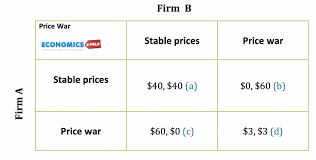
One of the most famous examples of a game is the Prisoner’s Dilemma. This scenario involves two prisoners who are interrogated separately by the police. Each prisoner has the option to confess or remain silent. The payoffs for each possible outcome are as follows:
| Pritioner A Confesses | Prisoner A Remains Silent | |
|---|---|---|
| Prisoner B Confesses | Both get a sentence of 5 years | Both get a sentence of 1 year |
| Prisoner B Remains Silent | Pritioner A gets a sentence of 6 years, Prisoner B gets a sentence of 1 year | Both get a sentence of 1 year |
The dilemma arises because, even though confessing seems like the best option for both prisoners, it is not. If both prisoners confess, they each receive a worse outcome than if they remained silent.
Nash Equilibrium
In game theory, the Nash Equilibrium is a concept that describes a stable state where no player can improve their payoff by unilaterally changing their strategy, assuming all other players keep their strategies unchanged. In the Prisoner’s Dilemma, the Nash Equilibrium occurs when both prisoners confess.
Applications of Game Theory
Game theory has numerous applications in economics, politics, and social sciences. Some examples include:
- Economic Decision-Making: Game theory helps individuals and businesses make informed decisions about investments, pricing, and production levels.
- Political Science: Game theory is used to analyze the behavior of politicians and interest groups in decision-making processes.
- Social Sciences: Game theory is applied to study social phenomena such as cooperation, competition, and conflict.
The Role of Nash in Game Theory
John Nash’s contribution to game theory was significant. His work on the concept of the Nash Equilibrium has had a lasting impact on the field. Nash’s own story, as depicted in the film “A Beautiful Mind,” is an inspiration for many mathematicians and scientists.
Types of Games
There are several types of games that are studied in game theory, including:
- Zero-Sum Games: These games result in a zero-sum payoff, where one player’s gain is equal to another player’s loss.
- Non-Zero Sum Games: These games do not result in a zero-sum payoff, and the payoffs can be positive or negative for all players.
- Cooperative Games: These games involve cooperation between players, rather than competition.
Game Theory Applications
Some examples of game theory applications include:
- Economic Auctions: Game theory is used to analyze the behavior of bidders in auctions and determine the optimal bidding strategy.
- Environmental Policy: Game theory is applied to study the impact of environmental policies on the behavior of firms and individuals.
- Network Security: Game theory is used to analyze the behavior of hackers and determine the most effective security measures.
Real-World Examples
Some real-world examples of game theory in action include:
- The Ultimatum Game: This game involves two players who divide a sum of money, with one player proposing a split and the other player deciding whether to accept or reject it.
- The Tragedy of the Commons: This scenario involves a shared resource that is overused by multiple individuals, leading to its depletion.
- The Prisoner’s Dilemma: As mentioned earlier, this scenario involves two prisoners who are interrogated separately by the police and must decide whether to confess or remain silent.
Conclusion
In conclusion, the Theory of Games provides a framework for understanding strategic decision-making under uncertainty. Its applications extend beyond economics to politics, social sciences, and other fields. By recognizing the power of game theory, we can better understand human behavior and make informed decisions in our personal and professional lives.
FAQs
- What is the main concept of game theory?
- Game theory is a branch of mathematics that studies decision-making under uncertainty.
- Who is John Nash and what contribution did he make to game theory?
- John Nash was an American mathematician who won the Nobel Prize in Economics for his contributions to game theory. He developed the concept of the Nash Equilibrium, which describes a stable state where no player can improve their payoff by unilaterally changing their strategy.
- What is the Prisoner’s Dilemma and how does it illustrate game theory concepts?
- The Prisoner’s Dilemma is an example of a game that demonstrates the conflict between individual and group rationality. It shows how, even when both prisoners confess, they each receive a worse outcome than if they remained silent.
- What are some applications of game theory in economics, politics, and social sciences?
- Game theory has numerous applications in economic decision-making, political science, and social sciences. It helps individuals and businesses make informed decisions about investments, pricing, and production levels, as well as analyze the behavior of politicians and interest groups.
- How does game theory relate to real-world scenarios?
- Game theory provides a framework for understanding strategic interactions between individuals or groups in various fields, including economics, politics, and social sciences. It helps us understand human behavior and make informed decisions in our personal and professional lives.
Additional Resources
For those interested in learning more about game theory, there are numerous books, articles, and online resources available. Some recommended readings include:
- “The Theory of Games and Economic Behavior” by John Nash and Oskar Morgenstern
- “A Beautiful Mind” by Sylvia Nasar
- “Game Theory: An Introduction” by Steven Tadelis
By exploring these resources, you can deepen your understanding of game theory and its applications in various fields.
References
- Nash, J. (1950). The Bargaining Problem. Econometrica, 18(2), 155-162.
- Nash, J. F. (1951). Non-Cooperative Games. Annals of Mathematics, 54(2), 277-300.
- Morgenstern, O., & Nash, J. F. (1944). The Pure Theory of Games of Strategy. Quarterly Journal of Economics, 58(3), 221-237.
By examining these references and additional resources, you can gain a deeper understanding of game theory and its applications in various fields.


