
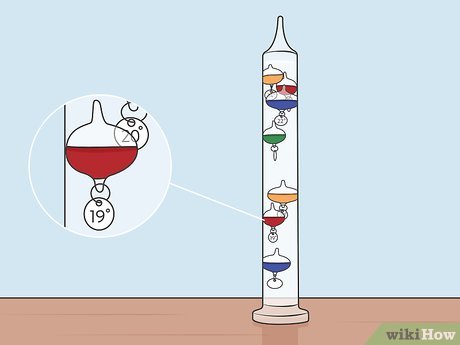
Introduction to the Galileo Thermometer
The modern meteorology has its roots in the early 16th century, when the first form of thermometer was born. However, it is not Galileo who invented what we commonly call the “Galileo thermometer” but rather a device that shares a similar functioning principle: the thermoscope.
Thermoscope of Galileo
The origins of the Thermoscope of Galileo are uncertain, but those of its termoscope are clear. The thermoscope consists of an ampulla made of glass, slightly larger than an egg, characterized by a long and thin neck. How does it work? When held in hand and partially immersed in water (in an inverted position), it records a phenomenon of thermal exchange: how does it work? When you take heat away from your hands, the air inside cools down and its volume decreases, causing the water to rise along the narrow neck of the ampulla. If you reheat the caraffa with your hands, the air expands, and the water descends along the neck.
This primitive thermometer opens up the doors to meteorology as a science.
How Does the Thermoscope Work?
The working principle of the thermoscope is similar to that described for the termoscope. The thermoscope consists of a vertical glass cylinder filled with alcohol in which delicate bubbles are suspended. Each bubble is marked with a temperature.
These bubbles float within the alcohol due to the thermal expansion/contraction principle. In equilibrium conditions, the temperature can be determined by observing the most submerged bubbles at the top of the column.
The thermoscope relies on Archimedes’ principle: if we have two bodies or fluids of different densities, the one with lower density will rise while the one with higher density will sink.
In this case, too, just like in the termoscope, the Galilean thermometer highlights changes in density resulting from temperature changes.
History of the Thermoscope
The origins and functioning of the thermoscope are shrouded in mystery. However, the history of its development is clear. The first thermometer was born with scales graduated but different, resulting in non-standardized instruments that could not be compared. Modern thermometers, on the other hand, use standardized measurements that have become widely accepted over time.
The mercury entered the scene alongside several different temperature scales in 1700. Among them were two prominent scales still used today: Celsius (our degrees when baking a cake or feeling a fever) and Fahrenheit, more commonly used in the USA.
Development of the Thermoscope
The thermoscope underwent numerous changes during its development. The first recorded description of the device was found in the work of Italian scientist Santorio Santorio in 1612. However, it is believed that the concept of a thermal measuring device existed even before Santorio’s time.
One such example is the invention by the Dutch scientist Johannes Kepler in 1596. He designed an early temperature-measuring instrument made of two cylindrical glass containers filled with different liquids.
Kepler’s design was used as a basis for further developments, and his ideas influenced other scientists to experiment with similar devices. The most significant development came when Galileo developed his thermoscope using air-filled tubes.
The first practical thermometer that could measure temperature accurately was developed in the 17th century by English scientist Robert Boyle. His device used mercury as the measuring liquid and provided more accurate results than earlier versions.
Modern Development of Thermoscopes
In modern times, the design of thermoscopes has evolved significantly. Many different designs have been developed to measure temperature variations using a variety of materials, including air, water, or liquids with different properties.
One such example is the use of gas-filled tubes that are designed to expand and contract in response to changes in temperature. These devices provide accurate results over long periods of time.
Thermoscope vs Thermometer
While both devices measure temperature changes, they differ in their mechanism of operation: thermoscopes rely on air density changes, whereas thermometers use a liquid that expands/contracts with temperature changes.
The Galilean thermometer is actually a type of thermoscope. It was developed by the students of Galileo Galilei and later refined by researchers at the Accademia del Cimento in Florence, founded in 1657.
Conclusion
In conclusion, the galileo thermometer has played an important role in the development of meteorology as a science. The termoscope, although primitive, was able to detect temperature variations and lay the groundwork for modern thermometers. The thermoscope’s working principle is simple yet elegant: it relies on Archimedes’ principle to measure changes in air density resulting from temperature fluctuations.
Frequently Asked Questions (FAQs)
- What is a thermoscope?
A thermoscope is an early device that measures temperature variations by detecting changes in air density due to thermal expansion and contraction.
- How does the thermoscope work?
The thermoscope consists of an ampulla filled with alcohol, into which delicate bubbles are suspended. These bubbles float within the alcohol due to thermal expansion/contraction and can be used to determine temperature by observing their position relative to the top of the column.
- What is the difference between a thermoscope and a thermometer?
The main difference lies in their mechanism of operation: thermoscopes rely on air density changes, while thermometers use a liquid that expands/contracts with temperature changes.
- Who developed the thermoscope?
While the origins of the termoscope are uncertain, it is clear that Galileo did not invent what we commonly call the “Galileo thermometer.” Instead, he developed a device that shares a similar functioning principle: the thermoscope.
- What are the advantages and disadvantages of using a thermoscope?
The thermoscope has several limitations compared to modern thermometers. These include lower accuracy, lack of standardization, and limited scalability for precise temperature measurements.
- Can I still buy a thermoscope today?
Yes, you can find various models of thermoscopes on Amazon or other online marketplaces. It is recommended to purchase one that suits your specific needs based on the size (smaller thermoscopes may have fewer measurement points).
- What is the most commonly used temperature scale in modern times?
Both Celsius and Fahrenheit are still widely used today, although Celsius has gained popularity due to its simplicity and direct relation to everyday temperatures.
- How accurate are thermoscopes compared to modern thermometers?
Thermoscopes have lower accuracy compared to modern thermometers, primarily due to limitations in their design and measurement principles.
- Can I use a thermoscope for precision temperature measurements?
No, it is not recommended to use a thermoscope for precise temperature measurements. The device has several limitations that make it unsuitable for such applications.
- Why are thermoscopes still of interest today?
Thermoscopes may seem like an old-fashioned concept, but they still hold historical significance and contribute to our understanding of the development of meteorology as a science.


