
The new article “Food Security: Why Climate Change Threatens It” is the result of a collaboration between the Valorizzazione and Impatto della Ricerca area and Public Engagement – Agorà Scienza, with the Green Office UniToGO from the University of Turin, and IdeaeGreen S.r.l. Società Benefit.
The article draws from the texts published by Dr. Nadia Tecco in her book “Lessico e Nuvole: le parole del cambiamento climatico,” the second edition of a linguistic and scientific guide to navigate the most urgent questions related to global warming.
The free version of Lessico e Nuvole is available for download from the zenodo.org platform. The paperback and eBook versions are available for purchase on various platforms, including youcanprint.it, Amazon, Mondadori (also with Carta del Docente and 18app), IBS, and Libreria Universitaria (also with Carta del Docente and 18app).
All proceeds from the paid versions will be used by the University of Turin to finance research projects and public engagement initiatives related to climate change and sustainability.
What is Food Security?
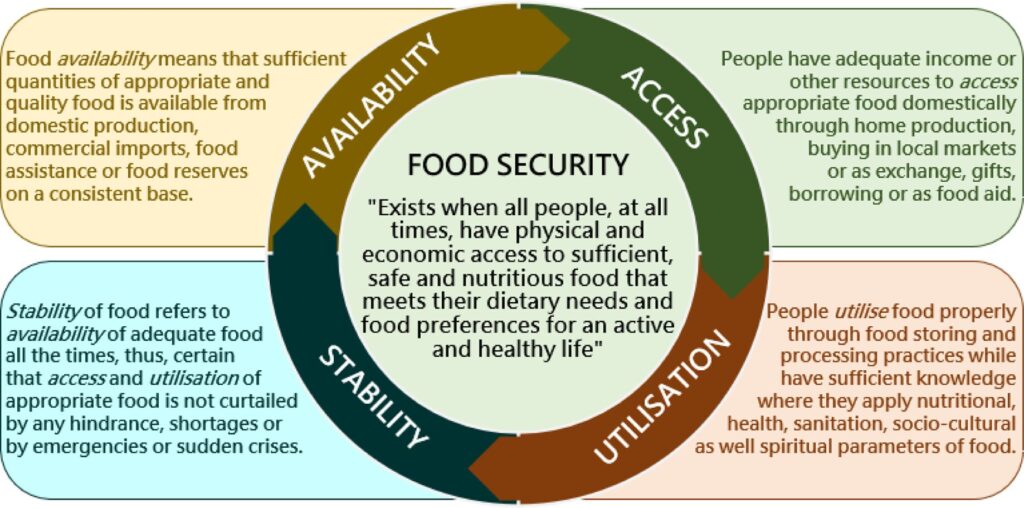
The concept of food security was first introduced at the World Food Summit in 1996. According to the Food and Agriculture Organization (FAO), food security means “the situation where all people have access, at all times, to sufficient safe and nutritious food to lead active and healthy lives.”
Food security encompasses four key dimensions:
- Availability of sufficient quantities of adequate quality food
- Access to resources to acquire food, including both purchasing power and legal rights to use common resources
- Utilization of food to meet nutritional needs for good health
- Stability of access to adequate nutrition in the face of economic, social, and environmental constraints
How Climate Change Impacts Food Production
To understand how climate change can impact food production, it’s necessary to consider the interdependencies between these four dimensions of food security.
The Intergovernmental Panel on Climate Change (IPCC) Special Report “Climate Change and Land” highlights in its fifth chapter that changes in global temperature will affect different regions unevenly. For example:
- Crops such as maize, cotton, wheat, and sugarcane will experience increased yields at high latitudes but decreased yields at lower latitudes.
- The same crops may be severely affected by droughts, floods, or heatwaves depending on the region.
In areas with limited water resources, climate change could exacerbate existing food insecurity issues. For instance, a study published in the journal Nature found that a 10% decrease in global precipitation could lead to a 3-5% reduction in maize yields worldwide.
The Impact of Climate Change on Agriculture
Climate change is affecting agriculture in various ways:
- Temperature changes: Rising temperatures are altering the optimal growing conditions for many crops, leading to reduced yields and changed harvesting times.
- Changes in precipitation patterns: Droughts, floods, and heavy rainfall events can damage crops, disrupt supply chains, and impact farm productivity.
- Increased frequency of extreme weather events: Events like heatwaves, droughts, and storms are becoming more frequent and severe, posing significant challenges for farmers.
The Consequences of Food Insecurity
Food insecurity has far-reaching consequences, including:
- Malnutrition: Insufficient access to nutritious food can lead to malnutrition, stunted growth, and increased susceptibility to illnesses.
- Economic losses: The economic impacts of food insecurity can be significant, particularly for small-scale farmers and vulnerable communities.
- Social unrest: Food insecurity can contribute to social unrest, migration, and conflict, as people seek better living conditions and access to resources.
Solutions to Mitigate the Effects of Climate Change on Food Security
Several solutions can help mitigate the effects of climate change on food security:
- Sustainable agriculture practices: Implementing sustainable agricultural practices like agroforestry, conservation agriculture, and organic farming can improve soil health, reduce greenhouse gas emissions, and enhance crop resilience.
- Climate-resilient crops: Developing and promoting climate-resilient crop varieties can help farmers adapt to changing weather conditions and reduced yields.
- Supporting small-scale farmers: Providing targeted support for small-scale farmers, including access to credit, technology, and market information, can help them improve their productivity and resilience in the face of climate change.
- Food waste reduction: Implementing strategies to reduce food waste, such as implementing food recovery programs and improving storage facilities, can help ensure that surplus food is used to feed those who need it most.
- Climate-smart agriculture policies: Governments and policymakers can play a crucial role in promoting climate-resilient agricultural practices through policy incentives, subsidies, and regulatory support.
Conclusion
The impact of climate change on food security is a pressing global concern. By understanding the interdependencies between food security dimensions and the effects of climate change on agriculture, we can develop effective solutions to mitigate these impacts and ensure that everyone has access to sufficient safe and nutritious food.
We must address this challenge through collaborative efforts among governments, farmers, researchers, and civil society organizations to promote sustainable agricultural practices, support small-scale farmers, reduce food waste, and develop climate-resilient crop varieties.


