
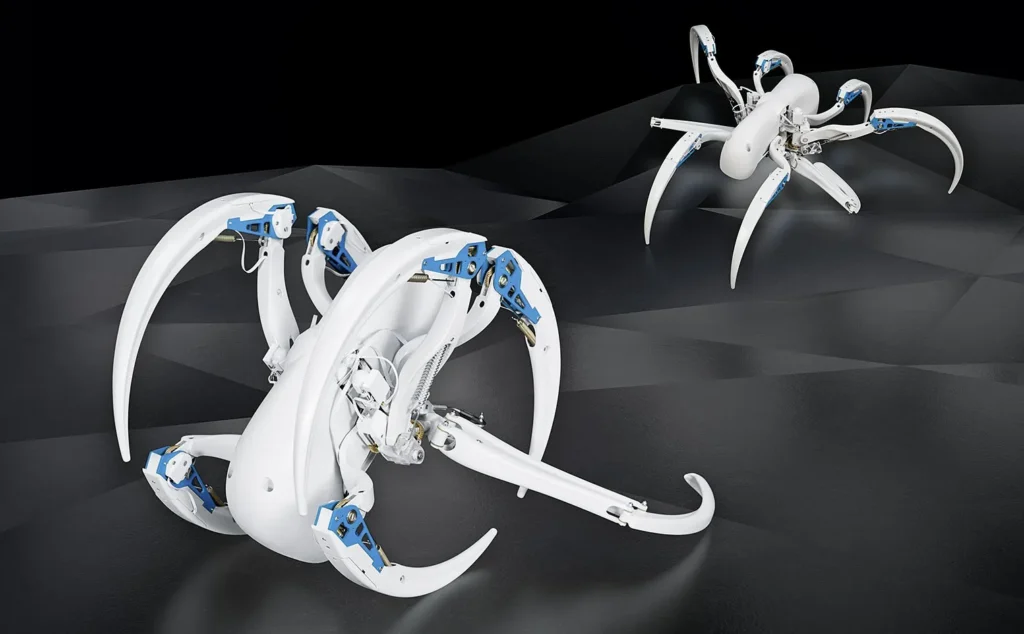
As we speak of the flying spider, it’s almost as if we’re talking about flying donkeys – a utopia. However, one exception comes to mind, exactly what we want to tell you not just for its strangeness but also for the contribution it could give to innovation and technology in the near future. We owe the discovery of the flying spider to a Berlin University biologist named Rechenberg who discovered it several years ago during one of his many expeditions in search of animals.
Characteristics of the Flying Spider
The name of our flying spider is Cebrennus Rechenbergi, and its scientific family belongs to Sparassidae. The Greek word σπαράσσω (sparàsso) means “being taken by convulsions,” which can be connected to the movements and stretching of this type of spider when caught or during courtship. Our flying spider is a large one, with some reaching up to 30 centimeters in length when spread out.
A Perilous yet Inspiring Creature
The idea of a spider that can jump and leap catching us off guard while we’re trying to avoid it isn’t reassuring. However, there are two main reasons not to be alarmed: first, this behavior is primarily done to escape predators, not to attack humans; second, the bite isn’t as dangerous as it could seem.
How Does the Flying Spider Fly?
After discovering our flying spider in the desert of Morocco, Reichenberg dedicated himself to studying its movements. He observed the spider jumping up to 6.6 meters and with a speed that doubles every time. When we look closer at the details of this acrobatic performance, we can see that the spider launches its web and manages to grasp it while in flight, which is crucial for survival.
However, this extraordinary feat comes at a great cost – the energy expenditure. The spider can only perform this move a maximum of 4 times before exhausting itself, especially in environments like the desert where conditions are unfavourable.
A Source of Inspiration for Future Robots
Beyond biologists and scientists, the flying spider has also captivated engineers who are studying robotics. Our flying spider could become a natural model for new robots that aspire to move with agility across sand with maximum energy efficiency. Understanding the mechanics and dynamics behind its ability to reach speeds of up to 2 meters per second could lead to the creation of robots with unprecedented movement capabilities.
The Flying Spider’s Habitat
Our flying spider was discovered in a specific region of southern Morocco called Erg Chebbi (in Arabic: عرق الشبي). It belongs to one of two formations created by wind-borne sand, the other being Erg Chigaga near M’hamid. These “sand dunes” can reach up to 150 meters in height and are spread over an area of 22 kilometers from north to south and 5-10 kilometers east to west.
If you’re interested in learning more about our flying spider, consider visiting Erfoud at approximately 60 kilometers north or Rissani at around 40 kilometers from Merzouga. You can also embark on excursions with camels, venturing into the Erg for several kilometers, losing sight of the village until you find it again.
Frequently Asked Questions
- What is unique about this type of spider?
Our flying spider has a few distinctive features that set it apart from other spiders. Its ability to jump and leap over long distances is unmatched among its fellow arachnids, making it an excellent example for scientists studying animal locomotion.
- Can humans be harmed by a flying spider bite?
While the flying spider’s bite may not be as dangerous as that of some other spiders, it can still cause minor discomfort and pain to humans. However, this is rare, and most bites are only painful for a short period.
- How does the flying spider jump so high?
The flying spider achieves its incredible jumping ability through a combination of powerful leg muscles and an efficient energy conversion system. The spider launches itself from the ground using its legs, which propel it forward with great force. At the same time, the web is released from the point where the spider was standing on it, acting as a sort of parachute to slow down the descent.
- Why can’t the flying spider jump every time?
The flying spider has an extremely high energy expenditure due to its impressive jumping ability. As mentioned earlier, the spider can only perform this move a maximum of 4 times before exhausting itself, especially in environments like the desert where conditions are unfavourable.
- What makes the flying spider’s movement efficient?
Several factors contribute to the flying spider’s remarkable efficiency when it comes to moving around its environment. Its powerful legs allow for rapid acceleration and deceleration, while its web-grasping ability enables it to cover long distances without expending too much energy.
- Could robots learn from the flying spider’s abilities?
Absolutely! Engineers are already working on developing robotic systems inspired by the flying spider’s movements and capabilities. By studying the mechanics behind this arachnid’s agility, scientists can design more efficient and capable robots for various applications.
- Where can you find flying spiders in nature?
The flying spider is primarily found in the deserts of southern Morocco, particularly in the Erg Chebbi region. However, its distribution may vary depending on environmental conditions and other factors.
- Are there any natural remedies against flying spiders?
While there are no known natural remedies that can completely eliminate the threat posed by flying spiders, there are a few methods you can use to minimize your exposure:
- Wear protective clothing when venturing into areas where flying spiders may be present.
- Use insect repellents or pesticides if necessary.
- Create traps using webs or sticky surfaces to catch and remove any unwanted flying spiders from your surroundings.
Conclusion
The discovery of the flying spider has shed new light on the fascinating world of arachnids, challenging our assumptions about animal locomotion and behavior. By studying this remarkable creature, scientists can gain valuable insights into energy efficiency, biomechanics, and robotics. The potential applications of these findings are vast, ranging from more efficient robots to novel solutions for sustainable environments.
As we continue to explore the natural world, we may uncover even more secrets hidden within its intricate structures and patterns. Who knows what other unexpected wonders lie waiting to be discovered?


