
Ficus pumila is a rapidly growing, aggressive, and rambling species with high tolerance to drought, shade, and a wide range of soil types and pH values. This plant is often considered an invasive species due to its ability to alter habitats and outcompete native vegetation.
Characteristics and Features of Ficus Pumila
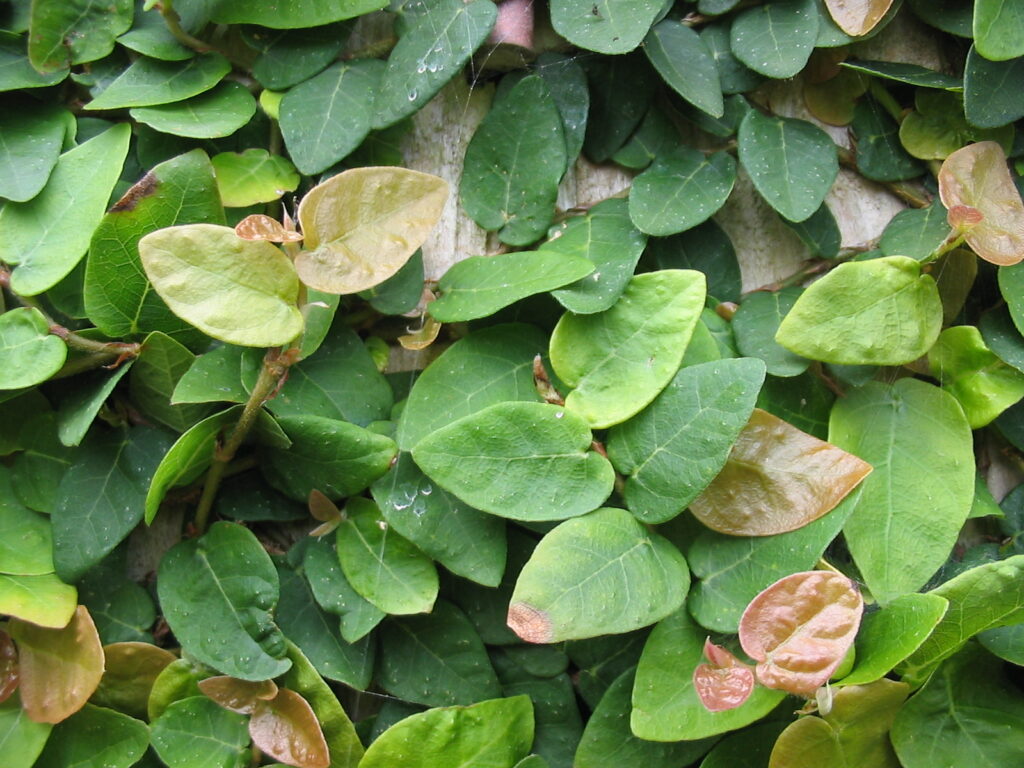
The juvenile stage of Ficus pumila is significantly different from the adult stage. The young plant can grow up to several meters in length, with large ramifications and adventitious roots, allowing it to climb using its fleshy stems and leaves that reach 1.5-2.5 cm in length, shaped like ovals or ellipses, and are closely spaced.
In contrast, the adult Ficus pumila develops into a highly branched liana with adventitious roots, reaching lengths of up to 10 meters. It produces an abundance of white latex when incised, and its stems are flattened and striated, with short pendulous branches. The leaves are alternate, simple, and oblong or oval in shape. The upper surface is dark green, glossy, and has a more pronounced venation; the lower surface is pale green, opaque, and features prominent reticulated venation.
Ficus pumila produces wood-like stems only after several years of growth.
Origin and Distribution
Ficus pumila originates from the temperate and tropical regions of Asia. It is widely cultivated in many parts of this region as well as in central America, the Philippines, Nepal, and Indocina. In the United States, it is grown along the southern and western coasts. Ficus pumila can also be found in Europe.
Risks Associated with its Introduction
Ficus pumila is a highly invasive species due to its rapid growth rate, aggressive rambling habit, high drought tolerance, and ability to thrive on a wide range of soil types and pH values. It requires a specialized pollinator for seed production but can reproduce vegetatively, making it easier to spread accidentally.
Moreover, Ficus pumila is toxic to some mammals, posing a significant risk when introduced to new environments where native insects may not be present.
Habitat and Growth
Ficus pumila thrives in tropical regions but has been widely cultivated both indoors and outdoors. It is often used as an ornamental plant, covering walls and other structures.
The Ficus pumila belongs to the Moraceae family, commonly known as the “fig family” or “gourd family.” This family comprises approximately 40 genera and over 1000 species of trees, shrubs, vines, or rarely herbaceous plants, most originating from tropical or subtropical regions. The latex of various Moraceae plant species contains a cardiac glycoside used as a poison in some cultures, while other parts of the plant, such as leaves and fruit, can cause allergic reactions or toxic effects.
The genus Ficus is particularly large, encompassing about 800-1000 tree and shrub species native to tropical and subtropical regions. These plants are often cultivated outside their natural habitats due to their fruits, which are edible in many cases, and for ornamental purposes. Members of this genus can be difficult to distinguish based on flowers alone but can be identified by leaf shape and fruit characteristics.
Ficus pumila is a climbing species that produces an adhesive latex, allowing it to climb up walls and other plants.
Origin of the Name Ficus Pumila
The name Ficus pumila comes from the Latin term “pumila,” meaning “small” or “tiny.” This likely refers to the plant’s habit of sprawling and creating a low, dense carpet on the ground. Several cultivars of Ficus pumila are known, including “minima,” which has delicate leaves; “quercifolia,” with small, lobed leaves resembling those of oak trees in miniature; and “variegata,” featuring leaves with white or cream-colored variegations.
Prevention and Control
It is essential to remember that Ficus pumila requires a specialized pollinator for its reproduction. In areas where the plant is already known as an invasive species, it is crucial to avoid introducing insects from other regions to prevent further spread.
Chemical control may also be employed against Ficus pumila. Herbicides such as triclopirics can be used as a treatment, but physical removal through pruning may help prevent maturation into a woody form or large shrub, given the plant’s ability to grow adventitiously and vigorously. However, pascoage and combustion are not effective methods for controlling invasive species like Ficus pumila.
Regulations and Laws
In some regions, Ficus pumila is considered an invasive species and regulated accordingly. For example, in Hawaii, where the plant has become a significant problem due to its rapid spread, it is prohibited from cultivation and sale without a permit.
Similarly, in California, the plant is listed as a Category 1 invasive species, which means that any individual caught with it can face fines of up to $5,000. The California Department of Food and Agriculture (CDFA) has implemented strict regulations on the importation, transportation, and cultivation of Ficus pumila.
Consequences of Invasion
Ficus pumila is highly invasive due to its rapid growth rate, aggressive rambling habit, high drought tolerance, and ability to thrive on a wide range of soil types and pH values. This plant can outcompete native vegetation for resources such as light, water, and nutrients, leading to changes in ecosystem structure and function.
In addition, Ficus pumila can alter fire regimes by creating dense thickets that reduce the effectiveness of prescribed burns and make it difficult to conduct controlled burns.
Conclusion
Ficus pumila is a highly aggressive and invasive species that can outcompete native vegetation in many regions due to its rapid growth rate, high tolerance of drought, shade, and varied soil conditions. Understanding its characteristics, habitat preferences, risks associated with its introduction, and methods for control are essential steps in mitigating the impact of this plant on ecosystems.
Frequently Asked Questions
- Q: What is Ficus pumila used for?
A: Ficus pumila can be used as an ornamental plant due to its attractive foliage and unique growth habit, although it is highly invasive and can outcompete native vegetation.
- Q: Is Ficus pumila edible?
A: While some members of the Ficus genus are edible, the toxicity and potential allergic reactions associated with Ficus pumila make it unsafe for consumption without proper identification and preparation.
- Q: Can I grow Ficus pumila in my garden?
A: While possible, growing Ficus pumila can be challenging due to its invasive nature. It is recommended to control or remove the plant if it appears in your area to prevent further spread of this highly aggressive species.
- Q: How do I identify Ficus pumila?
A: Ficus pumila can be identified by its distinctive leaf shape, size, and coloration, as well as its adhesive latex when incised, distinguishing features which can help distinguish it from other similar plant species.
- Q: What methods are most effective for controlling invasive Ficus pumila populations?
A: Physical removal through pruning or cutting, followed by destruction of all remaining parts, is often the most effective method for controlling invasive populations of Ficus pumila due to its ability to regrow from adventitious roots.
- Q: Is there a danger to human health associated with exposure to Ficus pumila?
A: While Ficus pumila can cause allergic reactions or skin irritation in some individuals, the risk is generally considered low for those who handle it infrequently or wear protective clothing.
- Q: Can I allow Ficus pumila to grow wild in my garden if I remove seeds from fruit?
A: Despite removal of seeds, allowing Ficus pumila to spread can be detrimental due to its ability to reproduce vegetatively and form dense thickets that may crowd out native vegetation or other desirable plants.
- Q: How can I prevent spreading invasive plant species like Ficus pumila in my area?
A: Prevention involves careful selection of nursery stock, thorough cleaning and disinfection of gardening tools between plantings, proper disposal of seed-bearing fruits, and avoiding the introduction of non-native pollinators to areas where this species is already present.


