
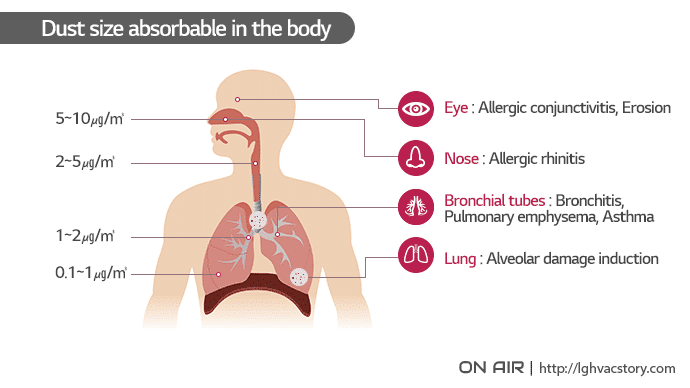
Imagine a silent and stealthy killer, so small it can be inhaled and accumulates in the respiratory system. When we talk about fine particles, we’re usually referring to PM 10, but in recent years, scientists have highlighted another form of air pollution linked to fine particles: PM 2.5.
What are fine particles, exactly? And what do PM 10 and PM 2.5 mean?
Fine particles PM 10 have a diameter of 10 microns, just like PM 2.5, which measures only 2.5 microns. To put it into perspective, the thickness of a hair is roughly equivalent to the size of fine particles PM 10. They’re so small that they can penetrate deep into our lungs and even reach other parts of our body.
What are the risks to human health?
While damage from PM 10 is mainly limited to the respiratory system, PM 2.5 poses a more significant threat. These tiny particles can be inhaled, accumulate in the bloodstream, and potentially harm various organs beyond just the lungs. This highlights the importance of understanding both types of fine particles.
Environmental impacts of fine particles
Who hasn’t experienced foggy days or reduced visibility? In many Italian cities, the primary cause is indeed pollution from fine particles. Besides affecting our view, these tiny particles also damage monuments, artifacts, and buildings by depositing on them. Moreover, they accelerate acid rain and can harm both humans and wildlife.
The nuances of different terms
When discussing air pollutants, it’s easy to get tangled up in the terminology. Let’s break down the key differences between fine particles (PM 10), particulate matter (total suspended particles), and nanoparticle ultrafine particles (PM 1, PM 01, PM 0.001). Fine particles are typically defined as having diameters between 2.5 microns and 10 microns. Particulate matter, on the other hand, includes larger particles that can be breathed in without being inhaled deeply.
Where do fine particles come from?
Since fine particles aren’t produced by a single source, let’s generalize: these tiny particles are primarily formed during combustion residues. Unfortunately, Italy exceeds EU standards for PM 10 levels in many areas. For more information on this topic, check out the European Report detailing Italy’s situation.
Air Quality Index (AQI) and fine particle exposure
The Air Quality Index is used to assess air quality based on concentrations of pollutants like PM 2.5, ozone, and nitrogen dioxide. When the AQI reaches high levels, it can indicate a greater risk of exposure to fine particles. Understanding how to measure and interpret the AQI is crucial for making informed decisions about your daily activities.
Understanding the impact of fine particles on human health
Research has shown that long-term exposure to PM 2.5 can lead to increased mortality rates, cardiovascular disease, and respiratory problems. Additionally, the World Health Organization (WHO) recommends reducing annual concentrations of PM 2.5 to at least 10 microns per cubic meter for optimal public health.
Health effects associated with fine particles
Some of the notable health effects linked to exposure to fine particles include:
- Respiratory issues: Fine particles can irritate lungs, causing coughing, wheezing, and shortness of breath.
- Cardiovascular problems: Long-term exposure has been shown to increase the risk of heart attacks, strokes, and other cardiovascular events.
- Neurological damage: Research suggests that fine particle exposure may lead to cognitive impairment and neurodegenerative diseases.
Environmental impacts of fine particles
In addition to harming human health, fine particles also have significant environmental impacts. Some of these effects include:
- Acid rain: Fine particles can react with water vapor in the atmosphere, leading to acid rain and its associated damage.
- Air quality degradation: By reducing visibility and affecting our view, fine particles contribute to overall air quality degradation.
- Environmental damage: These tiny particles can also damage buildings, monuments, and artifacts by depositing on them.
Technological solutions for reducing fine particle emissions
Several technological solutions have been developed to reduce fine particle emissions:
- Emissions control systems: These systems use technologies like scrubbers, filters, or electrostatic precipitators to remove particulate matter from combustion residues.
- Alternative energy sources: Transitioning to cleaner energy sources like solar or wind power can significantly reduce the amount of fine particles generated by combustion.
Policy and regulation
In recent years, there has been increased focus on implementing policies and regulations to mitigate the impacts of fine particles. Some notable initiatives include:
- EU standards: The European Union sets annual limits for PM 10 concentrations, aiming to minimize the negative health effects associated with exposure.
- National emissions standards: Countries like Italy have established their own national standards for reducing particulate matter emissions.
Conclusion
Fine particles pose a significant threat to human health and the environment. By understanding more about these tiny pollutants, we can work towards reducing pollution and creating cleaner air for everyone.


