
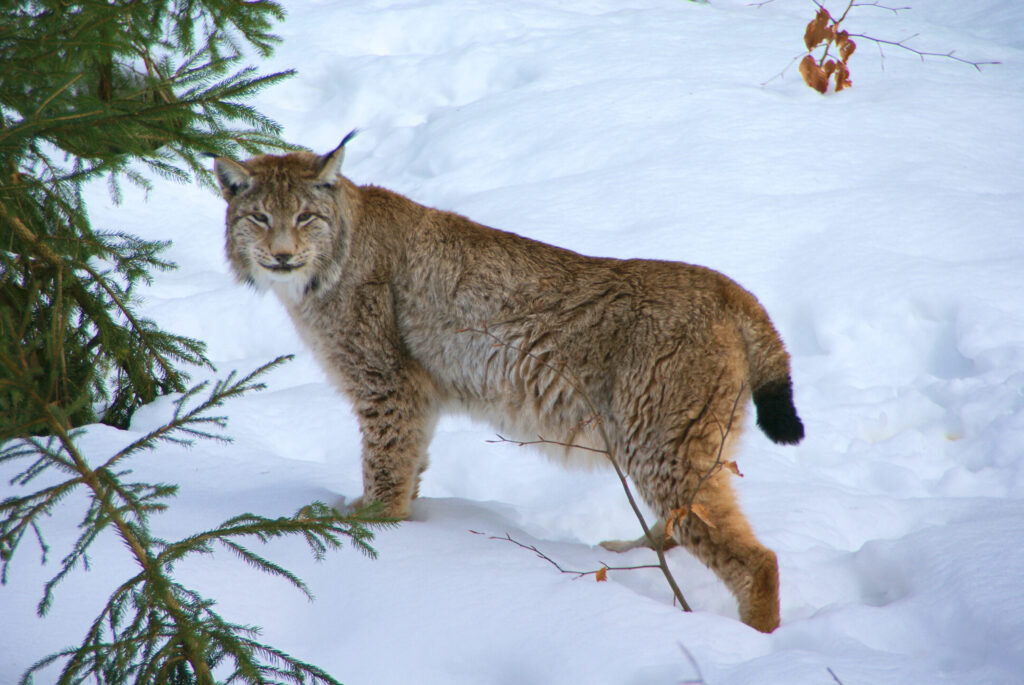
The Eurasian lynx (Lynx lynx), also known as the European lynx, is one of the largest species of wild cats in the mountains and plains of Eurasia. This formidable hunter uses its powerful hind legs to jump and grasp prey with its retractable claws.
Physical Characteristics
The Eurasian lynx has a compact body and short tail, but it is characterized by its elegant tufts on its ears. These tufts, present on both males and females, serve to protect the ears from cold temperatures and enhance auditory perception, which is capable of detecting even faint sounds in the surrounding forest.
Despite its imposing appearance, the Eurasian lynx is an endangered species due to habitat destruction and illegal hunting. However, thanks to conservation efforts over the past few decades, the population of Eurasian lynxes has slowly begun to increase in certain parts of their distribution range.
Classification and Description
The Eurasian lynx belongs to the family Felidae and is one of four recognized lynx species. Its taxonomy is as follows:
- Kingdom: Animalia
- Phylum: Chordata
- Class: Mammalia
- Order: Carnivora
- Family: Felidae
- Genus: Lynx
- Species: Lynx lynx
Habitat and Distribution
The Eurasian lynx (Lynx lynx) is a species of wild cat that spans from central Europe to the easternmost regions of Asia. This animal inhabits various environments, including forests, rocky terrain, and even high-altitude areas.
Geographical Areas
Currently, the populations of Eurasian lynxes are primarily found in northern Europe. In Central and Western Europe, there are still viable but isolated populations of this species. Historically, however, the Eurasian lynx was present throughout most of Europe, but its population declined significantly starting from the mid-20th century.
Preferred Environments
The Eurasian lynx is a solitary and territorial animal that primarily inhabits forests and mountainous regions, where it can find prey such as deer, rabbits, hares, and other small mammals. This species can also adapt to open environments like steppes and prairies provided there is sufficient vegetation for hunting and reproduction.
The presence of surface water, such as rivers and streams, is another factor that influences the choice of habitat for Eurasian lynxes. In summary, this species can thrive in various types of environments, but it requires a significant amount of habitat with adequate vegetation to ensure survival.
Behavior and Biology
The Eurasian lynx is a solitary and territorial animal that lives primarily in forested areas. It is nocturnal, spending most of its day resting within its den.
Diet
The Eurasian lynx is a predator that feeds mainly on ungulates such as deer and rabbits, but it can also hunt other small mammals, birds, and reptiles.
Reproduction
The Eurasian lynx reaches maturity at around two years old. During the reproductive season, males try to attract females by making vocalizations and marking their territory with urine. After mating, females give birth to litters of 2-4 cubs that are nursed for approximately three months.
Communication and Socialization
The Eurasian lynx is a solitary animal but not completely antisocial. Adults communicate mainly through territorial markings like urine and vocalizations. Young cubs learn how to communicate with their mothers from birth using sounds and body language.
Conservation Status
The Eurasian lynx is listed as an endangered species globally due to various threats such as habitat destruction, poaching, and vehicle collisions. Conservation efforts have been implemented to protect this species.
Conservation Status
According to the International Union for Conservation of Nature (IUCN), the Eurasian lynx is classified as a “vulnerable” or critically endangered species at the global level. In Italy, the species is present in only a few regions like the Alps and the Apennines. The Italian population of lynxes is considered “critically endangered.”
Threats to Survival
The Eurasian lynx faces multiple threats including habitat destruction, illegal hunting, and road mortality. This species requires large expanses of natural habitat for survival.
Conservation Efforts
Several conservation initiatives have been launched to protect the Eurasian lynx. In Italy, the “Life Lynx” project aims at protecting and reintroducing the Eurasian lynx in certain areas of Italy.
Reducing road mortality is also an ongoing effort through measures like building bridges and tunnels for animals. Hunting the Eurasian lynx has been banned in many European countries, including Italy.
Habitat Fragmentation
Habitat fragmentation is a significant threat to the survival of the Eurasian lynx. This occurs when large areas of natural habitat are broken up into smaller patches due to human activities such as agriculture, urbanization, and infrastructure development.
Habitat fragmentation can lead to reduced population sizes, isolation of subpopulations, and increased vulnerability to predators and competitors. Conservation efforts should focus on connecting fragmented habitats to create larger, more contiguous areas that support healthy lynx populations.
Human-Lynx Conflict
Human-lynx conflict is a significant threat to the survival of the Eurasian lynx. This occurs when lynxes encroach on agricultural lands, causing damage to crops and livestock.
In some cases, lynxes may be killed by farmers in response to these conflicts. However, this can lead to an over-reliance on hunting as a means of population control, which is often ineffective and can further exacerbate the decline of lynx populations.
Conservation Efforts to Address Human-Lynx Conflict
Several conservation initiatives have been launched to address human-lynx conflict. In Italy, for example, the “Life Lynx” project includes measures such as:
- Providing compensation to farmers for damage caused by lynxes
- Educating farmers about the importance of coexisting with lynxes
- Creating corridors and connectivity between fragmented habitats
Reducing human-lynx conflict is crucial to the long-term survival of the Eurasian lynx. Conservation efforts should focus on addressing these conflicts through education, compensation, and habitat connectivity.
Cultural Significance
The Eurasian lynx holds significant cultural and symbolic value in many European societies. In some cultures, it is seen as a symbol of power, strength, and resilience.
In other cases, the Eurasian lynx is revered for its beauty and majesty. This has led to a strong emotional connection between humans and lynxes, which can be leveraged in conservation efforts.
Conservation Success Stories
Despite the many challenges facing the Eurasian lynx, there have been several successful conservation stories in recent years.
In Poland, for example, the reintroduction of lynxes into the country’s wilderness has led to a significant increase in population sizes. In Sweden, conservation efforts have focused on protecting lynx habitats and reducing human-lynx conflict through education and compensation.
These success stories demonstrate that with concerted conservation efforts, it is possible to protect endangered species like the Eurasian lynx.
Conclusion
The Eurasian lynx is an iconic and threatened species that requires immediate attention from conservationists. Habitat destruction, poaching, and vehicle collisions pose significant threats to its survival.
However, thanks to conservation efforts over the past few decades, the population of Eurasian lynxes has slowly begun to increase in certain parts of their distribution range. Continued support for conservation initiatives like habitat connectivity, human-lynx conflict mitigation, and education is crucial to ensuring the long-term survival of this magnificent species.
As we move forward, it is essential that we prioritize conservation efforts and protect the natural habitats of the Eurasian lynx. By working together, we can ensure that this incredible animal continues to thrive in the wild for generations to come.


