
Introduction
One of the oldest known algorithms is the Euclidean algorithm, which has been used for centuries to find the greatest common divisor (GCD) of two numbers. This algorithm was first mentioned in Euclid’s Elements, written around 300 BC, and has since been refined and applied in various fields, including computer science and music theory.
A Brief History of the Euclidean Algorithm
While we can’t be certain that Euclid discovered the algorithm himself, his writings on the subject are some of the earliest recorded examples. It’s possible that he built upon earlier ideas, but it’s clear that he was one of the first to put the algorithm into writing. Over the centuries, other mathematicians have contributed to its development, including Eudoxus of Cnidus and Aristotle.
The Euclidean Algorithm in Computer Science
In modern computer science, the Euclidean algorithm is often used as a tool for finding the GCD of two numbers. When dealing with large datasets, this can be a computationally intensive task. However, by using algorithms like the binary search method, we can significantly speed up the process.
The Binary Search Method
The binary search method involves representing the numbers as binary fractions, which allows us to avoid division and increase efficiency. This approach is particularly useful when dealing with large datasets.
For example, if we want to find the GCD of 48 and 18 using the Euclidean algorithm, we can start by dividing the larger number into the smaller one: 48 ÷ 18 = 2 remainder 12. Then, we divide the divisor (18) into the remainder (12): 18 ÷ 12 = 1 remainder 6. Finally, we divide the previous divisor (12) into the new remainder (6): 12 ÷ 6 = 2 remainder 0.
Using binary search to find the GCD of two numbers can be implemented in several ways:
- We start by finding the maximum length between the two numbers and reducing it to a power of two.
- For each bit set in the maximum length, we divide the larger number by the corresponding digit of the smaller number (starting from the most significant bit).
- If the result is non-zero, we continue the process with the new divisor and remainder.
Using Recursion in the Euclidean Algorithm
Another way to express the Euclidean algorithm using recursion is by using a “loop” approach. In this case, we start by dividing one number into another and repeating the process until we reach a remainder of zero.
Here’s how it works:
- We define a recursive function
gcd(a, b)that takes two numbers as input. - If
bis equal to 0, we returna. - Otherwise, we calculate the quotient and remainder using integer division (
q = a // b,r = a % b). - We then call the recursive function with the new values of
aandb:gcd(b, r).
Properties of the Euclidean Algorithm
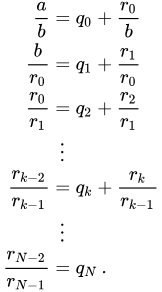
One of the key properties of the Euclidean algorithm is that it can be used to find the GCD of two numbers in a systematic way. This involves using the remainders obtained during each iteration to construct an equation involving the GCD.
To see how this works, let’s consider the first few steps of the Euclidean algorithm for finding the GCD of 48 and 18:
- 48 = 2 × 18 + 12
- 18 = 1 × 12 + 6
- 12 = 2 × 6 + 0
From these steps, we can see that the remainder sequence is {12, 6, 0}, and since each step is an integer division operation, the GCD of 48 and 18 must divide both 12 and 6.
Using this property, we can show that the GCD must be a divisor of 6 by repeatedly applying the Euclidean algorithm:
- 48 = 8 × 6 + 0
- 18 = 3 × 6 + 0
Since the remainder is zero in both cases, we know that 6 is a common factor. By inspecting the original numbers (48 and 18), we can see that they have no other common factors besides 1 and 2.
Therefore, the greatest common divisor of 48 and 18 is indeed 6.
Applications of the Euclidean Algorithm
The Euclidean algorithm has many practical applications in various fields:
- Polynomials with one variable: The Euclidean algorithm can be used to find the GCD of two polynomials, which is essential in computer algebra systems.
- Homogeneous polynomials with two variables: In this case, we need to find a common divisor between two polynomials that have exactly two terms each.
- Computer science: The Euclidean algorithm has numerous applications in computer science, including finding the GCD of two large numbers, generating pseudorandom numbers using modular arithmetic.
Geometric Interpretation of the Euclidean Algorithm
Interestingly, the original idea behind the Euclidean algorithm was not purely mathematical but rather geometric. This concept involves finding a common measure for the length of two segments:
- Imagine you have two line segments with different lengths.
- To find their common measurement (or GCD), we can use a technique called “similar triangles.”
- We create similar triangles by drawing perpendicular lines from each segment to a fixed point.
- By using the ratios of corresponding sides in these triangles, we can determine the ratio between the two segments.
The Connection to Music Theory
Did you know that the Euclidean algorithm has also been used in music theory? In 2004, Godfried Toussaint discovered that the algorithm generates traditional musical rhythms when applied to the rhythmic patterns of music. This finding highlights the algorithm’s versatility and its potential applications beyond mathematics.
Conclusion
The Euclidean algorithm is a testament to human ingenuity and innovation. Its ability to find the GCD of two numbers has been refined over centuries, and its applications continue to expand into new fields. Whether in computer science or music theory, this algorithm remains an essential tool for solving complex problems.
Frequently Asked Questions
- What is the Euclidean algorithm?
The Euclidean algorithm is a method for finding the greatest common divisor (GCD) of two numbers. - How does the binary search method work?
The binary search method involves representing the numbers as binary fractions and using this representation to avoid division and increase efficiency. - What are some practical applications of the Euclidean algorithm?
The Euclidean algorithm has many practical applications, including finding the GCD of two numbers in polynomials with one variable or homogeneous polynomials with two variables. - Can the Euclidean algorithm be used for other purposes besides mathematics?
Yes, the Euclidean algorithm has been applied in music theory to generate traditional musical rhythms. - How did Godfried Toussaint discover the connection between the Euclidean algorithm and music theory?
In 2004, Godfried Toussaint discovered that the algorithm generates traditional musical rhythms when applied to the rhythmic patterns of music by using a computer program. - Is there anything else I can use this algorithm for?
Yes, you can use it to solve other problems involving GCDs and find connections between mathematics and other fields such as computer science or music theory.
Final Thoughts
The Euclidean algorithm is an ancient problem-solving technique that continues to be relevant today. Its applications are diverse and numerous, from finding the GCD of two numbers to generating musical rhythms.
In conclusion, the Euclidean algorithm is a timeless method for finding the greatest common divisor (GCD) of two numbers, which has been refined over centuries and applied in various fields. By understanding its properties, history, and applications, we can appreciate its significance in mathematics and beyond.


