
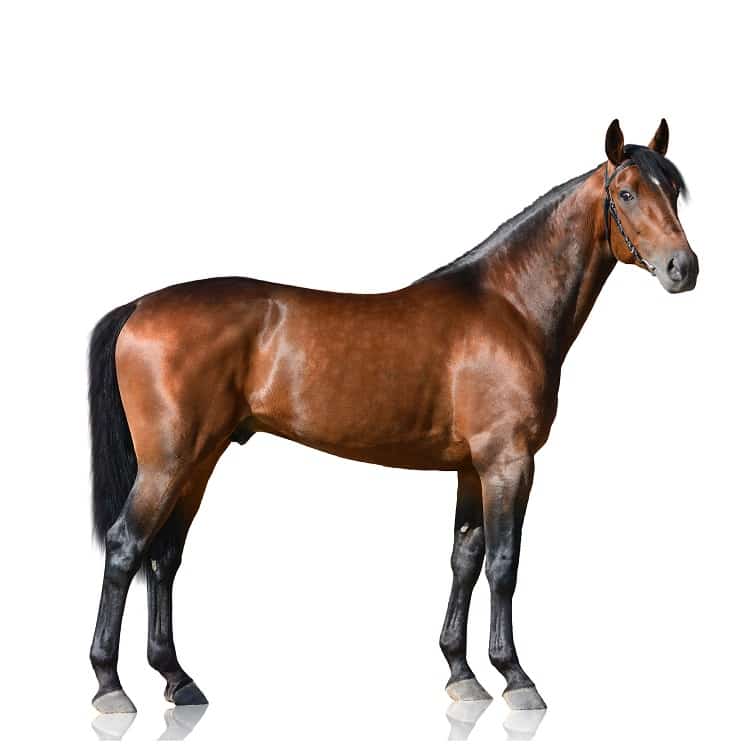
The agility and speed are the two characteristics that make the English Thoroughbred unique, making it recognizable especially when competing and giving its all to excel. This is a breed originating from Great Britain but also found in Italy and other countries around the world, and it has been carefully selected and attended to because of its potential for success in all types of horse racing competitions.
Contents
- Origin
- Characteristics
- Nature
- Breeding
The English Thoroughbred: Origin
The geographical origins of this English thoroughbred are fairly clear, but let’s dive into the historical and intricate origins that explain its characteristics. The official date of birth of the modern version of this breed is 1793, as recorded in the Stud Book, the book of horse origins or genealogical register of horse racing horses. This document tells us that the breed originated from 50 indigenous mares, the Royal Mares, and three Oriental stallions: Byerly Turk, Darley Arabian, and Godolphin Barb, whose male lineage descends into the modern Thoroughbred racehorse.
It’s worth noting that a fourth stallion has genetically contributed to the formation of what we know today as the English Thoroughbred. His name is Curwen’s Bay Barb.
While this official narrative is widely accepted, the selection process for achieving this breed began much earlier, even before the Roman conquest of Britain when the powerful people brought their own horses to these shores. In particular, the Berber horse used in the Circus Maximus for racing had already in its blood the speed and agility we find in our Thoroughbred.
Over time, several Oriental horses arrived in England, mainly during the Crusades or through trade with Italy, where numerous races and Palii took place in the Middle Ages. Some of these mares were known for their exceptional speed, such as the Royal Mares from various origins (Berber, Turkish, Syrian, Arabian, and crossbreeds). While they were selected for their speed over 400 meters, there were others with similar origins that suggest our Thoroughbred has clear Eastern roots.
The early history of England is also filled with stories about ancient races, where people competed to see whose horse could run the farthest distance without stopping. These old horses are believed to have been some of the first ancestors of the modern Thoroughbred breed.
The English Thoroughbred: Characteristics
The body of this racing horse is clearly suited to running. They are known as “thoroughbreds” in English and were created specifically to succeed at galloping races, thus studied almost like a blueprint for being powerful and fast. By prioritizing these traits during selection, we’ve obtained horses with non-homogeneous physical characteristics that have been grouped into three precise categories.
There’s the “stayer,” which is the tallest and longest-legged horse, often used in races over 2100 and 3000 meters and beyond; the “sprinter,” a compact and small-bodied horse used for racing between 1000 and 1500 meters; and finally the “intermediate,” characterized by an oblique withers, an inclined shoulder, and a relatively short back. While these horses have different dimensions, they all share common characteristics.
Their height at the withers ranges from 147 to 173 cm, with an average of around 162 cm, while their weight correspondsingly ranges from 350 to 500 kg. They are dolichocephalic (long-headed) with proportionate heads, small ears; large and gentle eyes, carried by a long and straight neck but also muscled. The back is prominent, and the belly line is quite extended.
The shape of their neck can vary: it may be more or less oblique depending on the category to which they belong. The chest is broad and deep while the tail has an elevated attack. When it comes to legs, for a racing horse, these are extremely important. The Thoroughbred’s legs are long with short braches and very muscular and wide joints and tendon evidence as well.
Their coat and mane can vary significantly, but they typically have black coats, with occasional bay, dark bay, or roan colors, while occasionally some may be chestnut, gray, or red; however, these rare colors do not influence the acceptability of the horse. They can also feature white markings, which are accepted.
In addition to their physical characteristics, Thoroughbreds have been selectively bred for centuries to possess a specific temperament and aptitude for racing. This includes traits such as:
- High energy levels: Thoroughbreds require regular exercise to maintain their fitness and speed.
- Strong instinctual behavior: They need to be taught and trained from an early age to respond to commands and behave in a desired manner.
- Good social skills: They should be able to interact well with humans, other horses, and other animals.
- High courage: They must have the strength and resilience to compete at high levels of racing.
The English Thoroughbred: Nature
This athletic and fast horse is accompanied by a somewhat nervous character, making it certainly not an animal for beginners to handle. It excels in galloping but also shows itself to be courageous, reliable, and affectionate towards its rider when a good feeling develops and they form a winning team.
In fact, the Thoroughbred’s emotional responses can be quite complex, involving elements of excitement, stress, and anxiety. For example:
- They tend to become excited or anxious before racing, which can lead to increased heart rates and blood pressure.
- After racing, they may experience relief and satisfaction after completing a challenging task.
- Some Thoroughbreds can also develop emotional associations with their riders or other horses, such as forming close bonds or experiencing jealousy.
To manage these complex emotions and ensure the well-being of both humans and animals involved in horse racing, specialized training and care are essential. This includes:
- Providing adequate exercise and mental stimulation to maintain the Thoroughbred’s physical and emotional health.
- Using positive reinforcement techniques to encourage desired behaviors and build trust between horses and riders.
- Developing strategies to minimize stress and anxiety associated with racing.
The English Thoroughbred: Breeding
Even in Italy, we can find English Thoroughbreds breeding programs, thanks largely to one person who has allowed the breed to remain here: Federico Tesio. We owe most modern Thoroughbreds to horses bred at Villa Tesio, near Dormello on the shores of Lake Maggiore. Tesio is known as the “Mago di Dormello” (Dormello’s magician) and devoted his life to studying this breed alongside his wife Lydia Fiori between the early 20th century and its mid-point.
He created champions that raced for the scuderia Dormello Olgiata, including Apelle, Ortello, Donatello II, Nearco, and Ribot, a true Italian pride. Tesio’s breeding program not only focused on creating superior racing horses but also aimed to preserve the genetic integrity of the breed by using only high-quality stallions and mares.
The success of Tesio’s breeding program has contributed significantly to the global recognition and appreciation of Thoroughbred horses as athletic competitors, beloved companions, and versatile working animals. Today, English Thoroughbreds are bred and trained in many countries around the world, with a strong emphasis on preserving their unique characteristics, temperament, and racing prowess.
However, this success also raises concerns about the welfare and sustainability of the breed. As demand for high-quality Thoroughbred horses continues to grow, so do concerns about overbreeding, genetic diversity, and the long-term health and well-being of these magnificent animals. To address these challenges, responsible breeding practices and strict regulations have been implemented in various countries, ensuring that the English Thoroughbred remains a respected and beloved breed for generations to come.
In conclusion, the English Thoroughbred is an exceptional horse breed known for its extraordinary speed, agility, and endurance. Its unique characteristics, combined with its rich history and cultural significance, make it a cherished companion and competitor worldwide. By understanding the origins, nature, and breeding of this magnificent breed, we can better appreciate the value and importance of preserving the English Thoroughbred for generations to come.
Conclusion
The English Thoroughbred has been bred specifically for racing purposes, making it unique among horse breeds. While it excels in galloping, its character is nervous and must be handled by beginners only under guidance from an experienced rider or trainer. In breeding programs, the breed’s genetic integrity has been preserved through careful selection of high-quality stallions and mares.
As with any living being, Thoroughbreds experience a range of emotions including excitement, stress, anxiety, and relief. To ensure their physical and emotional well-being, specialized training and care are essential.
The success of breeding programs such as the one by Tesio in Italy has contributed to the breed’s global recognition and appreciation. Nevertheless, concerns about overbreeding, genetic diversity, and animal welfare have been raised. Responsible breeding practices and strict regulations aim to ensure that the English Thoroughbred remains a respected and beloved breed.
Through careful management of these factors, we can preserve this magnificent horse breed for generations to come, ensuring its continued contribution to the world of equestrian sports and beyond.


