
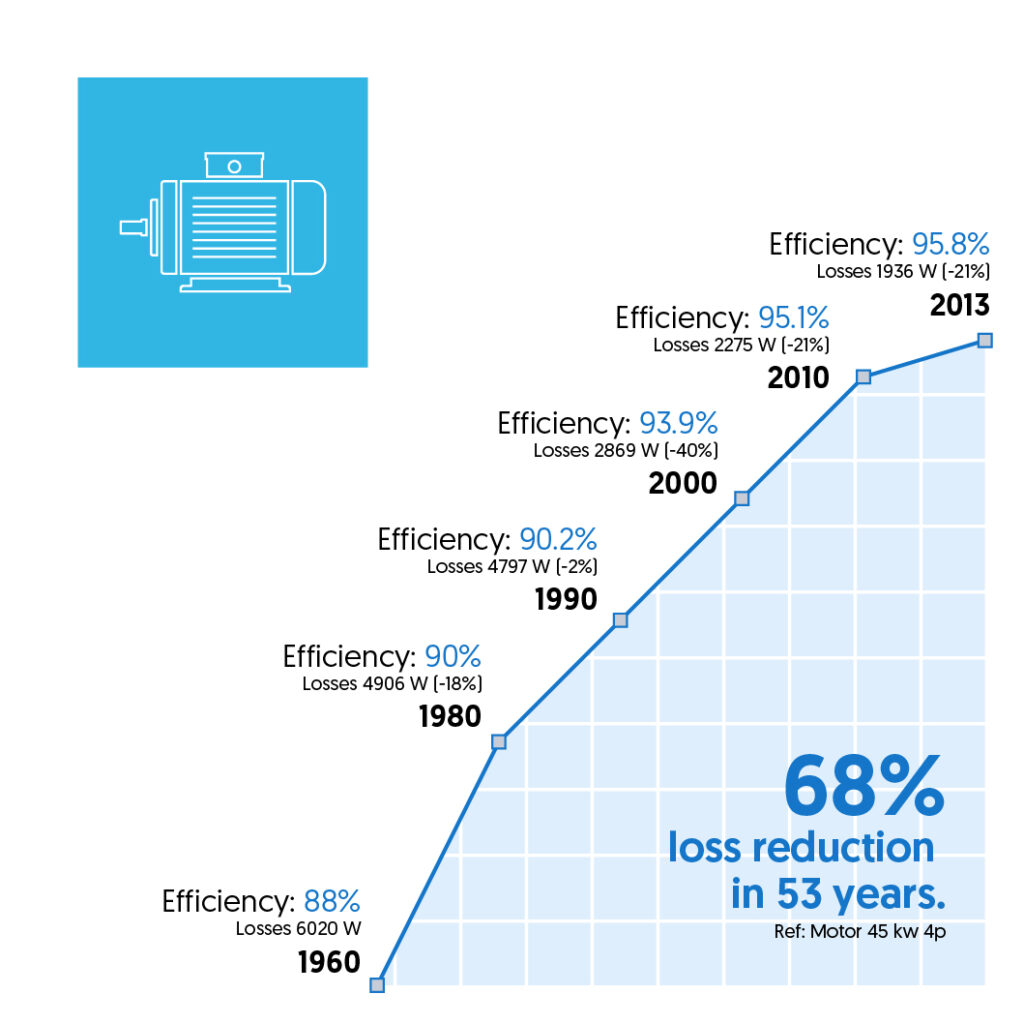
The Importance of Electric Motor Efficiency
When it comes to electric motors, efficiency is a crucial topic. Approximately two-thirds of the electricity used in industrial applications is consumed by these devices. Addressing motor efficiency and performance means making a significant contribution to managing a pressing national issue – energy rational use.
Electric Motor Efficiency: A Relevant Topic
Efficiency and electric motors are also an important theme because regulations are changing things. The European Union’s Regulation 640/2009, which outlines eco-friendly design requirements, stipulates that starting January 2015, all electric motors with a nominal power between 7.5 kW and 375 kW must meet high efficiency standards and therefore high performance standards as well. The regulation also states that for lower-power motors, the deadline is January 1st, 2017.
Electric Motor Efficiency in Italy: A Leader in High-Efficiency Motors
Efficiency and electric motors are an interesting topic for Italy because our country is at the forefront of building high-efficiency electric motors. As a result, Italian companies have already adapted to the new European regulation on eco-friendly design and have even anticipated its deadlines. However, business owners now expect institutions to monitor the market so that products conform to EU regulations.
What is an Electric Motor?
An electric motor receives electrical power as input and returns mechanical power as output. The International Electrotechnical Commission’s (IEC) 60034-30-2008 standard establishes different classes of efficiency energy (IE) for electric motors according to the following schema: IE1 (standard performance); IE2 (high-performance motor), IE3 (premium performance motor), and IE4 motors with super-premium performance.
Italian Electric Motor Data
According to the Energy Efficiency Report from Politecnico di Milano, by December 2013, Italy’s installed power of electric motors exceeded 100 GW (20 million units) of which approximately 80% belonged to the industrial sector. By 2013, around 50% of circulating electric motors belonged to the IE2 class, while 10-15% belonged to the IE3 class. Only a few projects with the IE4 class existed in 2013.
European Regulation 640/2009
As early as June 16th, 2011, all electric motors introduced on the market must be in the IE2 efficiency class. Starting January 1st, 2015, electric motors between 7.5 kW and 375 kW will need to meet at least IE3 or IE2 standards when coupled with inverters. In January 2017, even lower-power motors (0.75-375 kW) must be in the IE3 or IE2 efficiency class when coupled with inverters.
A Useful Resource for Electric Motor Efficiency and Future Normative Developments
The new Electric Motor Database portal opened by ENEA in collaboration with ANIE Energia’s Rotary Machine Group is an essential resource on electric motor efficiency, classes of efficiency, and upcoming regulatory changes. The website’s goal is to collect all products that comply with Regulation 640/2009.
How Do Electric Motors Work?
Electric motors work by converting electrical energy into mechanical energy through electromagnetic forces. This conversion process occurs in the presence of a magnetic field and an electric current. When a voltage is applied across the motor, the electromagnetic force causes the rotor to rotate around the stator.
Types of Electric Motors
There are several types of electric motors, including:
- Induction Motor: The most common type of electric motor, which uses electromagnetic induction to produce rotation.
- Synchronous Motor: A type of motor that rotates at a fixed speed, regardless of the voltage applied.
- DC Motor: A type of motor that uses direct current to produce rotation.
Benefits of High-Efficiency Electric Motors
High-efficiency electric motors offer several benefits, including:
- Reduced energy consumption
- Lower operating costs
- Increased reliability and lifespan
- Improved performance and efficiency
Challenges Facing the Electric Motor Industry
The electric motor industry faces several challenges, including:
- Increasing energy efficiency requirements
- Rising raw material costs
- Growing demand for high-performance motors
- Limited availability of skilled workforce
Conclusion
In conclusion, efficiency in electric motors is a critical issue due to the significant amount of electricity used by industrial applications. Regulations are changing things, so it’s essential to keep up-to-date on the topic.
FAQs: Electric Motor Efficiency and Classifications
- What does the regulation 640/2009 require for electric motors? Starting January 2015, all electric motors between 7.5 kW and 375 kW must meet IE3 or IE2 standards when coupled with inverters.
- What is the purpose of the Electric Motor Database portal? To collect products that comply with Regulation 640/2009.
- Why are high-efficiency electric motors important in Italy?
- In what year did Italian companies start adapting to the new European regulation on eco-friendly design?
- How many GW of installed power did Italy have by December 2013?
- What percentage of circulating electric motors belonged to the IE2 class by 2013?
- Why are lower-power motors becoming more important in January 2017?
- Can you explain the difference between IE3 and IE2 efficiency standards for electric motors?
- How can I find out which products comply with Regulation 640/2009?
- What is the goal of the new Electric Motor Database portal?


