
1. Introduction to the Earth’s Mantle
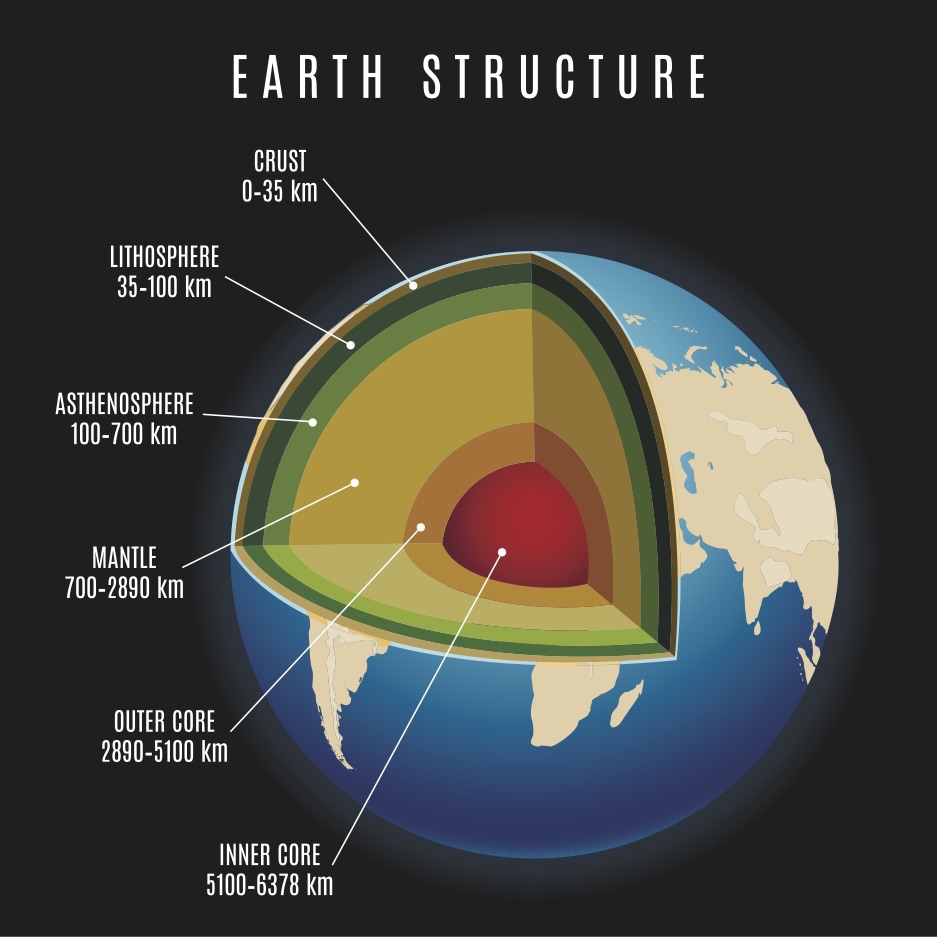
The Earth’s mantle is often misunderstood as the layer that surrounds the planet, but in reality, it is one of the most internal layers of our planet. The term “mantle” comes from geology and geophysics and refers to one of the concentric rings that make up the Earth’s structure. The mantle, particularly, is a solid layer with high viscosity, situated between the crust and the core, occupying a total thickness of approximately 2890 km.
The study of the mantle has gained significant attention in recent years due to its crucial role in shaping the Earth’s surface and internal structures. By understanding the mantle’s composition, structure, and dynamics, scientists can gain insights into geological processes, improve our ability to predict natural hazards, and better understand the Earth’s evolution over time.
2. The Mantle: A Complex and Dynamic System
The temperature in the mantle varies greatly, depending on its location. Near the surface, it can range from 500°C to 900°C, while near the center of the Earth, it exceeds 4000°C. As we move downward into the mantle, the temperature increases, with the outermost part consisting of ultrafertile rocks that are more rigid and dense than the crust.
The mantle is also characterized by its complex structure, which includes various sub-layers such as the asthenosphere, mesosphere, and lithospheric plate. These sub-layers have distinct physical and chemical properties, which affect the mantle’s overall dynamics and behavior.
3. The Mantle’s Structure
The mantle is divided into several sub-layers, each with its unique characteristics and composition. The asthenosphere, located near the surface, is a region of partially molten rock that exhibits low viscosity and high ductility. This sub-layer plays a crucial role in shaping the Earth’s surface through volcanic activity and plate tectonics.
As we move deeper into the mantle, we encounter the mesosphere, a region with crystalline structures that are rigid and have varying chemical compositions. The mesosphere is characterized by its unique seismic properties, which allow scientists to gain insights into the mantle’s internal structure and dynamics.
4. The Mantle’s Boundary with the Crust
The boundary between the mantle and the crust is marked by the discontinuity of Mohorovičić, which separates the two layers. This discontinuity is characterized by a sudden increase in seismic velocity, indicating a change in rock type or composition.
As we move deeper into the mantle, the temperature increases, causing the rocks to become more rigid and dense. This process, known as differentiation, leads to the formation of distinct sub-layers with unique properties and compositions.
5. The Mantle: A Window into the Earth’s History
The mantle provides a unique window into the Earth’s history, with clues about the planet’s formation and evolution. By studying the mantle’s composition and structure, scientists can gain insights into the Earth’s past and its potential for future geological activity.
One of the most significant discoveries related to the mantle is the presence of ancient rocks and minerals that date back billions of years. These rocks provide valuable information about the Earth’s early history and the processes that shaped our planet over time.
6. The Mantle in Popular Culture
The mantle has captivated human imagination, particularly in science fiction, such as in Jules Verne’s novel “Journey to the Center of the Earth” (1959). This classic tale has inspired numerous adaptations and interpretations, showcasing the fascination with the Earth’s internal workings.
In recent years, the mantle has also been featured in popular culture through films, television shows, and video games. For example, the movie “The Core” (2003) explores the idea of a group of scientists drilling into the Earth’s core to save humanity from a catastrophic event caused by the planet’s internal heat.
7. The Mantle: A Frontier for Scientific Research
Scientists are currently conducting research on the mantle, particularly the Japan Agency for Marine-Earth Science and Technology (JAMSTEC), which aims to drill into the Earth’s mantle using the Chikyu ship. This ambitious project seeks to explore the boundary between the crust and the mantle, aiming to better understand the Earth’s internal structure and potential hazards.
Other research initiatives, such as the National Science Foundation’s (NSF) Deep Carbon Observatory (DCO), focus on understanding the role of carbon in the Earth’s interior and its impact on geological processes. These projects demonstrate the ongoing exploration and discovery related to the mantle.
8. The Mantle: A Source of Natural Resources
The mantle is a source of natural resources, including minerals and metals. By understanding the mantle’s composition and structure, scientists can identify potential areas for resource extraction, which can have significant economic and environmental implications.
One of the most significant natural resources associated with the mantle is diamonds, which are formed through high-pressure and high-temperature processes deep within the Earth’s crust. The discovery of diamond-bearing rocks in the mantle has led to new mining operations and has expanded our understanding of these valuable minerals.
9. The Mantle: A Challenge for Geologists
Geologists face numerous challenges when studying the mantle, including the difficulty in accessing its depth and the complexity of its internal structures. By overcoming these challenges, scientists can gain a deeper understanding of the Earth’s internal workings and improve our knowledge of geological processes.
One of the most significant challenges related to the mantle is the lack of direct access to its interior. Scientists rely on seismic data and geochemical analysis to infer the mantle’s structure and composition, which can be incomplete or uncertain at times.
10. The Mantle: An Ongoing Exploration
The study of the mantle is an ongoing exploration that continues to captivate scientists and the general public alike. As new technologies and techniques emerge, researchers are pushing the boundaries of human knowledge about the Earth’s internal structure and composition.
One of the most significant advancements in recent years has been the development of advanced seismic imaging techniques, which allow scientists to create detailed images of the mantle’s internal structures. These advances have improved our understanding of the mantle’s dynamics and behavior, providing valuable insights into geological processes.
11. The Mantle’s Role in Shaping the Earth’s Surface
The mantle plays a crucial role in shaping the Earth’s surface, particularly through volcanic activity and tectonic processes. By understanding the mantle’s dynamics and behavior, scientists can better predict geological hazards and improve our ability to mitigate their impacts on human populations and the environment.
One of the most significant geological hazards associated with the mantle is volcanic activity, which can lead to widespread destruction and loss of life. Scientists are working to develop more accurate models of volcanic eruptions, taking into account the complex interactions between the mantle, crust, and atmosphere.
12. The Mantle: A Key to Understanding Plate Tectonics
Plate tectonics is a fundamental concept in geology that explains the movement of Earth’s lithospheric plates. By studying the mantle’s structure and composition, scientists can gain insights into plate tectonic processes and better understand the Earth’s geological evolution.
One of the most significant discoveries related to plate tectonics is the presence of ancient oceanic crust, which provides valuable information about the Earth’s early history and the processes that shaped our planet over time. The study of mantle rocks and minerals has also helped scientists develop a more accurate understanding of plate tectonic processes and their role in shaping the Earth’s surface.
13. The Mantle: A Source of Volcanic Activity
Volcanic activity is a manifestation of the mantle’s dynamic behavior. By understanding the mantle’s internal structures and processes, scientists can improve our ability to predict volcanic eruptions and mitigate their impacts on human populations and the environment.
One of the most significant volcanic hazards associated with the mantle is the Yellowstone Caldera, which is located in the western United States. Scientists are working to develop more accurate models of volcanic activity at this location, taking into account the complex interactions between the mantle, crust, and atmosphere.
14. The Mantle: A Window into the Earth’s Core
The mantle provides a unique window into the Earth’s core, with clues about its composition and behavior. By studying the mantle’s structure and dynamics, scientists can gain insights into the Earth’s core and improve our understanding of geological processes.
One of the most significant discoveries related to the Earth’s core is the presence of iron-rich minerals, which are thought to be present in large quantities at the center of the planet. The study of mantle rocks and minerals has also helped scientists develop a more accurate understanding of the Earth’s core and its role in shaping our planet.
15. Conclusion
In conclusion, the Earth’s mantle is a complex and dynamic system that plays a crucial role in shaping the planet’s surface and internal structures. Through ongoing research and exploration, scientists continue to uncover new insights into the mantle’s composition, structure, and behavior, which are essential for improving our understanding of geological processes and mitigating their impacts on human populations.
The study of the mantle is an ongoing journey that continues to captivate scientists and the general public alike. As new technologies and techniques emerge, researchers are pushing the boundaries of human knowledge about the Earth’s internal structure and composition, providing valuable insights into the planet’s history and geological processes.
In the future, we can expect significant advances in our understanding of the mantle, driven by continued research and exploration. These advancements will provide valuable insights into the Earth’s internal workings and improve our ability to predict and mitigate geological hazards on a global scale.


