
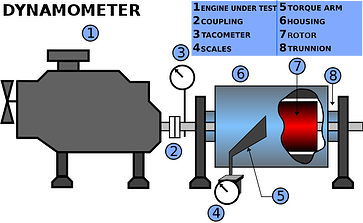
As we often find ourselves in everyday life, words ending in “-meter” indicate objects designed to quantify some measurement. We’ve seen this with the barometer, hygrometer, densimeter, and so on.
The term dynamometer comes from the Greek: δύναμις (dýnamis), meaning force or power, and μέτρον (métron), meaning measure. While we may know the language, it’s not necessarily a guarantee that we understand the underlying physics principles behind these measuring devices. There are actually two types of dynamometers today: digital and non-digital. And there are many more models beyond this point, some now obsolete but still part of science history.
Contents
1. What Does a Dynamometer Measure?
2. Digital Dynamometer
3. The β-Dynamometric Key
4. Dynamometers in Physics
5. Dynamic Balances
What does a dynamometer measure?
A dynamometer measures the magnitude of a force, which may seem like something difficult to grasp or mysterious, but it’s actually quite straightforward. The most common type of dynamometer is a simple device consisting of a spring placed inside a plastic or metal tube. If we apply a force, the spring extends and when it stops “stretched,” the measure shows the intensity of that applied force.
At its core, this design relies on Hooke’s Law, which ensures that the deformation of an elastic material is directly proportional to the force applied to it. This type of dynamometer is called elastic, but there are also levers and pendulum-based models less commonly used. In any case, the unit of measurement for a force can be Newtons, but also dynes or kilograms-force (kgf).
Digital Dynamometer
The digital dynamometer is often used as an electronic balance or luggage scale. They’re widely available at travel shops, such as airports, or online.
One popular model, which has over 20,000 positive reviews from users who have purchased it, stands out on Amazon with a price of just €14.99. This particular model is particularly appreciated for its simplicity and ease of use, allowing you to get instant weight measurements in both kilograms (kg) and pounds (lb).
The β-Dynamometric Key
When it comes to dynamometric keys, the most purchased one can be found on Amazon produced by the well-known brand Beta.
Here’s an image. Dynamometric keys have various measurements and are identified by a number on the handle, such as 606/10x in this case.
Amazon provides detailed technical information for each model so you can select the one that suits your needs most accurately.
In this case, the specifications include:
- Precision of serration ± 4%
- Operating range: Nm (20-100) – kgf (2-10) – lbf.ft (15-80)
- Attachment type from: 1/2 inch
- Crank width: 30 mm
- Crank thickness: 37 mm
- Key length: 345 mm
Dynamometers in Physics
In a more scientific context, discussing dynamometers and the forces we’re measuring should consider that when taking measurements, you compare an unknown force to known forces of intensity. This can be done either directly or indirectly.
Direct measurement is like using a balance scale, while indirect measurement involves a device such as a graduated cylinder with a spring connected to it.
To ensure accurate results, it’s essential to have a calibrated scale and perform calibration by applying known weights and measuring the corresponding deformations.
Dynamic Balances
When faced with a dynamometer that acts like a balance, it can be misleading. To avoid confusion, let’s emphasize that this type of device measures mass under gravitational acceleration, which means the “weight” we perceive is actually a force derived from gravity, not actual weight.
The measurement units are typically Newtons (N), rather than kilograms (kg).
Understanding Hooke’s Law
Hooke’s Law states that the force exerted by an elastic material when subjected to stress is directly proportional to the amount of stress applied. Mathematically, this can be expressed as:
F = kx
Where:
– F is the force exerted on the spring
– x is the displacement of the spring from its equilibrium position
– k is the spring constant (a measure of the stiffness of the spring)
In practice, Hooke’s Law works well for springs and other elastic materials that have a linear relationship between force and deformation. However, it does not account for non-linear relationships or the effects of temperature on elasticity.
The Importance of Calibration
Calibration is an essential aspect of using dynamometers. It ensures that the device accurately measures forces and provides reliable results. Calibration typically involves applying known weights or forces to the dynamometer and measuring the corresponding deformations.
To ensure accurate calibration, it’s crucial to follow proper procedures, such as:
- Ensuring the dynamometer is properly installed and aligned
- Applying known weights or forces in a consistent manner
- Measuring the deformations accurately using calibrated instruments
- Documenting the results and performing quality control checks
Applications of Dynamometers
Dynamometers have various applications across different fields, including:
- Mechanical Engineering: Dynamometers are used to measure forces and torques in mechanical systems, such as engines and gearboxes.
- Aerospace Engineering: Dynamometers are used to test the performance of aircraft and spacecraft components, such as engines and control surfaces.
- Biomechanical Engineering: Dynamometers are used to study the biomechanics of human movement, such as the force exerted by muscles on bones.
- Industrial Applications: Dynamometers are used in various industrial applications, such as testing machine tools and measuring forces in manufacturing processes.
Conclusion
In conclusion, dynamometers are an essential tool for measuring forces and understanding the underlying physics principles behind these measurements. By understanding how dynamometers work and their various applications, we can navigate everyday situations with confidence. Whether it’s a simple electronic balance or a complex mechanical system, dynamometers play a crucial role in ensuring accurate results and reliable performance.
In the future, advancements in technology will likely lead to more precise and efficient dynamometer designs, enabling researchers and engineers to push the boundaries of what is possible. As we continue to explore new frontiers in science and engineering, it’s essential that we appreciate the importance of dynamometers and their role in shaping our understanding of the world around us.


