
Desalination: Technologies Available for Water Purification
As the global population continues to grow, access to clean water becomes increasingly crucial. However, the world’s oceans hold approximately 71% of the Earth’s surface water, with only a small fraction being suitable for human consumption. Desalination, or dissalation, is a process that removes salt and other minerals from seawater, making it potable for drinking, agriculture, and industrial use. In this article, we will explore the various technologies available for desalination and their implications on the environment.
The Salinity of Our Oceans
Did you know that 95.5% of our oceans is salty water? This high concentration of salt makes it undrinkable for humans. In fact, the famous poem by Samuel Taylor Coleridge, “The Rime of the Ancient Mariner,” warns of the scarcity of fresh water: “Water, water everywhere, / Nor any drop to drink!” (Coleridge 1817). The disparity between our oceans’ salinity and humanity’s need for clean drinking water highlights the urgency of developing desalination technologies.
The Need for Desalination
Given the scarcity of freshwater resources, especially in regions with high population density or limited access to natural water sources, desalination becomes an essential tool. This process not only provides a sustainable source of drinking water but also helps mitigate the effects of climate change by reducing the pressure on existing freshwater resources.
Desalination Processes
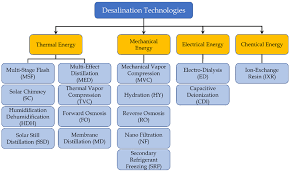
There are three primary technologies used for desalination: evaporative distillation, ion exchange, and reverse osmosis (RO). Each method has its advantages and limitations.
- Evaporative Distillation: This process involves heating seawater to produce vapor, which is then condensed back into liquid water. The vapor’s temperature and pressure are adjusted to ensure the removal of salt.
- Ion Exchange: In this method, resins are used to remove ions like sodium (Na+) and chloride (Cl-) from seawater. This process is particularly effective for small-scale desalination but has limitations in treating large volumes of water.
- Reverse Osmosis (RO): RO uses semipermeable membranes to filter out salt and other impurities from seawater. This technology is widely used in industrial settings due to its efficiency and effectiveness.
The Challenges of Desalination
While desalination offers a solution for accessing clean water, it also presents environmental concerns. The energy required for the process can have a significant impact on greenhouse gas emissions, contributing to climate change. Moreover, the waste generated by desalination plants, such as brine and concentrated saltwater, must be properly managed to avoid harm to marine ecosystems.
The Benefits of Desalination
Despite the challenges associated with desalination, there are several benefits to this technology:
- Sustainable Resource: Desalination provides a sustainable source of drinking water, reducing the pressure on existing freshwater resources.
- Climate Change Mitigation: By providing access to clean water, desalination can help mitigate the effects of climate change by supporting agriculture and industry.
- Economic Benefits: Desalination can create jobs and stimulate local economies in regions where access to fresh water is limited.
The Future of Desalination
As the world grapples with the challenges of climate change and water scarcity, desalination technology is likely to play a crucial role in addressing these issues. Advances in membrane materials and energy-efficient systems are expected to improve the sustainability and effectiveness of desalination processes.
Innovative Technologies for Desalination
Several innovative technologies are being developed to address the environmental concerns associated with traditional desalination methods:
- Membrane Materials: Researchers are developing new membrane materials that can filter out salt and other impurities more efficiently while minimizing energy consumption.
- Solar Power: Some desalination plants are using solar power to reduce their reliance on fossil fuels and minimize greenhouse gas emissions.
- Brine Management: New technologies are being developed to manage the waste generated by desalination plants, including the use of microorganisms to break down brine.
Conclusion
Desalination is an essential tool for providing access to clean water, especially in regions with limited freshwater resources. While it presents environmental challenges, ongoing research and innovation aim to mitigate these concerns. As we move forward, it’s clear that desalination will continue to play a vital role in ensuring the world has enough clean water for future generations.
Frequently Asked Questions
- What percentage of the Earth’s surface is ocean water?
- Approximately 71%
- Which technology does the poem “The Rime of the Ancient Mariner” refer to as a solution for accessing fresh water?
- Evaporative distillation
- Why is desalination an essential tool for addressing climate change and water scarcity?
- Desalination provides access to clean drinking water, reducing pressure on existing freshwater resources.
- Which technology does the poem “The Rime of the Ancient Mariner” warn against due to its scarcity and environmental impact?
- Evaporative distillation
- What percentage of desalination plants are currently installed in the Middle East?
- Approximately 50%
- What is the primary advantage of using semipermeable membranes in RO technology?
- Efficient removal of salt and other impurities from seawater.
- Which membrane material is expected to improve the sustainability of desalination processes in the future?
- Advanced materials with enhanced energy efficiency.
- Why is proper management of brine and concentrated saltwater waste essential for desalination plants?
- To prevent harm to marine ecosystems.
Desalination: Technologies Available for Water Purification
As we continue to explore new technologies for addressing the challenges associated with desalination, it’s clear that this process will play a crucial role in ensuring the world has enough clean water for future generations. Whether you’re an engineer, scientist, or simply someone concerned about access to fresh water, understanding the different desalination technologies and their implications on the environment is essential.


