
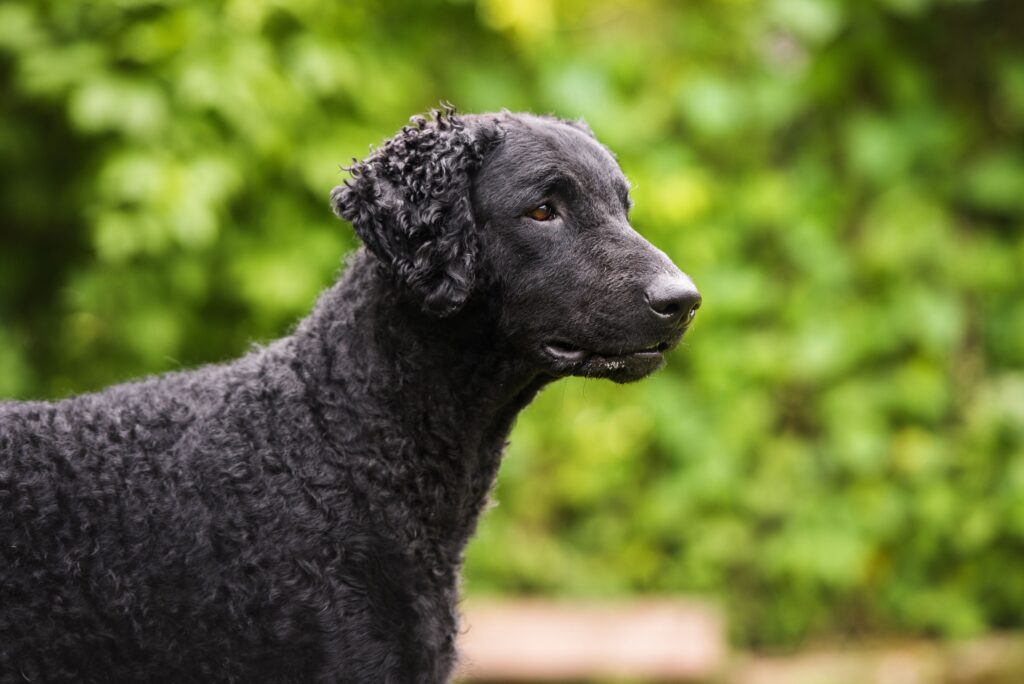
The Curly Coated Retriever, a name that means difficult but significant for the oldest of English retrievers. It is recognized by the FCI, and in the 19th century, it was highly utilized in the hunting industry, although today the corresponding smooth-coated Flat-Coated Retriever is preferred.
Origin of the Curly Coated Retriever
Being the oldest breed, finding its origins requires a lot of digging. Among its ancestors are likely the Newfoundland and Irish Water Spaniel, to whom our Curly Coated Retriever owes its distinctive curly coat. The Curly Coated Retriever can be seen as a descendant of the Barbone, which has ceded some of its hunting talent without asking for anything in return – the remaining curly coat.
According to historical records, the breed was first described by the British Kennel Club in 1860, and it gained popularity during the Victorian era. The Curly Coated Retriever was highly sought after as a hunting dog due to its exceptional tracking abilities and strong prey drive. However, with the rise of other breeds, such as the Flat-Coated Retriever, the popularity of the Curly Coated Retriever began to decline.
Declared and Undeclared Incrosciations
While there is evidence of declared incrosciations with Labrador, the Curly Coated Retriever remains unproven. This breed made its first appearance in official canine exhibitions in 1860 and welcomed its first club in 1896. Between the two World Wars, however, this breed enjoyed great popularity – a peak that soon followed by a collapse, placing it in a marginal position today.
The smooth-coated version is widely popular, while the curly-haired remains niche. The Curly Coated Retriever has also been crossed with other breeds to improve its hunting abilities and temperament, resulting in various hybrid breeds such as the Curly-Coated Retriever-Poodle or the Curly-Coated Retriever-Boston Terrier.
Physical Characteristics of the Curly Coated Retriever
The curly coat covers the entire body of the Curly Coated Retriever, including its tail, and is the characteristic that sets this dog apart from others, making it look proud. However, there are other reasons for this unique appearance: the robust and energetic physique makes it an excellent swimmer, a trait that has always been utilized in hunting alligators.
The Curly Coated Retriever is of medium size, with a height at the shoulder ranging from 67 cm (25.6 inches) for males to slightly less than that for females. The ideal weight range is between 32 and 36 kg (70-79 pounds). It has a confident gaze, attentive yet sweet eyes that are dark brown or dark tan, with small but well-proportioned nostrils.
The tail is black and fawn-colored with a distinctive “feather.” Its ears are relatively small, low-set, and carried near the head, similar to those of other Retrievers. The curly coat extends even to its ears, though it is moderately short.
Personality Traits of the Curly Coated Retriever
This breed is highly intelligent, and its nature as an old retriever dog makes it still more wise and capable of behavior. It has a social personality with a friendly and confident attitude towards humans. While being slightly egocentric, this dog shows sympathy: it must always stay at the center of attention from its owner.
Tendently, this breed is attached to only one person, requiring all the affection and attention it can get from them. However, if that person has family or other dogs, there are no problems whatsoever.
Exercise Needs
Caring for a Curly Coated Retriever requires patience but primarily focuses on its unique fur, which demands regular grooming, two-thirds of which is spazzolazione per settimana, with the rest requiring little to no effort. This dog needs daily physical exercise, which is typical for dogs in this category, including swimming, a trait that has always been used in hunting waterfowl.
In addition to swimming, the Curly Coated Retriever also benefits from long walks and playtime on land. It’s essential to provide mental stimulation through activities such as obedience training or scent work to prevent boredom and destructive behavior.
Price
It’s difficult to give an exact price range for a Curly Coated Retriever puppy today due to rarity. However, it is not an expensive breed once found; starting at around €300 without exaggeration. You will find yourself with a fantastic dog that can be used as a retriever or companion.
Conclusion
The Curly Coated Retriever is a great choice for hunting waterfowl due to its unique abilities and characteristics. It’s also suitable as a guard dog, thanks to its excellent sense of smell. Today, it’s gaining popularity as a family pet.
With proper care and attention, the Curly Coated Retriever can thrive as a beloved companion. Its loyalty and affectionate nature make it an ideal breed for families with children or individuals seeking a loyal canine friend.
Frequently Asked Questions
- Q: What is the origin of the Curly Coated Retriever?
A: The exact origins are unclear, but it’s believed that the breed descended from the Newfoundland and Irish Water Spaniel.
- Q: How do I care for my Curly Coated Retriever’s curly coat?
A: Regular grooming is necessary to prevent matting. Two-thirds of your time should be dedicated to spazzolate weekly, with additional efforts on its ears and tail.
- Q: Do Curly Coated Retrievers get along well with other pets or children?
A: This breed is very social and gets along great with families, even children, but requires individual attention from a specific person within the family.
- Q: How much exercise does a Curly Coated Retriever need?
A: A daily routine of swimming is necessary to keep them healthy.
- Q: What health problems might occur in this breed?
A: No major issues have been reported, but regular check-ups are always recommended.
- Q: Is the Curly Coated Retriever suitable as a guard dog?
A: Yes, due to its excellent sense of smell and tracking ability, it can make an effective guard dog.
- Q: How long does the average lifespan of this breed be?
A: The life span of this breed is typically around 10 years, depending on various factors such as diet and environment.
- Q: Is a Curly Coated Retriever considered rare or common?
A: This breed has relatively low popularity compared to other Retrievers but remains popular among enthusiasts for its unique characteristics.


