
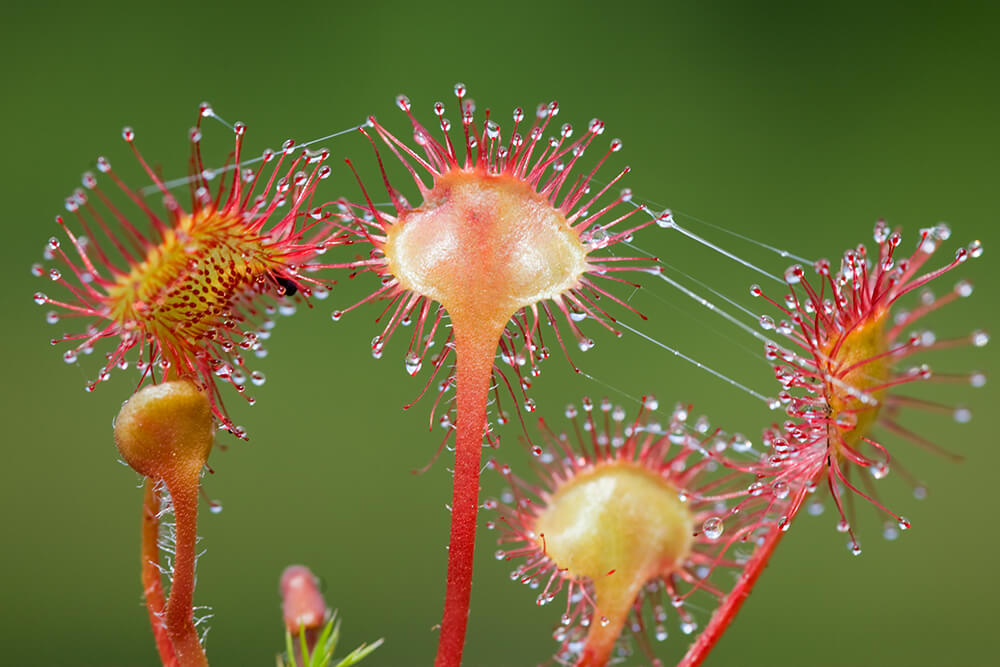
As you might think, a carnivorous plant like the Drosera is often associated with being a bad guy, but in reality, it has some very interesting properties that can benefit our health and well-being. Without any preconceptions, let’s dive into understanding this fascinating plant and learn how to cultivate it.
Content
- Drosera: Characteristics
- Drosera: Cultivation
- The Properties of Drosera in Homeopathy
- Varieties of Drosera
- Sowing Drosera Seeds
Drosera: Characteristics
For centuries, this carnivorous plant has been used as a remedy for respiratory infections and muscle tension. Its many species can be found throughout the world, but most are concentrated in Australia, South America, and Southern Africa. In Italy, we find the Rugiada del Sole, also known as Rotundifolia, which is rare and protected. To spot it, you’ll need to venture into the alpine meadows, up to 1600 meters high. During the summer, you might even catch a glimpse of its white flowers.
The Drosera’s unique appearance is striking, with colorful tentacles protruding from its leaves. These aren’t just decorative – they play a crucial role in capturing insects, which are then digested inside the plant’s leaves. The air-filled parts of the leaves contain glands that secrete a sticky substance to trap prey. The plant’s aerial part is rich in essential oils, naphthochinones, and flavonoids, making it ideal for producing natural remedies.
Drosera: Cultivation
If you were to cultivate Drosera, here’s how to do it. If you live in an area where winters are harsh, it’s best to keep the plant indoors or in a protected greenhouse. The Drosera requires plenty of light but not direct sunlight. To create a suitable substrate, mix equal parts of sand and peat moss, watering it with rainwater regularly. Be careful not to overdo it, as this can harm the roots.
To keep the substrate moist without overwatering, use a separate container filled with water. During the winter months, reduce watering and maintain high humidity levels by vaporizing water daily. When the plant enters its dormant phase, stop watering altogether, but monitor the moisture level to avoid dryness.
Properties of Drosera in Homeopathy
The Drosera is renowned for its ability to cure respiratory issues like bronchitis and coughs. Its active compounds, drosterone, naphthochinones, and flavonoids, work together to soothe muscle contractions in the smooth lining of bronchi, while also exhibiting antimicrobial properties that combat fungi and bacteria.
These same substances make Drosera an excellent ant-inflammatory agent, preventing new blood vessels from forming, which can aid in cancer prevention. Historically, people have used Drosera as an expectorant to treat respiratory issues, such as bronchitis, tracheitis, and pertussis. It has also been employed as a treatment for reumatism, arthritis, depression, and digestive disorders.
Varieties of Drosera
There are numerous species of Drosera, each with unique characteristics. The most common ones include:
- Drosera binata: Found in New South Wales, Australia, this variety grows up to 35 cm tall and features forked leaves.
- Drosera capensis: Native to South Africa, it is smaller than the previous one, growing no more than 15 cm high.
- Drosera spatulata: The smallest species, found in Australia, reaching a height of only 10 cm.
Sowing Drosera Seeds
To propagate Drosera, you’ll need to obtain seeds from reputable sources. Prepare a pot filled with a mixture of peat moss and perlite, water it, and gently press the seeds into the substrate. Keep the soil consistently moist until germination, which typically takes 15-20 days.
To encourage seedling growth, maintain high humidity levels by vaporizing water daily. As you know, carnivorous plants have adapted to capture insects alive; we want to avoid providing them with dead insects as food sources.
Homeopathic Preparations of Drosera
There are several ways to prepare homeopathic remedies from Drosera:
- Infusion: Steep 1-2 teaspoons of fresh Drosera leaves in boiling water for 10-15 minutes, then strain and cool.
- Decoction: Boil 1/4 cup of fresh Drosera roots or leaves in water for 5-7 minutes, then strain and cool.
- Tincture: Steep 1/4 cup of fresh Drosera roots or leaves in a solvent like ethanol or glycerin for several weeks, then filter and bottle.
Important Considerations
When using Drosera in homeopathy, it’s essential to consider the following:
- Contraindications: Do not take Drosera if you’re pregnant, breastfeeding, or taking certain medications.
- Dosage: Start with a low dose (1/4 teaspoon of fresh leaves infused in boiling water) and gradually increase as needed.
- Duration: Typically, use Drosera for 2-3 weeks before reassessing treatment.
By understanding these fascinating plants and their properties, we can appreciate the beauty of nature while harnessing its power for our health and well-being.
Frequently Asked Questions
- What are the benefits of Drosera in homeopathy?
- Drosera is used to treat respiratory issues like bronchitis, coughs, muscle tension, reumatism, arthritis, depression, digestive disorders, and even cancer prevention.
- How do I cultivate Drosera?
- To cultivate Drosera, you’ll need to provide it with plenty of light but not direct sunlight. Use a suitable substrate mix, water regularly, maintain humidity levels, and avoid overwatering.
- What is the recommended dosage for Drosera in homeopathy?
- For expectorants, a single spoonful of fresh Drosera leaves infused in boiling water can be consumed 4 times daily.
- Can I take Drosera if I’m taking certain medications or have specific health conditions?
- Consult with a healthcare professional before using Drosera, especially if you’re on corticosteroids, FANS, antidepressants, antitumor agents, or anti-coagulants.
- What are the potential risks of using Drosera?
- Overdosing on Drosera can lead to kidney issues, and direct contact with its sap can irritate your skin.
By asking these questions and understanding the properties of this incredible plant, you’re one step closer to harnessing the power of nature for a healthier lifestyle.


