
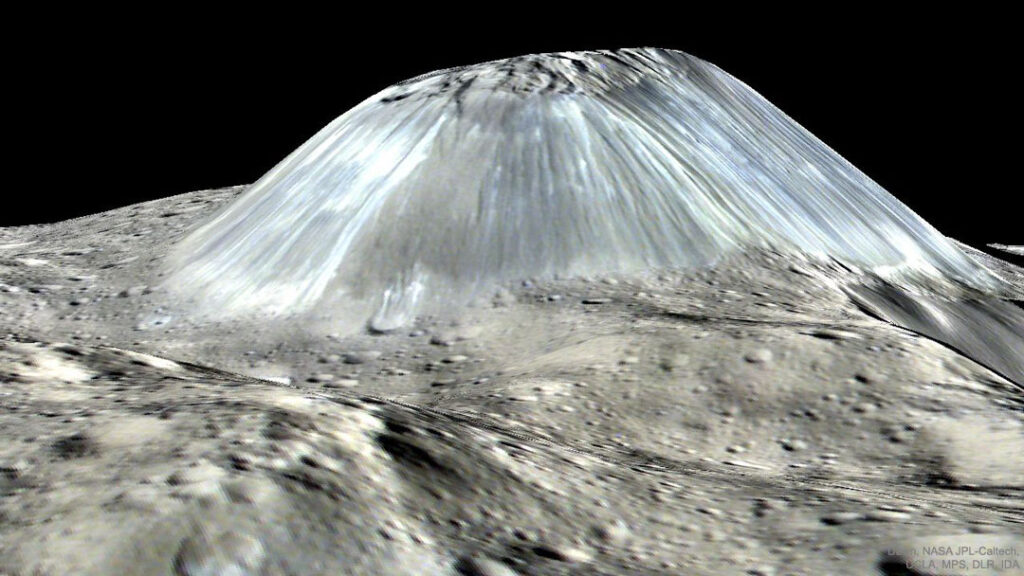
Deep within the realm of special effects that can be imagined in surrealist films, cryovolcanism actually occurs. It’s a unique eruption of water, ammonia, or methane compounds, rather than the usual lava we’re accustomed to seeing from volcanoes on Earth. In our own solar system, this special mixture, known as “criomagma,” is usually liquid but can also be in a gaseous state during eruptions.
What is Cryovolcanism?
Literally, a cryovulkanic volcano is an icy volcano, but when discussing cryovolcanism, we’re entering the realm of understanding various phenomena related to volcanic activity that have been observed on some icy bodies in our solar system. Specifically, cryovolcanism takes place on Encelado, Titan, and Triton.
This phenomenon doesn’t occur by chance; it requires a certain amount of energy to happen. This energy likely comes from the interaction between a natural satellite and its parent planet, typically a gas giant, but there are other theories as well.
Cryovolcanism on Saturn
Recently, the ESA (European Space Agency) observed an enormous water jet erupting from Encelado, one of Saturn’s moons. The team began to study what was captured and discovered that around Saturn is an ring of vaporized water fueled by this water jet coming from Encelado.
Encelado contributes significantly, expelling about 250 kg per second with various jets. This discovery has significant implications for our understanding of the geological processes occurring on Encelado and its parent planet, Saturn.
Cryovolcanism in the Solar System
Cryovolcanic activity has been observed on some icy bodies in our solar system. We might not be aware that all of them have these phenomena; they’re typically natural satellites of the outer solar system or objects in the Kuiper belt. The first observation of cryovolcani dates back to 1989 when flying over Triton, Neptune’s main moon.
Over time, similar phenomena have been observed on other icy bodies in the outer solar system, including Europa, Ganimede, Titan, and Encelado. In 2005, attention turned to Titan because the Cassini mission found a cryovulkanic activity on its surface, while also identifying geysers near Encelado’s southern polar cap.
Cryovolcanism on Pluto
On Pluto, NASA discovered what is believed to be the largest known cryovulkanic feature – Mons Wright. It was named after astronaut David R. Wright and stands at an impressive 4 km in height and 144 km long.
Mons Wright is not only large but also has a unique shape that is characteristic of cryovolcanoes, with a central vent surrounded by slopes that are indicative of volcanic activity. The discovery of this feature has significant implications for our understanding of Pluto’s geological history and the processes that shaped its surface.
Experimenting with Cryovolcanism
To better understand the mechanisms behind this phenomenon, numerous experiments are conducted using advanced technology and computer simulations. Due to these phenomena not occurring on Earth, scientists often rely on innovative approaches to study them.
Using advanced support, two American scientists successfully reproduced cryovulcanic eruptions on Encelado, potentially identifying the mechanism responsible for these events. This experiment has provided valuable insights into the processes that drive cryovolcanism and has shed light on the complex interactions between ice, water, and other volatiles in our solar system.
Cryovolcanism: A Liquid Ocean Beneath Encelado’s Surface
Underneath Encelado’s icy surface is a large ocean. When this ocean forms many narrow cracks or “tiger stripes,” geysers erupt, releasing vapor and ice particles into space. This is a typical cryovulcanic eruption.
The discovery of liquid water beneath Encelado’s surface has significant implications for our understanding of the moon’s geological history and the processes that shaped its surface. The presence of this ocean suggests that Encelado may have had a more complex internal structure than previously thought, with possible evidence of tectonic activity and volcanic processes.
Conclusion
Cryovolcanism might seem like the stuff of science fiction, but it’s a real phenomenon that occurs on icy bodies in our solar system. From Encelado to Pluto, these icy worlds have unique geological features that challenge our understanding of volcanology. As scientists continue to explore and study cryovolcanic phenomena, we may uncover new insights into the nature of our solar system.
Frequently Asked Questions (FAQs)
- What causes cryovolcanism?
Cryovolcanism is caused by the interaction between a natural satellite and its parent planet, typically a gas giant, or other factors like the presence of surface ice deposits that can create an “ice-solar” greenhouse effect.
- Where does cryovolcanism occur in our solar system?
Cryovolcanic activity has been observed on Encelado, Titan, Triton, Europa, Ganimede, and Pluto.
- What are the effects of cryovolcanism on a planet’s surface?
The effects can include the eruption of water vapor, ammonia, or methane compounds from the surface of an icy body, potentially creating geysers and affecting the surrounding environment.
- How is cryovolcanic activity studied?
Scientists use advanced technology, such as spacecraft and computer simulations, to study cryovolcanic phenomena in our solar system.
- What can we learn from studying cryovolcanism?
Studying cryovolcanism helps us better understand the geological processes occurring on icy bodies in our solar system, shedding light on their formation and evolution.
- Can cryovolcanism occur on other planets besides those with ice deposits?
While less common, cryovolcanic activity has been observed on some gas giants, suggesting that it might be more widespread than previously thought.
- What is the largest known cryovulkanic feature in our solar system?
Mons Wright on Pluto is currently recognized as the largest cryovulkanic feature, standing at 4 km high and 144 km long.
- Will future missions explore cryovolcanism further?
Upcoming space missions, such as those targeting the outer planets and their moons, will likely provide more insights into this phenomenon and its role in shaping our solar system’s geological history.
- How does cryovolcanism compare to traditional volcanic activity on Earth?
While both involve eruptions, cryovolcanic activity is unique due to the use of water vapor or other volatiles instead of molten rock.
- Can we expect to see more research on cryovolcanism in the future?
Yes, as scientists continue to explore and study our solar system’s icy bodies, they may uncover new insights into this phenomenon and its implications for our understanding of planetary formation and evolution.


