
Introduction
As we go about our daily lives, there are many natural phenomena that shape our environment and influence our experiences. One such phenomenon is the Coriolis effect, a fundamental concept in meteorology and physics that has far-reaching implications for various fields, including aviation, oceanography, and climate science. In this article, we will delve into the world of the Coriolis effect, exploring its definition, principles, applications, and importance.
What is the Coriolis Effect?
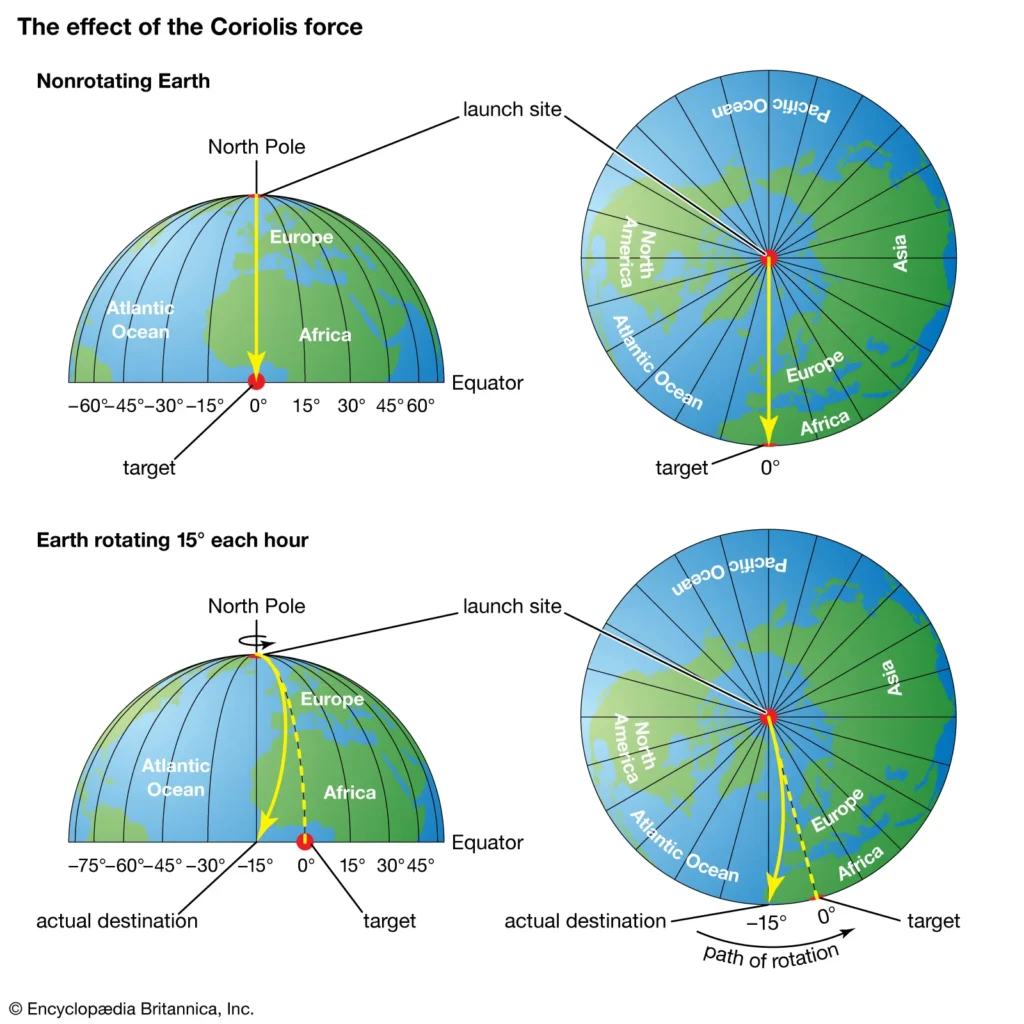
The Coriolis effect refers to the apparent deflection of moving objects on Earth due to the planet’s rotation. This phenomenon occurs when a body moves over the surface of the Earth, resulting in a change in direction that depends on its latitude. The Coriolis force acts perpendicular to the direction of motion and is responsible for the deflection of air masses, ocean currents, and other large-scale motions.
The Science Behind the Coriolis Effect
Every day, the Earth rotates around its axis, causing any point on its surface to move at a speed of 15° per hour. This means that, at a given latitude, an object will experience a velocity change as it moves towards or away from the pole. The rate of this change varies with latitude, with higher velocities occurring near the equator and lower velocities near the poles.
When an object is displaced from its original position, it experiences a force directed perpendicular to its motion. This force, known as the Coriolis force, causes the object’s trajectory to deviate from its intended path. The direction of this deflection depends on the hemisphere in which the object is moving: in the Northern Hemisphere, the Coriolis force deflects objects to the right, while in the Southern Hemisphere, it deflects them to the left.
The Relationship Between the Coriolis Effect and the Force of Coriolis
The Coriolis effect is closely related to the force of Coriolis, a fundamental concept in classical mechanics. The force of Coriolis acts on objects moving in a north-south direction on Earth’s surface, causing them to accelerate perpendicular to their motion. This force is responsible for the deflection of air masses and ocean currents.
The Impact of the Coriolis Effect on Aviation
Understanding the Coriolis effect is crucial for pilots and aircraft designers. The force affects the trajectory of flying objects, particularly when navigating across different latitudes. For example, a plane flying from equatorial regions to northern latitudes will experience a deflection to the right due to the Coriolis effect.
The Coriolis Effect in Meteorology and Oceanography
The Coriolis effect plays a significant role in shaping our weather patterns and ocean currents. It influences the direction of wind, atmospheric circulation, and marine currents, making it essential for predicting weather patterns and understanding global climate dynamics.
Applications of the Coriolis Effect
The Coriolis effect has numerous applications across various fields:
- Weather forecasting: Understanding the Coriolis effect helps meteorologists predict weather patterns, including high-pressure systems and low-pressure systems.
- Aviation: Pilots must consider the Coriolis effect when navigating across different latitudes to ensure accurate flight trajectories.
- Oceanography: The Coriolis effect influences ocean currents, which in turn affect global climate patterns.
Misusing the Coriolis Effect
There are various devices that utilize the Coriolis effect for measuring fluid flow. These include flow meters and mass flow meters, which use the deflection of a moving object to calculate the fluid’s velocity and density.
Real-World Examples
- Hurricane Formation: The Coriolis effect plays a crucial role in hurricane formation and intensity. Hurricanes form over warm ocean waters, where the Coriolis force helps steer them towards land.
- Global Wind Patterns: The Coriolis effect influences global wind patterns, including trade winds and westerlies. These winds help shape our climate and weather patterns.
- Ocean Currents: The Coriolis effect plays a significant role in shaping ocean currents, which are responsible for transporting heat and nutrients around the globe.
Frequently Asked Questions (FAQs)
- What causes the Coriolis effect?
- The Coriolis effect is caused by the deflection of moving objects on Earth due to its rotation.
- How does the Coriolis effect affect weather patterns?
- The Coriolis effect influences the direction of wind and atmospheric circulation, making it essential for predicting weather patterns.
- What are some applications of the Coriolis effect in aviation?
- Pilots must consider the Coriolis effect when navigating across different latitudes to ensure accurate flight trajectories.
- Can the Coriolis effect be measured using devices?
- Yes, there are various devices that utilize the Coriolis effect for measuring fluid flow, such as flow meters and mass flow meters.
- How does the Coriolis effect influence ocean currents?
- The Coriolis effect influences ocean currents, which in turn affect global climate patterns.
Conclusion
The Coriolis effect is a fundamental concept that has far-reaching implications for various fields. Understanding its principles, applications, and importance can help us better appreciate the complex interactions between Earth’s rotation and large-scale motions.
Further Reading
- “Coriolis Effect” by NASA
- “The Coriolis Force” by Physics.org
- “The Role of Coriolis in Weather Patterns” by American Meteorological Society
Stay up-to-date with our latest articles by following us on social media: Twitter, Facebook, Google+, Instagram


