
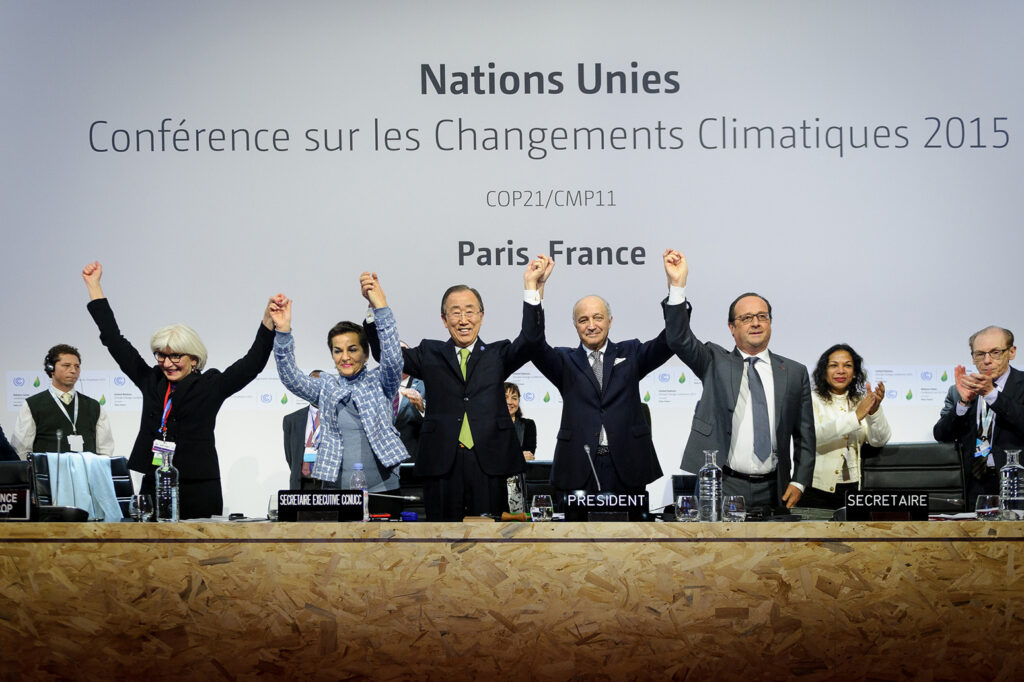
After the historic agreement signed by over 190 countries in December last year in Paris, what can we expect? Leaving aside utopian hopes but also avoiding a destructive skepticism without any sense of reality and dictated only by past delusions, we can respond to this question by not saying anything. And reading the excellent eBook “The World After Paris: The Climate Accord Seen from Italy” (Ambiente Edizioni, 4.99 euros).
Emanuele Bompan and Sergio Ferraris, the authors, far from thinking they have the science infused within them, with great selection and initiative spirit never tainted by trying to impose an opinion, have collected essays on the Paris Agreement, written by politicians, activists, and scholars, representatives of social organizations and parties. Each one responds to the question: COP21: The World After Paris, will it change? Will it change because some people doubt this?
Some see the agreement as a compromise at the lowest level, while others are convinced that, just two steps from the Eiffel Tower, in the City of Light, the first step was taken towards a global revolution. Presented during the recently concluded International Book Fair of Torino, in the Fima area, the eBook has created the opportunity for the authors to tell their vision of COP21: The World After Paris.
According to Bompan, “it’s been a historic turning point,” but “consequently, it’s not just about words”: if the agreement is ratified, “the entire industrial system must change radically.” Those who are skeptical or prudent will note that each signing country has kept the possibility of choosing their own strategies for reducing emissions: there is no predetermined plan to follow obligatorily today. But couldn’t this be better? Bompan insinuates the doubt, recalling that “more rigid international agreements, like the Kyoto Protocol, have so far not reached expected goals.”
So, we also have a task, because “in this process of adaptation and continuous negotiation, civil society will play a fundamental role in forcing governments to not retreat. Especially if they are ready to sanction them when they don’t do enough.”
Civil society, us included, how much do we know about COP21: The World After Paris? And above all, how can we be more aware and conscious of the problem? It’s only natural to wonder, given that we have to take on the role of “guard dogs” towards governments. Therefore, we also need to address the issue of communication.
Who has the courage to contradict Bompan when he says that climate change is considered a “not sexy” topic, uninteresting for those in the field? However, and although Bompan is not alone in this effort, he is determined to continue creating a story that will engage everyone, from ski instructors to housewives, explaining how temperature increases will have a devastating impact on our daily lives.
Even Marco Fratoddi has intervened on the topic of environmental communication as Secretary General of FIMA, recalling that it’s not only for COP21: The World After Paris but also and above all, given the current urgency of the problem, “it’s up to us to make sure the opportunity of the Paris Agreement is fully seized by going beyond specialist narration and trying to build a mainstream around these themes. This is the ninth proof for this generation of environmentalists and even journalists.”
Marco Fratoddi and Emanuele Bompan at the Book Fair in Torino to present “The World After Paris”
No one should be surprised that critics and observations are not missing towards the ruling class who perhaps hoped to leave without any “to-do” on the topic: COP21: The World After Paris.
In the publication of Edizioni Ambiente, as among the Italian population and worldwide, there is no one who thinks that governments do not perceive the drama of the problem or do not want to do it. Bompan, beyond pointing a finger at those who are less attentive at the top, also points to positive signs on the same aspect of the problem that COP21: The World After Paris highlights.
The first, China: “after years of indifference, has decided to act both because its levels of pollution have become intolerable and because it has understood that green technologies are an economic opportunity.” The second, China to CIA: the former director said that climate change is the challenge of the century recalling that “we will soon have to accept 100 million environmental refugees.”
We cannot forget the role of India in COP21: The World After Paris. This country “will soon surpass China as a major polluter,” Bompan recalls – and has decided to sign the Paris Agreement despite being led by a government that is always close to the world of fossil fuel producers.
At the risk of forgetting what happens at home, taken up in other debates. How can we not see that it’s just us, the undersigned, who are falling behind, at least from the political point of view? After a long period of slowing down, our emissions have started to grow again in the last year, meanwhile “the executive has made wrong policy choices, such as the retroactive elimination of incentives” explains Bompan with elegant but realistic clarity: “I don’t think it’s due to a conscious choice, but rather because Matteo Renzi did not put this theme at the top of his political agenda.”
If we want to have an idea of how COP21: The World After Paris will be interpreted and accepted by various countries around the world, let’s take a look at what China thinks about it. “We are committed to reducing our carbon emissions,” said the Chinese Environment Minister.
On the other hand, we see a very different reaction from Russia. The country has refused to sign the agreement because, according to their government, it is too restrictive.
But what does this mean for Italy? According to Emanuele Bompan, “we are in the middle of a climate emergency.” And also the Italian Environmental Ministry has highlighted that Italy needs to take action quickly and decisively.
To better understand COP21: The World After Paris, we need to look at it from different angles. What does this agreement mean for us? How will it affect our daily lives?
The impact of COP21: The World After Paris on our daily lives is not an easy topic to discuss. We are all caught up in the complexities and intricacies of politics, economics, and environmental issues.
However, let’s try to simplify things a bit. Imagine that you live in a city that is constantly plagued by pollution, noise, and overcrowding. You can’t even step outside without being hit with toxic fumes or suffocated under the weight of smog.
This is what climate change looks like on our planet. The effects are already visible today, but they will only become more pronounced in the coming decades if we don’t take drastic action to reduce our carbon emissions and transition to renewable energy sources.
In this context, COP21: The World After Paris becomes a crucial turning point. Will we seize this opportunity to create a better future for ourselves and future generations?
COP21: The World After Paris is not just about the environment; it’s also about politics, economics, social justice, and human rights. It’s a complex issue that requires careful consideration and analysis.
However, what COP21: The World After Paris does offer us is hope. Hope for a world where we can live in harmony with nature, where our air is clean, our water is pure, and our climate is stable.
In conclusion, COP21: The World After Paris represents a significant step forward in the fight against climate change. It’s not a panacea, but it’s a start.
As Emanuele Bompan has said, “the agreement is not a solution by itself, but rather the first step towards a global revolution.” And we must continue to push for more ambitious action from governments and corporations around the world.
We have no choice. The clock is ticking, and the fate of our planet depends on it.
If you enjoyed this article, continue to follow me also on Twitter, Facebook, Google+, Pinterest and… elsewhere, find me!
If you’re interested in exploring COP21, I’ve talked about it in the article “Paris Climate Agreement: What Does It Preclude?”
You might also like the book I reviewed: “Two Degrees: Winning the Climate Challenge Even with Economy.”
Another related article of ours that may interest you is dedicated to Environmental Journalists.
You might also find the World Weather Day interesting.


