
Introduction
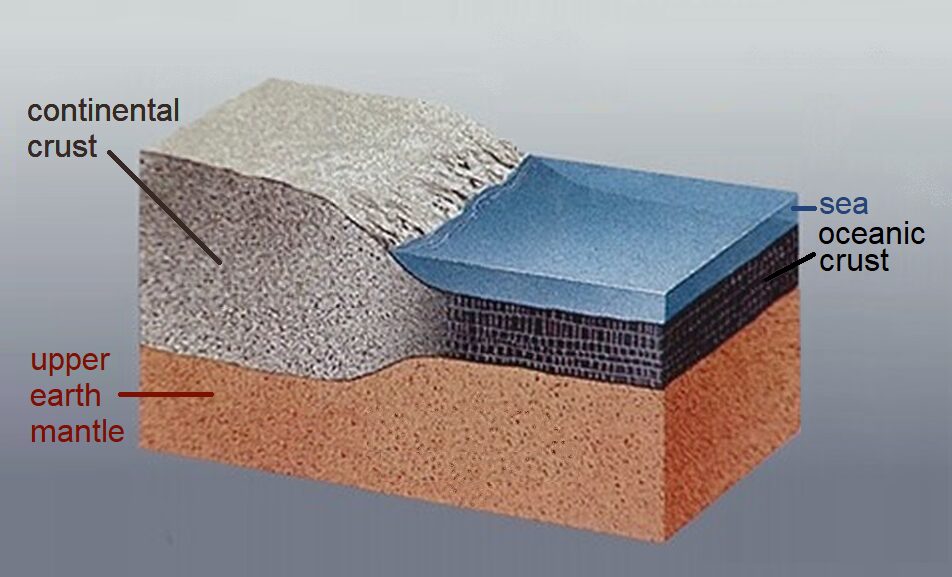
The Earth’s surface is composed of two distinct layers: the continental crust and the oceanic crust. These two crusts are often referred to as the uppermost part of the solid Earth, and their unique characteristics have captivated scientists for centuries. In this article, we will delve into the world of crustal formation, composition, and evolution, exploring the fascinating history behind these two layers.
What is the Continental Crust?
The continental crust is a dense, solid layer that covers about 30% of the Earth’s surface. It has a thickness ranging from 35 km to 90 km, with an average thickness of around 70 km. This crust is characterized by its low density, primarily due to the presence of granitic rocks, which are composed mainly of quartz, feldspar, and mica minerals.
The continental crust is further divided into several sub-layers, each with distinct characteristics:
- Upper Crust: The upper crust is the outermost layer of the Earth’s surface, interacting with both the atmosphere and hydrosphere (the water component). This interface plays a crucial role in shaping our planet’s climate and weather patterns.
- Middle Crust: The middle crust is characterized by its high porosity and the presence of hydrothermal veins. These veins are formed when hot water rich in minerals flows through the rocks, depositing minerals and creating economic deposits such as copper, lead, and zinc.
- Lower Crust: The lower crust is a thick, rigid layer that underlies the continental crust. This region is characterized by its high temperature and pressure, which causes it to deform over time.
What is the Oceanic Crust?
In contrast, the oceanic crust is a thinner layer, ranging from 0 to 10 km in thickness. It has a higher density than the continental crust, due to its composition of ultrabasic and basic rocks. The oceanic crust also features a unique feature called the “scarped continental edge,” where it meets the continental crust.
The oceanic crust is formed through a process known as seafloor spreading, which occurs at mid-ocean ridges. At these ridges, magma from the Earth’s mantle rises to the surface and solidifies into new oceanic crust, pushing older crust away from the ridge.
The Transition Zone
As we move from the continental crust to the oceanic crust, we encounter the transition zone, characterized by a sudden change in rock composition and density. This zone marks the boundary between the two crusts and is an area of significant geological interest.
The transition zone is also home to hydrothermal systems, which are formed when hot water rich in minerals flows through the rocks, depositing minerals and creating economic deposits such as copper, lead, and zinc.
Plate Tectonics
Plate tectonics is a theory that explains how the Earth’s surface has changed over time. According to this theory, the Earth’s surface is divided into several large plates that move relative to each other. These plates can interact in various ways, including:
- Divergent motion: Plates move apart from each other, resulting in the formation of new crust.
- Convergent motion: Plates collide with each other, resulting in subduction (the sinking of one plate beneath another).
- Transform motion: Plates slide past each other horizontally.
The Upper Crust: Atmosphere and Hydrosphere Interface
The upper crust is the outermost layer of the Earth’s surface, interacting with both the atmosphere and hydrosphere (the water component). This interface plays a crucial role in shaping our planet’s climate and weather patterns.
The upper crust is characterized by its high porosity and the presence of hydrothermal veins. These veins are formed when hot water rich in minerals flows through the rocks, depositing minerals and creating economic deposits such as copper, lead, and zinc.
The Lower Crust: A Window into the Mantle
Beneath the continental crust lies a thick, rigid layer known as the lithosphere. This is followed by the asthenosphere, a region of partially molten rock that can flow over time.
The lower crust is also characterized by its unique composition, featuring rocks such as eclogites and gabbros. These rocks are formed through a process known as partial melting, which occurs when the rocks are subjected to high temperatures and pressures.
Extension and Thickness
While the continental crust covers about 30% of the Earth’s surface, it does not account for all of the landmasses on our planet. In fact, the total area of continents and islands combined is significantly smaller than oceanic areas, which cover approximately 70% of the Earth’s surface.
Density: A Key to Understanding Crustal Composition
The density of the continental crust can be determined by analyzing its composition. The majority of rocks in this layer are oxides, with only a small percentage (less than 1%) containing chlorides, sulfates, and fluorides. Silica (SiO2), aluminum oxide (Al2O3), calcium oxide (CaO), potassium oxide (K2O), iron oxide (FeO), and sodium oxide (Na2O) are the most common oxides present in this layer.
Conclusion
The continental crust and oceanic crust are two fascinating layers that make up our planet’s surface. Understanding their unique characteristics, composition, and evolution is crucial for advancing our knowledge of the Earth’s history and future. By exploring these topics further, we can gain a deeper appreciation for the complex processes that shape our world.
Frequently Asked Questions
- What is the main difference between the continental crust and oceanic crust?
The main difference lies in their thickness, composition, and density, with the oceanic crust being thinner and denser than the continental crust. - Why does the continental crust have a lower density than the oceanic crust?
The presence of granitic rocks in the continental crust contributes to its low density, while the oceanic crust’s composition of ultrabasic and basic rocks increases its density. - What is the significance of the transition zone between the continental and oceanic crusts?
This zone marks a significant change in rock composition and density, making it an area of great geological interest. - How does the upper crust interact with the atmosphere and hydrosphere?
The upper crust plays a crucial role in shaping our planet’s climate and weather patterns through its interaction with both atmospheric and hydrospheric components. - What can we learn from studying the lower crust?
Studying the lower crust provides insights into the Earth’s mantle and lithosphere, helping us understand geological processes such as plate tectonics and seismology. - How does the density of the continental crust affect its composition?
The majority of rocks in this layer are oxides, with only a small percentage containing chlorides, sulfates, and fluorides, contributing to its low density. -
What is the relationship between the continental crust’s thickness and its extension?
While the total area of continents and islands combined is smaller than oceanic areas, the continental crust itself covers about 30% of the Earth’s surface. -
Can we use the density of the continental crust to infer its composition?
Yes, by analyzing the density of this layer, we can gain insights into its composition, including the presence of oxides and other minerals. - How does the oceanic crust affect plate tectonics?
The oceanic crust plays a significant role in plate tectonic processes, influencing the movement of tectonic plates and the formation of mountain ranges. -
What are some potential applications of studying the continental crust and oceanic crust?
Understanding these layers can help us better comprehend geological processes, including natural disasters like earthquakes and tsunamis, as well as provide insights into the Earth’s internal structure and evolution. -
How does the formation of new crust affect the climate and weather patterns on Earth?
The formation of new crust through seafloor spreading has a significant impact on the climate and weather patterns on Earth. This process contributes to the creation of ocean currents, which in turn influence regional climates. -
Can we use geological data to predict natural disasters such as earthquakes and tsunamis?
Yes, by analyzing geological data and understanding the processes that shape our planet’s surface, we can gain insights into the likelihood of natural disasters occurring in a particular area. -
How does the movement of tectonic plates affect the distribution of landmasses on Earth?
The movement of tectonic plates has played a significant role in shaping the distribution of landmasses on Earth. This process has led to the creation of mountain ranges, oceanic trenches, and other geological features that are essential to understanding the planet’s surface. -
Can we use geophysical data to infer the composition and structure of the Earth’s mantle?
Yes, by analyzing geophysical data such as seismic velocities and magnetic field measurements, we can gain insights into the composition and structure of the Earth’s mantle. - How does the study of the continental crust and oceanic crust contribute to our understanding of the Earth’s internal structure?
The study of the continental crust and oceanic crust provides valuable insights into the Earth’s internal structure, including the distribution of heat and density within the planet.


