
Introduction
Chromatography is a powerful analytical technique used to separate, identify, and quantify the components of a mixture. In this article, we will explore chromatography on column, also known as high-performance liquid chromatography (HPLC), and its applications in various fields.
What is Chromatography on Column?
Chromatography on column is a technique that separates mixtures based on the interaction between the components and a stationary phase. The mixture is passed through a column filled with a stationary phase, which selectively absorbs or interacts with certain components, allowing them to separate from others.
Types of Chromatography on Column
There are several types of chromatography on column, including:
- Cation Exchange Chromatography (CEC): This type of chromatography uses a cation exchange resin as the stationary phase. CEC is commonly used for analyzing ions and charged molecules.
- Anion Exchange Chromatography (AEC): This type of chromatography uses an anion exchange resin as the stationary phase. AEC is commonly used for analyzing anions and negatively charged molecules.
- Size-Exclusion Chromatography (SEC): This type of chromatography separates molecules based on their size. SEC is commonly used for analyzing polymers, proteins, and other biomolecules.
- Affinity Chromatography: This type of chromatography separates molecules based on their affinity for a specific ligand. Affinity chromatography is commonly used for analyzing proteins, antibodies, and other biomolecules.
How Does Chromatography on Column Work?
The process of chromatography on column involves the following steps:
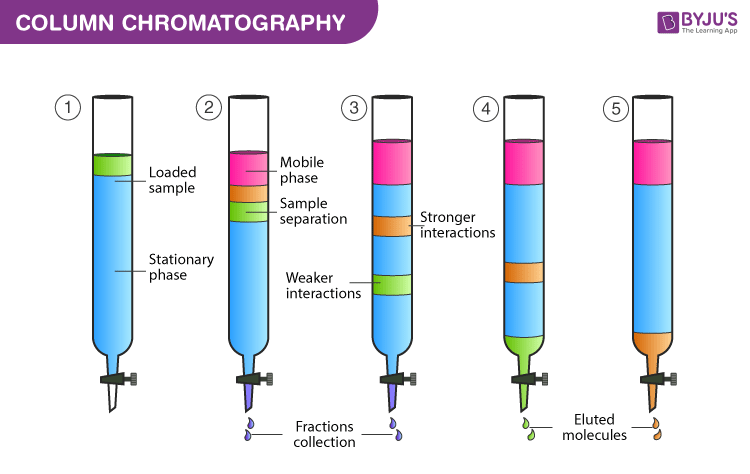
- Preparing the stationary phase: The stationary phase is prepared by loading it into a column.
- Preparing the mobile phase: The mobile phase is prepared by dissolving the mixture in a solvent.
- Loading the sample: The sample is loaded onto the top of the column.
- Separating the components: The mixture is passed through the column, allowing the components to separate based on their interaction with the stationary phase.
- Collecting the fractions: The separated components are collected in fractions.
Advantages and Applications of Chromatography on Column
Chromatography on column has several advantages, including:
- High resolution: Chromatography on column can provide high-resolution separations of mixtures.
- Flexibility: Chromatography on column can be used to separate a wide range of molecules.
- Speed: Chromatography on column is relatively fast compared to other analytical techniques.
- Sensitivity: Chromatography on column can detect small amounts of molecules.
Some common applications of chromatography on column include:
- Pharmaceutical analysis: Chromatography on column is widely used in pharmaceutical analysis to separate and identify the components of drug samples.
- Biological research: Chromatography on column is used in biological research to separate and analyze biomolecules such as proteins and nucleic acids.
- Environmental monitoring: Chromatography on column is used in environmental monitoring to detect and quantify pollutants in water and air.
- Food safety testing: Chromatography on column is used in food safety testing to detect contaminants and adulterants in food products.
Conclusion
Chromatography on column is a powerful analytical technique used to separate, identify, and quantify the components of a mixture. Its applications are diverse and include pharmaceutical analysis, biological research, environmental monitoring, and food safety testing.
Frequently Asked Questions (FAQs)
- Q: What is chromatography on column?
- A: Chromatography on column is an analytical technique used to separate, identify, and quantify the components of a mixture.
- Q: How does chromatography on column work?
- A: The process involves preparing the stationary phase, mobile phase, loading the sample, separating the components, and collecting the fractions.
- Q: What are the advantages of chromatography on column?
- A: Chromatography on column provides high-resolution separations of mixtures, is flexible in its applications, and can detect small amounts of molecules.
- Q: How is chromatography on column used in pharmaceutical analysis?
- A: Chromatography on column is widely used in pharmaceutical analysis to separate and identify the components of drug samples.
- Q: What are some common applications of chromatography on column?
- A: Chromatography on column has diverse applications, including pharmaceutical analysis, biological research, environmental monitoring, and food safety testing.
Tips for Using Chromatography on Column
- Choose the right stationary phase: Select a stationary phase that is compatible with the sample being analyzed.
- Select the right mobile phase: Choose a mobile phase that is suitable for the separation of the components of interest.
- Optimize the column temperature: Adjust the column temperature to optimize the separation of the components of interest.
- Monitor the chromatogram: Carefully monitor the chromatogram to ensure that all components are separated and detected.
Troubleshooting Common Issues with Chromatography on Column
- Poor resolution: Check the stationary phase, mobile phase, and column temperature to optimize the separation of the components of interest.
- Contamination: Check for contamination in the sample and equipment to prevent interference with the analysis.
- Inadequate detection: Adjust the detector settings or choose a more sensitive detector to improve detection of the components of interest.
Conclusion: The Future of Chromatography on Column
Chromatography on column is a powerful analytical technique that continues to evolve and improve. As new technologies emerge, chromatography on column will remain an essential tool for separating, identifying, and quantifying the components of complex mixtures.


