
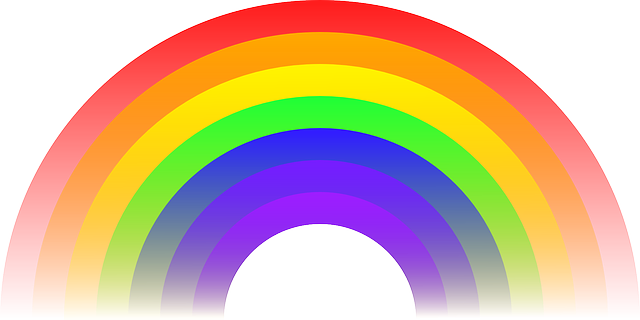
Are there six or seven colors in the rainbow? This is a question that has puzzled many for centuries, and while it may seem like a trivial matter, the answer lies at the intersection of physics and perception. In this article, we will delve into the world of optics and explore the science behind the colors of the rainbow.
What are the Colors of the Rainbow?
The colors of the rainbow are a result of a phenomenon known as refraction, where light passes through water droplets in the air and is split into its individual colors. This process occurs when sunlight enters a droplet of water at an angle of approximately 42 degrees, causing the light to be refracted, or bent, as it passes through the droplet.
Refraction is the bending of light as it passes from one medium to another with a different optical density. When light travels from air into water, it slows down and bends towards the normal, or perpendicular line. This bending causes the light to split into its individual colors, which we perceive as a band of colors in the sky.
A Brief History of the Rainbow
The study of the rainbow dates back to ancient civilizations, with the Greek philosopher Aristotle being one of the first to describe the phenomenon. However, it was not until the 17th century that Isaac Newton conducted extensive research on the subject, publishing his findings in his book “Opticks.” Newton’s work laid the foundation for our modern understanding of the rainbow and its colors.
Newton’s experiments involved shining sunlight through a prism, which split the white light into its individual colors. He then observed that these colors appeared in the same order as they do in the rainbow: red, orange, yellow, green, blue, indigo, and violet. This was a major breakthrough in understanding the nature of light and color.
The Colors of the Rainbow: Which Ones?
Newton initially identified five colors in the rainbow: red, yellow, green, blue, and violet. However, in 1666, he introduced a sixth color, indigo, which is now widely accepted as part of the rainbow spectrum. Some argue that there are actually seven colors, with indigo being the seventh.
The debate over whether there are six or seven colors in the rainbow is largely a matter of terminology and perception. While Newton’s original identification of five colors was based on his experiments, modern spectroscopy has confirmed that there are indeed seven distinct colors in the visible spectrum: red, orange, yellow, green, blue, indigo, and violet.
The Science Behind the Colors
So, why do we see different colors in the rainbow? It all comes down to the angle at which light enters the water droplet. When sunlight enters a droplet at an angle of 42 degrees, it is refracted, or bent, and split into its individual colors. The different angles of incidence determine the colors that we perceive.
This phenomenon is known as dispersion, where light is split into its individual colors based on their wavelengths. The longer wavelengths of light, such as red and orange, are refracted less than the shorter wavelengths of light, such as violet and blue. This creates the characteristic band of colors in the sky that we know as a rainbow.
Rainbow Variations
Did you know that there are variations of the rainbow? One such variation is the moonbow, also known as a lunar rainbow, which occurs when the Moon is full and is shining brightly in the sky. Another variation is the secondary rainbow, which appears outside the primary rainbow and has colors that are inverted.
The secondary rainbow is formed by light that is reflected twice off the back of the water droplet before it reaches our eyes. This creates a fainter, second band of colors that is outside the primary rainbow. The colors of the secondary rainbow are also inverted compared to those of the primary rainbow, with red on the outside and violet on the inside.
Imagining the Colors
When we look at images of rainbows, it can be difficult to tell whether there are six or seven colors. However, by examining the way that light interacts with water droplets, we can gain a deeper understanding of the science behind these beautiful natural phenomena.
By studying the refraction and dispersion of light as it passes through water droplets, we can see how the different angles of incidence determine the colors that we perceive. This knowledge allows us to visualize the rainbow in a more precise way, taking into account the complex interactions between light, water, and air.
The Indigo Enigma
Indigo is a color that has fascinated humans for centuries. Not only is it part of the rainbow spectrum, but it also has a rich cultural and symbolic significance in many societies. From its use as a natural dye to its appearance on traditional clothing and textiles, indigo is a color that commands respect.
In ancient Egypt, indigo was used to dye royal robes and other important garments. In many African cultures, indigo is still considered a sacred color, representing spiritual growth and enlightenment. The indigo dye has also been used in medicine for centuries, with its antibacterial properties making it an effective treatment for wounds and skin conditions.
Why Does the Rainbow Form?
So, when does the rainbow form? It occurs when there are specific conditions in the atmosphere, such as after a storm or during periods of high humidity. The ideal time for viewing a rainbow is typically early morning or late afternoon, when the sun is at an angle that creates the optimal conditions for refraction.
Rainbows can also occur at night, but this is much less common and requires very specific conditions, such as a lunar eclipse or a volcanic eruption. In these cases, the moonlight passing through water droplets in the air can create a faint, lunar rainbow.
Conclusion
The colors of the rainbow are a source of endless fascination and wonder. From their scientific explanation to their cultural significance, the rainbow is a phenomenon that has captivated human imagination for centuries. By understanding the science behind these beautiful natural wonders, we can gain a deeper appreciation for the intricate dance of light and water that creates them.
FAQs
- What are the colors of the rainbow?
The colors of the rainbow are typically listed as: red, orange, yellow, green, blue, indigo, and violet. - Are there six or seven colors in the rainbow?
While Newton initially identified five colors, he later introduced a sixth color, indigo, which is now widely accepted as part of the rainbow spectrum. Some argue that there are actually seven colors, with indigo being the seventh. - What causes the colors of the rainbow?
The colors of the rainbow are caused by refraction and reflection of light as it passes through water droplets in the air. - When does the rainbow form?
Rainbows typically form after a storm or during periods of high humidity, when the sun is at an angle that creates optimal conditions for refraction. - What is the moonbow?
The moonbow, also known as a lunar rainbow, is a variation of the rainbow that occurs when the Moon is full and is shining brightly in the sky. - How does the secondary rainbow form?
The secondary rainbow forms outside the primary rainbow and has colors that are inverted due to a second reflection off the back of the water droplet. - What is the significance of indigo?
Indigo is a color with significant cultural and symbolic meaning, used as a natural dye and appearing on traditional clothing and textiles in many societies.
Additional Tips for Viewing Rainbows
If you’re lucky enough to spot a rainbow in person, here are some additional tips for maximizing your viewing experience:
- Find a location with minimal cloud cover and ideally in the early morning or late afternoon when the sun is at an angle of 42 degrees.
- Look for water droplets in the air, such as after a storm or during periods of high humidity.
- Be patient and wait for a few minutes to allow the rainbow to form.
- Bring a camera with a wide-angle lens to capture the beauty of the rainbow.
- Consider using binoculars or a telescope to get a closer look at the rainbow.
By understanding the science behind the colors of the rainbow, we can appreciate these natural wonders in a more precise way. Whether you’re witnessing a rare lunar rainbow or simply gazing at a traditional rainbow, the beauty and magic of optics will continue to captivate our imagination for centuries to come.



