
Coastal erosion, a “disease” very Italian because our country is full of coastlines that are not always properly cared for. This phenomenon is only partially due to natural, climatic, and environmental factors. Human beings, the inhabitants of the territory that faces the sea, often do not take into account coastal erosion and its potential consequences.
Year after year, decade after decade, we find ourselves with a changed landscape and worse than before. Coastal erosion means the retreat of the coastline, which is linked to numerous meteorological, geological, biological, and anthropogenic factors. Before human arrival, it was mainly due to climate, but today the balances have changed.
What is Coastal Erosion?
When we talk about coastal erosion, we mean the retreat of the shoreline. This means that beach surfaces decrease and year after year we find ourselves with less beach. It’s not just an optical effect or a nostalgic feeling; it’s the real consequence of coastal erosion.
Imagine walking on a beach where once you found beautiful sand, but now there is only sand dunes or rocky shores left. Or imagine your favorite beach that has disappeared in front of your eyes. This is what happens when coastal erosion takes over.
Causes of Coastal Erosion
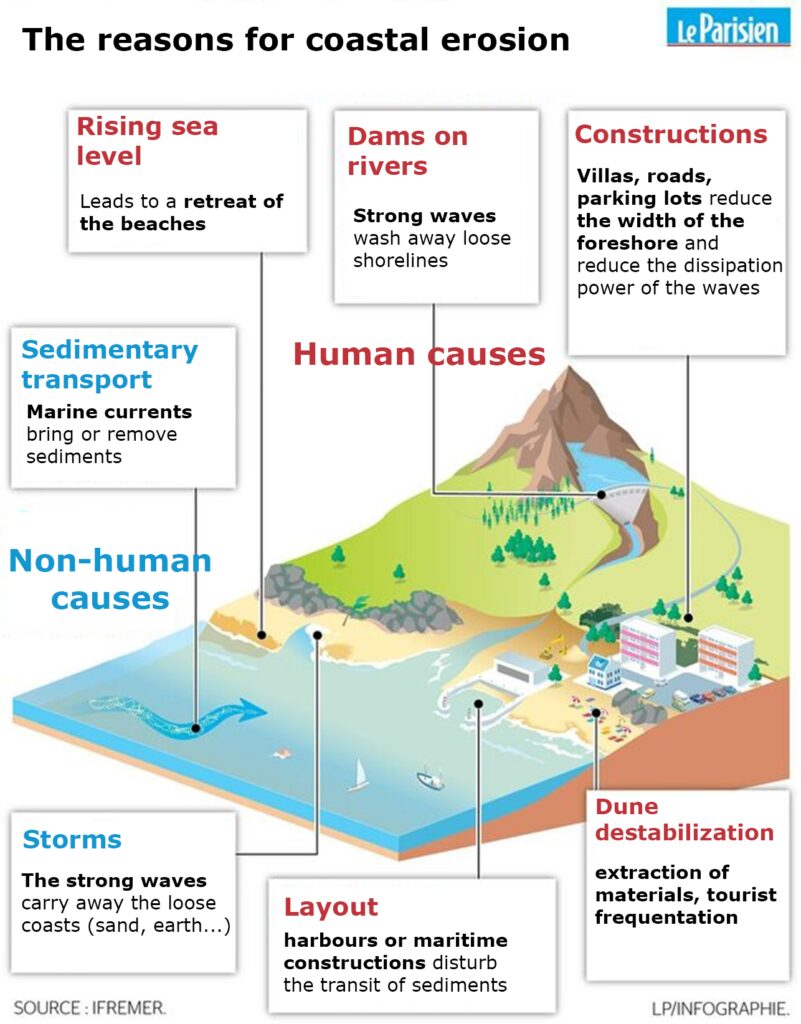
The climate was the cause, but then came man and took its place. Today coastal erosion is mainly caused by human activity. Agriculture, deforestation and forest clearance, building and infrastructure works are some of the main factors contributing to coastal erosion.
For example, coastal erosion can occur when sand is dug up from a beach to build dunes or other coastal protection systems, leaving the shore without enough sand to protect it from waves and storms. Additionally, human activities such as construction, mining, and quarrying can alter the natural shape of the coastline, making it more vulnerable to erosion.
Climate change also plays a role in coastal erosion. Rising sea levels and increased storm intensity are caused by global warming, which contributes to coastal erosion. Furthermore, changes in ocean currents and tides can also affect the shoreline, leading to erosion.
Human Impact on Coastal Erosion
One of the main reasons for coastal erosion is human presence and activities. Our coastlines are not protected or preserved, and instead, they are often used for urbanization, agriculture, and other human activities that contribute to erosion.
In Italy, for example, many beaches have been built over or covered with buildings, roads, and other infrastructure, reducing the natural shoreline and increasing the risk of erosion. Similarly, in Calabria, the Tyrrhenian coast has suffered from severe coastal erosion due to the construction of dams and water storage facilities that alter the natural flow of rivers.
Solutions for Coastal Erosion
Calling them solutions is fitting because coastal erosion is a serious disease, but more than solutions are needed to make a significant change. It is necessary that our country and not only realize structural interventions that protect coastlines with medium-long term results.
These interventions can include the construction of seawalls, breakwaters, or other coastal protection systems to prevent erosion. Additionally, measures such as dune restoration, beach nourishment, and habitat creation can help to stabilize the shoreline and promote ecosystem health.
Local strategies for short-medium term can also be implemented to save beaches with engineering works such as adding sand from deep depths, while being careful not to build artificial barriers that, although saving the beach, spoil the landscape and transfer the problem to adjacent coastlines.
Coastal Erosion in Italy
Italian coastlines need to be protected, and the Agency for Environmental Protection (Ispra) has thought of it too, monitoring kilometers of coastline and noticing that over the past 50 years, the average retreat of the shoreline is 25 meters. Our peninsula’s coasts are not only composed of beaches; indeed, out of 8,350 km, only 3,600 are.
To illustrate, take the Arno delta, which has advanced by about 7 km and a half in 2,000 years and will advance another 2 meters by the end of the century, according to pessimists. In general, estimates say that every 2.5 cm of sea level rise, beach retreats by one meter.
Coastal Erosion in Calabria
Calabrian coast erosion affects mainly the Tyrrhenian side but also cannot be ignored by the other side. Monitored from 1988 to 2011, it was notable on almost all 798 km of coastline and today 65% are urbanized. When coastlines fall into human hands, they often become inhabited centers or agricultural areas, not always particularly useful.
Coastal Erosion in Puglia
In the last millennium, the sea has risen by about 15 cm, so Puglian beaches shrink rapidly, by 0.5 m per year for Adriatic beaches and a bit more for Ionian ones.
Coastal Erosion in Sardinia
Living on tourism and the sea, Sardinia is one of Italy’s regions that has moved first and best to protect its coastlines, trying to keep erosion under control by monitoring sea level rise. For years now, Sardinia is included in the European Community strategy for defending coastal areas with the Eurosion project, commissioned in 2001 by the European Parliament and carried out by the General Environment Directorate of the European Commission.
The Impact of Coastal Erosion on Local Communities
Coastal erosion can have significant impacts on local communities, including loss of property values, displacement of residents, and disruption to tourism and other economic activities. In some cases, coastal erosion can also lead to increased risk of flooding and saltwater intrusion into freshwater sources.
For example, in Calabria, the Tyrrhenian coast has suffered from severe coastal erosion due to the construction of dams and water storage facilities that alter the natural flow of rivers. This has led to the displacement of local communities and the loss of property values.
The Economic Cost of Coastal Erosion
Coastal erosion can have significant economic costs, including damage to infrastructure, loss of property values, and disruption to tourism and other economic activities. In some cases, coastal erosion can also lead to increased risk of flooding and saltwater intrusion into freshwater sources.
For example, in Italy, the average annual cost of coastal erosion is estimated to be around €100 million. This includes costs such as damage to infrastructure, loss of property values, and disruption to tourism and other economic activities.
Conclusion
Coastal erosion is a serious disease that affects not only our coastlines but also local communities and economies. To combat coastal erosion, we need to take a multi-faceted approach that includes structural interventions, local strategies, and global action to reduce greenhouse gas emissions and control sea level rise.
By working together, we can protect our coastlines, preserve natural habitats, and promote sustainable development. The future of our coastlines depends on it.
Recommendations for Coastal Erosion Prevention
- Implement structural interventions such as seawalls, breakwaters, or other coastal protection systems to prevent erosion.
- Restore dunes and beaches through engineering works such as adding sand from deep depths.
- Create habitats and restore ecosystems along the coastline to promote biodiversity and resilience.
- Monitor sea level rise and adjust policies accordingly.
- Implement local strategies for short-medium term to save beaches with engineering works or other measures.
- Encourage sustainable development practices that prioritize coastal protection and preservation.
- Support research and monitoring efforts to better understand coastal erosion and its impacts.
Future Directions
The future of our coastlines depends on the actions we take today. To combat coastal erosion, we need to take a multi-faceted approach that includes structural interventions, local strategies, and global action to reduce greenhouse gas emissions and control sea level rise.
By working together, we can protect our coastlines, preserve natural habitats, and promote sustainable development. The future of our coastlines depends on it.
In the next few years, we will see more research and studies about coastal erosion and its impacts. We will also see new projects and initiatives to combat this disease, and we will see changes in policies and practices that prioritize coastal protection and preservation.
The road ahead is long, but with determination and action, we can protect our coastlines for future generations.


