
Introduction
Climate models are complex systems that use mathematical equations to simulate the behavior of the Earth’s climate system. These models are crucial for understanding and predicting the impacts of climate change, but they can be difficult to understand and interpret. In this article, we will explore what climate models are, how they work, and their limitations.
What is a Climate Model?
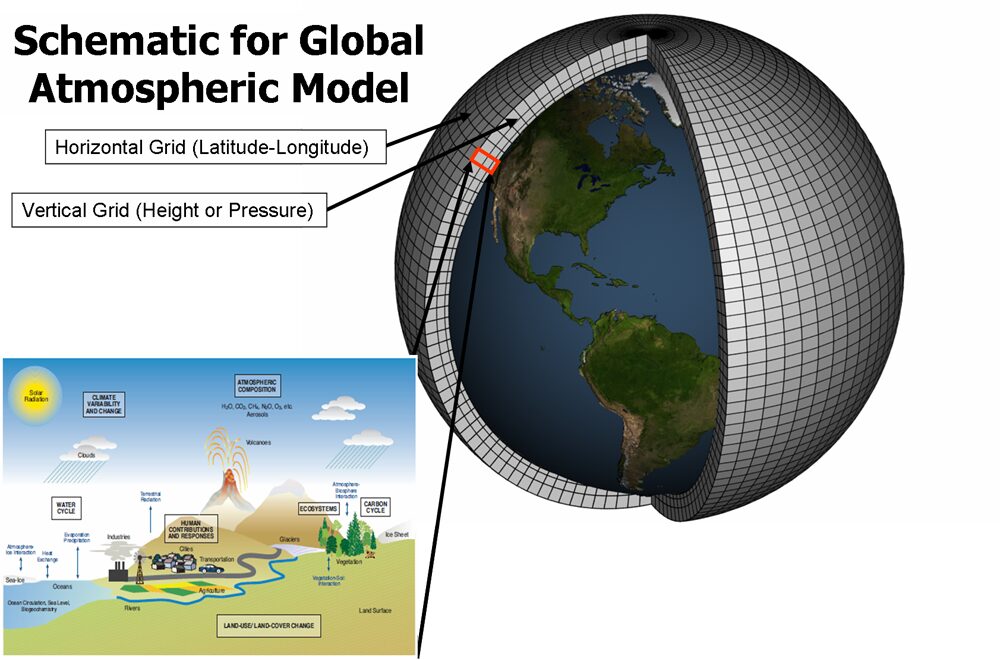
A climate model is a simplified representation of the Earth’s climate system, including the atmosphere, oceans, land surfaces, and ice sheets. These models use computer simulations to mimic the behavior of these components over time, taking into account factors such as temperature, humidity, wind patterns, and precipitation.
Climate models are based on the laws of physics that govern the natural world, such as Newton’s laws of motion and thermodynamics. However, they also introduce simplifications and assumptions that allow for efficient computation and ease of interpretation. By reducing the complexity of the climate system to a set of mathematical equations, climate models can simulate the behavior of the Earth’s climate over long periods of time.
Why Do We Need Climate Models?
Climate models are essential for understanding and predicting the impacts of climate change. They help us understand how the Earth’s climate system responds to different scenarios, such as increased greenhouse gas emissions or changes in global temperatures. By analyzing these simulations, scientists can identify potential future changes in climate patterns and provide early warnings of extreme weather events.
How Do Climate Models Work?
Climate models work by breaking down the complex interactions within the climate system into smaller components that can be simulated using computer algorithms. These components include:
- Atmospheric circulation: The movement of air in the atmosphere, including winds and ocean currents.
- Ocean heat transport: The transfer of heat from the equator to the poles through ocean currents.
- Land surface processes: The exchange of energy between the land surface and the atmosphere.
To simulate these components, climate models use a range of techniques, such as:
- Numerical integration: This involves solving mathematical equations that describe the behavior of each component using numerical methods.
- Physical parameterizations: These are simplified representations of complex physical processes, such as cloud formation or ocean mixing.
- Data assimilation: This involves combining model output with observational data to improve the accuracy of the simulations.
Types of Climate Models
There are several types of climate models, including:
- Global Climate Models (GCMs): These models simulate the entire Earth’s climate system, from the oceans to the land surfaces.
- Regional Climate Models (RCMs): These models focus on specific regions, such as Europe or Asia, and can provide more detailed information about local climate patterns.
Limitations of Climate Models
While climate models are incredibly powerful tools for understanding the Earth’s climate system, they are not without limitations. Some of these limitations include:
- Simplifications: Climate models simplify complex processes within the climate system, which can lead to errors and biases.
- Data limitations: The accuracy of climate model simulations depends on the quality and availability of data used to initialize the models.
Sources of Uncertainty
There are several sources of uncertainty in climate models, including:
- Variability in the climate system: Natural fluctuations in the climate system can affect the accuracy of model predictions.
- Model biases: The simplifications made by climate models can lead to errors and biases that need to be accounted for.
Ensemble Modeling
To account for these uncertainties, scientists use ensemble modeling techniques. This involves running multiple versions of the same model with slightly different initial conditions or parameter settings, which allows researchers to estimate the range of possible outcomes.
By understanding how climate models work and their limitations, we can better appreciate the complexities of the Earth’s climate system and make more accurate predictions about future changes in climate patterns.


