
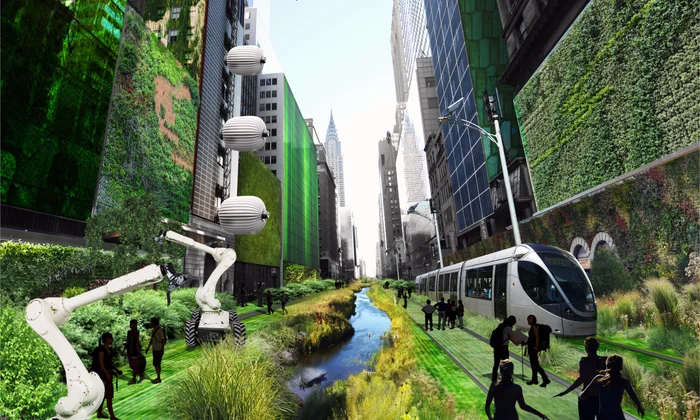
As we imagine the city of tomorrow, we are also envisioning the society of tomorrow and the life that future generations will lead. Building and laying down intelligent and studied premises for the city of tomorrow means shaping it and giving direction to an idea of direction that others will have to pursue until the end. The goal is the future, so the journey continues, and each generation has its role in contributing to what cities of the future will be like by making informed decisions today.
This is an invitation, explicitly stated, not to only think about what is currently comfortable but also about what has better consequences for those who will live on our planet within decades. History tells us that with cities, societies have always changed and influenced each other. Think of the Egyptians, Romans, Greeks. Now, let’s see what we can do today.
What are Cities of the Future?
Cities of the future literally mean those that we imagine and design according to what we think is better, but when we say this term, it usually means “advanced”. Urban or metropolitan areas that show up on a global scale particularly functional, efficient, healthy without becoming too impersonal. It’s clear that cities of the future, intended positively as we would like them to happen, are cities that do not forget their past but rather treasure and value it.
If a city of the future loses its identity, society in the future will be severely harmed, and this is what most architects of tomorrow want to avoid. Let’s take a moment for an instant, and think about the responsibility we have towards the citizens of the future, those who will inhabit our world, Italy, Milan, Rome or Turin, in centuries but also in just 50 years. Our grandchildren.
Guiding Principles for Future Cities
An interesting text for those interested in this topic is “The City of Tomorrow: How Networks Are Changing the Urban Future,” written by Carlo Ratti and Matthew Claudel. The authors are well-known figures who already create works that make us look forward to what will be our city of tomorrow. I’m referring to Torino’s Carlo Ratti and Matthew Claudel, who have a book translated from E. Benghi and can easily be found on Amazon for 12 euros.
In this book, there are many interesting considerations, both technical and broad-spectrum, that allow us to reflect on the relationship between us and the city, between our generation, and cities, between social development and urban planning in various cities around the world. Sometimes they seem all alike if you look at certain aspects but turned to another angle you run into enormous differences even among metropolises of the same continent.
Returning to the book by Ratti and Claudel, we start by telling the story of large technological transformations in the world of networks and how these affect the city then vice versa, touching on how influences are crossed out and we’re all very connected. Theoretically and practically.
Research on future cities has been done at the Senseable City Lab at MIT from where both authors come and they don’t shy away from exploring the consequences of emerging paradigms in areas like transportation, energy, production methods, or civic participation. As a result, there’s a book that looks forward to the future concretely without enthusiastic nor dramatic tones because the future cities and cities of the future are built by us today.
Cities of the Future on the Periphery
In recent years, there’s been a strong sense of smell of future in peripheries. It seems like an utopia but it’s not. Experiments with cities of the future are increasingly being carried out in the outskirts of big cities instead of the center. Roads with special asphalt to systems of energy-efficient lighting, new buildings that are also communities: everything is experimented in a distant quarter away from the center, perhaps to avoid risks? It doesn’t matter what interests us is that peripheries will be protagonists in cities of the future and not passive spectators disenchanted.
What Cities of the Future Will Be Like
There won’t be one standard for cities of the future. Each city is building its own future now, and it’s noticeable seeing how investments are being made immaterially and only. In Italy, there’s an increase in the gap between cities that are “ahead” like Milan and Turin, which remain further behind, like beautiful Rome, which can’t always rely on its glorious past to survive.
Cities of the future, those better ones, will be less polluted and quieter with public transportation punctual and a capillary network of stops. They will be welcoming cities in which center is not the only important one, they will be livable for everyone, even those who have mobility problems or health issues related to vision, those who are small but still vote, and those who are too old to make long walks but have every right to live, walk, shop, or renew a document.
Innovative Technologies
Cities of the future can benefit from innovative technologies such as renewable energy sources like solar panels and wind turbines. These can provide clean power for homes, businesses, and transportation systems. Moreover, green buildings made with natural materials like wood and stone can be designed to reduce waste and carbon emissions.
Smart cities will also rely on advanced technologies like artificial intelligence (AI) and the Internet of Things (IoT). These tools can help cities optimize resource usage, improve public services, and enhance the quality of life for citizens. For instance, smart traffic management systems can reduce congestion by dynamically adjusting traffic light timing to minimize delays.
Another key aspect is the use of data analytics to make informed decisions about urban planning and development. By analyzing data on population growth, transportation patterns, and economic trends, cities can identify areas of high demand and invest in infrastructure that meets those needs.
Challenges for Cities of the Future
While there are many benefits to building cities of the future, there are also significant challenges to be addressed. One of the biggest hurdles is financing urban development projects, which often require substantial investments from governments, private companies, or international organizations.
Another challenge is addressing issues like climate change, air pollution, and social inequality. Cities that prioritize sustainability and equity can create a high-quality living environment for all citizens while minimizing their environmental footprint.
To overcome these challenges, cities must adopt a collaborative approach, engaging stakeholders from various sectors to ensure that development projects meet the needs of both residents and future generations.
Designing Sustainable Urban Spaces
Cities of the future will be designed with sustainability in mind. Urban planners can incorporate green spaces into urban planning to reduce the urban heat island effect, mitigate stormwater runoff, and create habitats for wildlife.
Public transportation systems must become more efficient and accessible to reduce reliance on personal vehicles and minimize traffic congestion. Electric and autonomous vehicles can play a key role in this transition.
Moreover, cities should prioritize affordable housing options, ensuring that residents have access to safe, comfortable living spaces regardless of income level.
Citizen Engagement and Participation
Cities of the future must foster citizen engagement and participation in decision-making processes. This involves creating inclusive public spaces for citizens to share their ideas and feedback on urban development projects.
Online platforms can also be used to facilitate citizen engagement, allowing residents to provide input on issues like transportation systems, waste management, and energy efficiency.
The Role of Education and Research
Education and research play a crucial role in shaping cities of the future. By investing in research institutions and programs focused on sustainable urban development, we can develop innovative solutions to complex problems and inform policy decisions that support equitable and sustainable urban growth.
In addition, educators must integrate sustainability and equity into curricula to ensure that students are equipped with knowledge and skills to design and manage sustainable cities of the future.
Conclusion
The city of tomorrow is not just a concept but a reality that we can shape through informed decision-making. By embracing innovative technologies, prioritizing sustainability and equity, and fostering citizen engagement and participation, we can create vibrant, livable cities for all citizens.
Cities of the future are not utopias; they are built on the principles of inclusivity, social responsibility, and a commitment to sustainability. As architects of tomorrow, we must take up this challenge to build sustainable urban spaces that meet the needs of both residents and future generations.
References
- Ratti, C., & Claudel, M. (2017). The City of Tomorrow: How Networks Are Changing the Urban Future. MIT Press.
- Senseable City Lab. (n.d.). Retrieved from https://senseable.mit.edu/
- Asimov, I. (1966). The End of Eternity. Doubleday.
- Orwell, G. (1949). 1984. Secker and Warburg.
Image Credits
- Image of a cityscape at sunset: Creative Commons licensed via Unsplash
- Diagram of smart traffic management system: Licensed under CC BY-SA 3.0 via Wikimedia Commons
- Picture of green building materials: Creative Commons licensed via Pexels


