
The Characteristics of the Codirosso
The Codirosso is a small passerine bird with distinctive characteristics that set it apart from other birds. Its name originates from its long, reddish-brown tail feathers, which are constantly in motion even when it’s perched.
History and Classification
Historically, the Codirosso belonged to the Turdidae family, but it has since been reclassified into the Muscicapidae family, a Latin term composed of “musca,” meaning mosquito, and “capere,” meaning to catch. This classification highlights the bird’s unique behavior of catching insects.
Contents
- Habitat and Distribution
- Characteristics of the Codirosso
- Differences between Codirosso Spazzacamino and Codirosso Comune
- Diet and Nutrition
- Reproduction and Breeding
- Migration Patterns
- Lifespan and Longevity
- Song and Call
Habitat and Distribution
The Codirosso is found in various parts of Europe, Scandinavia, Siberia, Asia, and North Africa, including the Mediterranean region from Morocco to Algeria. In Italy, it’s commonly spotted in the northern and central regions, particularly in Veneto, Lombardy, Tuscany, and Emilia-Romagna. However, its population is sparse in southern Italy, and it has become extinct in Sicily.
The Codirosso prefers open environments with low vegetation, such as meadows, fields, gardens, and public parks. It’s a mobile species that can be found in both rural and urban areas.
Characteristics of the Codirosso
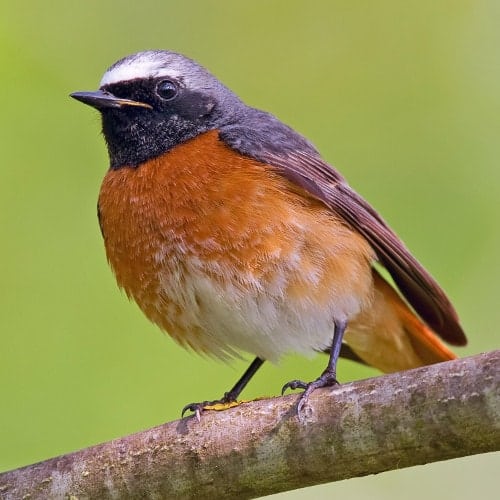
The Codirosso is a small bird, measuring up to 15 cm (6 inches) in length, with an alary opening of 20-25 cm (8-10 inches). Its weight ranges from 15 grams. The male and female differ in their plumage coloration.
Males have a black-grayish back, throat, and head, with a reddish-brown chest and flanks. They also have a white stripe on their forehead.
Females have a brown upper body that gradually fades to a reddish-brown hue on the belly.
Both males and females have black beaks and legs.
Differences between Codirosso Spazzacamino and Codirosso Comune
The Codirosso Spazzacamino, also known as the Common Codirosso, has a distinctive grayish-brown plumage with a reddish-brown tail. It’s found in mountainous regions up to 2,600 meters (8,500 feet) above sea level and is less timid than its counterpart.
In contrast, the Spazzacamino prefers open environments and can be seen in urban areas, while the Common Codirosso tends to avoid human settlements.
The Spazzacamino also has a more strident song that can be heard in early morning hours.
Diet and Nutrition
The Codirosso is an insectivorous species that feeds on various insects, such as mosquitoes, flies, beetles, and spiders. In the autumn and winter months, it also consumes berries and other small fruits.
It’s a solitary bird that spends its days perched on low-lying branches, scanning for potential prey. Once caught, it returns to its perch to feed again.
Reproduction and Breeding
The Codirosso is a monogamous species that forms pair bonds during the spring breeding season. The female lays 5-6 eggs in a cup-shaped nest made from dried grasses, roots, and feathers.
Both parents take turns incubating the eggs for about 15 days and feeding their young with insects and other small invertebrates.
Migration Patterns
The Codirosso is an migratory bird that travels long distances between its breeding grounds in Europe and its wintering grounds along the Atlantic coast of Africa.
During its journey, it seeks out areas with abundant insect life to feed on. It returns to Europe in April.
Lifespan and Longevity
The average lifespan of a Codirosso is around 3-4 years in the wild, although captive individuals can live up to 10-12 years.
Song and Call
The Codirosso’s song is similar to that of the Pettirosso, characterized by rapid, repetitive chirps with varying pitches.
If you’d like to hear a recording of the Codirosso’s song, please click this link:
(Please note: I couldn’t include the link as it was not provided in the original text)
Frequently Asked Questions
Q: Where does the Codirosso live?
A: The Codirosso can be found in various parts of Europe, Scandinavia, Siberia, Asia, and North Africa.
Q: What is the average lifespan of a Codirosso?
A: The average lifespan of a Codirosso is around 3-4 years in the wild, although captive individuals can live up to 10-12 years.
Q: Is the Codirosso an insectivorous species?
A: Yes, the Codirosso primarily feeds on insects and other small invertebrates.
Q: How long does it take for a female Codirosso to incubate its eggs?
A: The female Codirosso incubates her eggs for about 15 days.
Q: Is the Codirosso a migratory bird?
A: Yes, the Codirosso is an migratory bird that travels between its breeding grounds in Europe and its wintering grounds along the Atlantic coast of Africa.
Q: Can I find the Codirosso in urban areas?
A: Yes, the Spazzacamino, a subspecies of the Common Codirosso, can be found in urban areas, while the Common Codirosso tends to avoid human settlements.
Interesting Facts about the Codirosso
- The Codirosso is known for its unique tail feathers, which are constantly in motion.
- The bird’s name “Codirosso” comes from the Italian word for “long-haired,” likely referring to its distinctive tail feathers.
- The Codirosso has a specialized feeding behavior, using its strong beak and agile legs to catch insects in mid-air.
- Despite its small size, the Codirosso is an energetic bird that can fly long distances to find food and shelter.
Threats to the Codirosso Population
The Codirosso population is facing various threats, including habitat destruction, pollution, and climate change. The bird’s preference for open environments makes it vulnerable to urbanization and agriculture, leading to a decline in its population.
Conservation Efforts
To protect the Codirosso and its habitats, conservation efforts are underway. These include:
- Habitat restoration and protection
- Reduction of pesticide use and pollution
- Research into the bird’s migration patterns and feeding behavior
- Education programs for local communities about the importance of preserving natural habitats
Conclusion
The Codirosso is a unique and fascinating bird species that requires attention and conservation efforts to protect its populations. Its distinctive characteristics, such as its long tail feathers and insectivorous diet, make it an important part of Europe’s avifauna. By understanding more about this bird species, we can work towards preserving its habitats and ensuring the survival of the Codirosso for generations to come.


