
As we first meet a cat, our attention is drawn to its piercing eyes. They seem mysterious, penetrative, deep, and unreadable. Immediately, we sense that we are dealing with an intelligent animal that doesn’t intend to be fawned over; it may even want to assert itself, when the mood strikes it. The eyes of a cat are anatomically special, not just in terms of their gaze, but also because they can see in the dark.
The Anatomy of Cat Eyes
There are three concentric membranes of tissue inside a cat’s eye. The outermost membrane is fibrous and consists of the sclera, white, and cornea. In the middle lies the vascular membrane, which is thicker and composed of coroide, ciliary body, and iris. Finally, there is the nervous membrane at the center.
The pupilla regulates the amount of light entering a cat’s eyes, while the retina contains millions of receptors that convert light energy into electrical signals, which are then transmitted to the brain through the optic nerve. It’s worth noting that besides the visible parts of an eye, there are also the conjiunctiva and tear ducts present.
The anatomy of a cat’s eye is complex and unique. The shape and structure of their eyes allow them to see in multiple directions at once, thanks to their wide-set pupils. This allows cats to detect movement more easily and makes it harder for their prey to escape. Additionally, the reflective layer behind the retina helps to amplify any light that enters the eye, giving cats better low-light vision.
Characteristics of Cat Eyes
Once a cat’s eyes have been dissected, we can observe their complete features. Starting with their position and dimensions, they occupy the central and upper part of the head and don’t vary greatly depending on the breed. The Birman and Persian are exceptions, however, as the former has more protruding eyes and the latter appears more impressive when viewed up close.
Additionally, there can be variations in the opening of the eyelids. Some cats have a wider opening, while others have a narrower one. This variation is due to the shape and size of their eye sockets and can affect their ability to open and close their eyes properly.
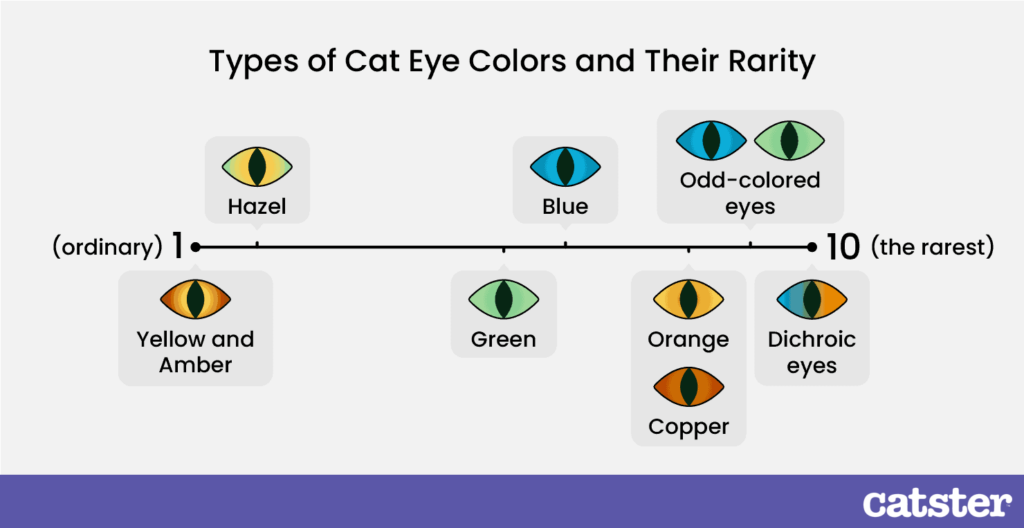
The color of a cat’s eyes is also an important characteristic that helps identify different breeds. For example, Siamese cats have bright blue eyes, while British Shorthairs have green or gold eyes. However, even within breeds, there can be variations in eye color, making each individual unique.
Colors of Cat Eyes
We have already discussed the colors of a cat’s fur, but what about its vision? While it may seem trivial, understanding the colors that cats see is actually quite complex. This is especially true for predators like cats, whose senses are highly developed to capture prey quickly and efficiently.
To begin with, let’s look at the retina, where we find more rods than cones. Rods detect black and white, while cones translate light into colors. In contrast, humans have a much higher concentration of cones in their retina, which allows us to see a wider range of colors.
In cats, this means that they are better suited for detecting movement and changes in brightness rather than distinguishing between different colors. This is not particularly relevant in their daily lives, but they do have an advantage when it comes to low-light conditions, such as dawn or dusk. During these periods of reduced illumination, a cat’s eyes can capture more light than those of humans thanks to the dilation of the pupil.
Veiled Eyes
If we notice that a cat’s eyes appear veiled, it could be due to conjunctivitis, a relatively common issue if treated promptly won’t have severe consequences. This condition may arise from either an infectious or allergic cause and will manifest as dim eyes, sometimes even appearing closed or puffy.
Additionally, there can be mucous on the eyelids and itchiness. If you notice that your cat’s eyes are red, itchy, or discharge is present, it’s essential to take them to a veterinarian for proper diagnosis and treatment.
Glowing Eyes at Night
Another enigma surrounding cat eyes is their ability to glow in low light conditions. We’ve all experienced this feeling when we glance into a cat’s eyes, hoping it will eventually fall asleep but instead seems to stare intently.
The glowing effect of a cat’s eyes is not voluntary; it’s due to the tapetum lucidum behind the retina. This reflective layer acts like a mirror, reflecting light onto the sensors in the retina and making their eyes appear brighter when even minimal amounts of light are present.
Conclusion
The eyes of cats are full of mysteries waiting to be unraveled by us. Their intricate anatomy, along with unique visual characteristics, contribute to their reputation as skilled predators. Understanding these eye features can help deepen our appreciation for this fascinating animal and provide insight into its inner workings.
Frequently Asked Questions
- What is special about the anatomy of a cat’s eyes?
Cats have three concentric membranes inside their eyes: fibrous, vascular, and nervous membranes. - Can cats see in complete darkness?
While they can’t see in absolute darkness, their eyes are more sensitive to low light conditions, thanks to their pupil dilation. - What causes a cat’s eyes to appear veiled or dim?
This could be due to conjunctivitis, which may arise from an infectious or allergic cause. - Why do cats’ eyes glow in the dark?
The tapetum lucidum behind the retina acts like a mirror, reflecting light onto the sensors and making their eyes appear brighter in minimal light conditions. - Can cats see colors as vividly as humans?
Their limited number of cones makes it difficult for them to distinguish between different colors, but they have an advantage when it comes to detecting black and white. - How do cat eye characteristics differ across breeds?
While there are some general differences in the appearance of certain breeds’ eyes, each has its unique features. - What is tapetum lucidum and how does it work?
It’s a reflective layer behind the retina that helps cats see better in low light conditions by reflecting any incoming light onto their photoreceptors. - Can cat eye issues be serious or even life-threatening?
In some cases, yes; for example, severe conjunctivitis can lead to more serious complications if left untreated.
If you enjoyed this article, please follow me on Twitter, Facebook, Google+, and Instagram


