
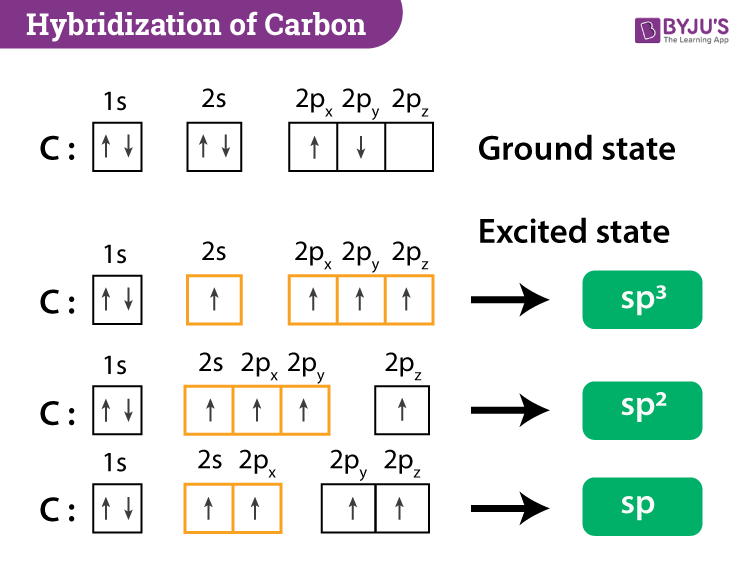
As a fundamental concept in chemistry, hybridization is the process by which two or more atomic orbitals combine mathematically to form new, hybridized orbitals with distinct spatial characteristics. This phenomenon has been extensively studied and is essential for understanding the structure and behavior of molecules.
In this article, we will delve into the world of hybridization, focusing on its significance, application, and importance in chemistry. We will explore the concept of hybridization, its relationship to molecular orbitals, and its implications for understanding chemical bonding and molecular geometry.
What is Hybridization?
Hybridization occurs when atomic orbitals combine to form new orbitals with different spatial characteristics. This process allows for more effective description of molecular structure and bonding. In simple terms, hybridization enables us to create new “hybrid” orbitals that are better suited to explain the formation and arrangement of molecules.
To understand hybridization, it is essential to grasp the basics of atomic orbitals. Atomic orbitals are mathematical functions that describe the probability distribution of an electron within an atom’s energy level. The most common types of atomic orbitals are s-orbitals, p-orbitals, d-orbitals, and f-orbitals.
S-orbitals have a spherical shape and are symmetrical about their center. They are typically used to describe the outermost energy level electrons in an atom. P-orbitals, on the other hand, have a dumbbell shape and are asymmetrical about their center. They are often used to describe the middle-energy level electrons in an atom.
When atomic orbitals combine, they form new hybridized orbitals that exhibit distinct spatial characteristics. These hybridized orbitals can be used to explain the formation of molecular bonds between atoms.
The Carbon Atom: A Prime Example
Let’s take a closer look at the carbon atom (C), which is a key element in the world of chemistry. When a carbon atom is in its lowest energy state, it exhibits a unique configuration characterized by two electrons in the inner 1s orbital, one full 2s orbital, and two partially filled 2p orbitals.
Typically, we would expect this arrangement to lead to two covalent bonds with neighboring atoms, resulting in an angle of approximately 90 degrees. However, in reality, carbon atoms often form four bonds, exhibiting different bond angles that deviate from the predicted values based on the original orbital configurations.
Initially, this appeared contradictory, but modern approaches focusing on molecular orbitals have helped clarify the situation. When carbon forms bonds with other atoms, it modifies its atomic orbitals by rearranging and reorganizing the 4 valence electrons (s and p) into new hybridized orbitals.
These hybridized orbitals are essential for understanding the behavior of carbon-based molecules. For example, when a carbon atom forms a bond with oxygen in carbon dioxide (CO2), it creates two sp2 hybridized orbitals that lie in a plane. These hybridized orbitals allow the carbon and oxygen atoms to form a strong triple bond.
Ibridazione degli Orbitali
The concept of hybridization extends beyond the carbon atom, applying to other elements as well. It provides a framework for explaining various molecular configurations, such as:
- Tetrahedral, pyramidal, or planar shapes
- Trigonal planar structures
- Linear shapes
By combining atomic orbitals mathematically, we can describe these complex molecular geometries and provide a deeper understanding of the underlying chemistry.
Ibridazione del DNA
In the realm of biology, hybridization plays a crucial role in the pairing of complementary nucleotide bases in DNA. This process is fundamental to gene expression and heredity. The hybridization of DNA strands is essential for identifying bacterial species using techniques like PCR (Polymerase Chain Reaction).
By analyzing the extent of DNA hybridization between two organisms, researchers can determine their taxonomic relationships. For example, DNA-DNA hybridization can distinguish between different species based on the percentage of DNA similarity.
Conclusion
Hybridization is a fundamental concept in chemistry that enables us to describe and understand the behavior of molecules. By combining atomic orbitals mathematically, we can explain complex molecular geometries and provide insights into the underlying chemistry.
In this article, we have explored the world of hybridization, focusing on its significance, application, and importance in chemistry. We hope this explanation has helped you grasp the basics of hybridization and appreciate its role in shaping our understanding of the molecular world.
Frequently Asked Questions (FAQs)
- What is hybridization?
Hybridization is the process by which two or more atomic orbitals combine mathematically to form new, hybridized orbitals with distinct spatial characteristics.
- Why is hybridization important in chemistry?
Hybridization helps describe complex molecular geometries and provides insights into the underlying chemistry of molecules.
- What is the significance of hybridization in biology?
In biology, hybridization plays a crucial role in gene expression, heredity, and identifying bacterial species using techniques like PCR.
- How does hybridization affect molecular bonding?
Hybridization enables us to create new orbitals that are better suited to explain the formation and arrangement of molecules, resulting in more effective descriptions of molecular structure.
- Can hybridization occur with any element?
Yes, hybridization can occur with any element, not just carbon. It provides a framework for explaining various molecular configurations across different elements.
- What is the relationship between hybridization and molecular orbitals?
Hybridization is closely related to molecular orbitals. By combining atomic orbitals mathematically, we can describe complex molecular geometries using molecular orbital theory.
- How does hybridization differ from other chemical bonding concepts?
Hybridization differs from other chemical bonding concepts in its ability to explain complex molecular geometries and provide insights into the underlying chemistry of molecules.
- What are some common applications of hybridization in chemistry?
Some common applications of hybridization include understanding molecular structure, predicting chemical reactivity, and explaining biological processes like DNA hybridization.
Advanced Topics: Hybridization Theories and Models
In addition to its significance in understanding molecular geometry and bonding, hybridization has been used as a theoretical framework for developing various models and theories. Some of the most influential hybridization theories include:
- VSEPR Theory: This theory explains the shapes of molecules based on the spatial arrangement of electron pairs around central atoms.
- Molecular Orbital Theory: This theory describes molecular structures in terms of combinations of atomic orbitals.
- Hybridization Index: This index is used to describe the extent of hybridization between atoms in a molecule.
These advanced topics provide further insight into the concept of hybridization and its role in understanding chemical bonding and molecular geometry.


