
Understanding the Principle Behind It
Imagine a liquid in stillness, exerting a force on the surface it comes into contact with. This is the fundamental concept behind capillary hydrostatic pressure. From a glass to our bodies, from dams to cups, this force is omnipresent and plays a crucial role in various aspects of our lives.
What is Capillary Hydrostatic Pressure?
Capillary hydrostatic pressure refers to the force exerted by a fluid on its container or surrounding surface. This force depends solely on the density of the fluid and the depth at which it is measured, not on the mass beneath the point considered. The concept was first demonstrated by Pascal when he filled an open container with water and observed that it pushed out equally and quickly.
The Formula: p = ρgh
The formula for capillary hydrostatic pressure is:
p = ρgh
Where:
– p is the static pressure (Pa)
– ρ (rho) is the density of the fluid (Kg/m3)
– g is the acceleration of gravity
– h is the height of the point considered (m)
The Role in Biological Systems
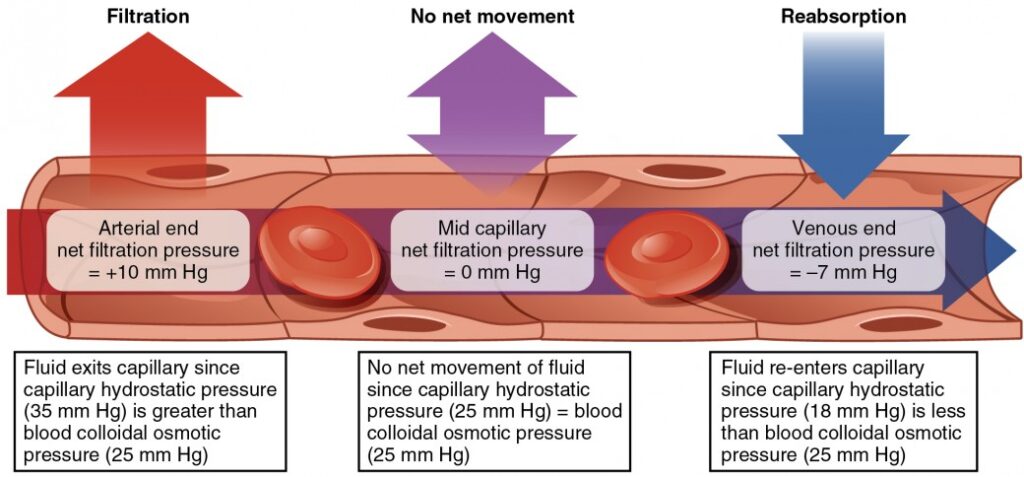
Scientists like Starling have investigated the role of hydrostatic pressure and oncotic pressure in the movement of fluids through capillary membranes. Although this seems technical, it has significant implications for everyday life.
For instance, Starling focused on an equation that described fluid flow through a membrane due to the difference between hydrostatic pressure and oncotic pressure. When the hydrostatic pressure exceeds the oncotic pressure, the liquid flows from the capillaries into the interstitial space.
Hydrostatic Pressure in Blood
In blood vessels, there is a pressure that counteracts the osmotic pressure exerted by large molecules like proteins. This pressure is the hydrostatic pressure exerted on the surface of capillary walls.
The hydrostatic pressure plays an essential role in maintaining blood circulation and ensuring the proper delivery of oxygen and nutrients to tissues. If the hydrostatic pressure were too low, it would be difficult for red blood cells to navigate through the narrow capillaries, leading to inadequate oxygenation of tissues.
Hydrostatic Pressure and Blood Circulation
The concept of hydrostatic pressure in blood circulation is crucial in understanding how the cardiovascular system regulates fluid movement between organs. For instance, when you exercise or increase your heart rate, your body generates more hydrostatic pressure to push blood throughout your muscles.
In addition, hydrostatic pressure helps regulate blood flow by controlling the amount of blood that flows into and out of capillaries. The balance between hydrostatic pressure and oncotic pressure determines how much fluid flows in and out of the capillaries, ensuring that tissues receive the right amount of oxygen and nutrients.
The Relationship Between Hydrostatic Pressure and Archimedes’ Principle
Now let’s explore the relationship between hydrostatic pressure and what we commonly refer to as Archimedes’ principle, which states that “An object immersed in a fluid experiences an upward buoyant force equal to the weight of the fluid it displaces.” This is derived from the principle of Archimedes.
In essence, when an object is submerged in a fluid, it displaces some volume of water. The weight of this displaced water equals the buoyant force acting on the object, as described by Archimedes’ principle. Hydrostatic pressure, however, plays a role in the density of the fluid and its effect on the upward buoyant force.
Exercises and Applications
There are many practical exercises that help us grasp capillary hydrostatic pressure and its theoretical and practical implications, often compared with atmospheric pressure. One common scenario is a two- or multi-container system containing the same liquid in stillness, where the surface level remains constant regardless of container shape.
Additionally, there are problems involving calculating the hydrostatic pressure when dealing with different non-miscible fluids of varying densities. This is achieved by summing up the pressures caused by each fluid individually.
3D Printing with Hydrostatic Pressure
A recent innovation in 3D printing technology relies on capillary hydrostatic pressure. Known as cubicatura or Water Transfer Printing, this process uses hydrostatic pressure to adhere an image from a film onto any surface. This technique has revolutionary implications for artisanal industries and beyond.
Unlike traditional coatings, cubicatura is not merely a paint but a true, functional coating. It can be applied to various materials such as plastic, wood fibers, glass ceramics, metals, and alloys, overcoming previous issues associated with methods like hot stamping or similar techniques.
In the automotive industry, this technology allows for personalized car bodies and custom features such as crusted gears, pedals, and steering wheels. Beyond that, cubicatura can also be applied to electronic components, home appliances, vases, and more. The certainty is that this method does not alter the properties of treated objects or their individual components.
Conclusion
Capillary hydrostatic pressure plays a significant role in various aspects of our lives, from everyday experiences like drinking water or swimming to advanced 3D printing techniques. Understanding its principles can help us grasp broader concepts and appreciate the intricate relationships between seemingly disparate phenomena.
As we conclude this exploration into capillary hydrostatic pressure, remember that staying informed about scientific advancements is key to navigating a rapidly evolving world.
FAQs
-
What exactly causes hydrostatic pressure?
Hydrostatic pressure results from the force exerted by a fluid on its container or surrounding surface and depends solely on the density of the fluid and the depth at which it’s measured. -
What is capillary hydrostatic pressure used for?
Capillary hydrostatic pressure plays roles in both scientific research, such as understanding biological systems like blood circulation, and practical applications like 3D printing. -
How does Archimedes’ principle relate to hydrostatic pressure?
Hydrostatic pressure relates closely to Archimedes’ principle, which states that an object immersed in a fluid experiences an upward buoyant force equal to the weight of the fluid it displaces. -
What are cubicatura and Water Transfer Printing?
Cubicatura or Water Transfer Printing is a method of 3D printing utilizing hydrostatic pressure for adhering images onto any surface, revolutionizing various industries from automotive to electronics. -
Can you apply cubicatura to different materials?
Yes, the technology can be applied to numerous materials such as plastics, wood fibers, glass ceramics, metals, and alloys without altering their properties. -
What is the primary difference between hydrostatic pressure and 3D printing?
The main distinction lies in their purpose: hydrostatic pressure describes a natural phenomenon, while cubicatura or Water Transfer Printing employs this force for a specific industrial application. -
Is there an advantage to using hydrostatic pressure in 3D printing over traditional methods?
Hydrostatic pressure offers several advantages, including improved accuracy and ability to apply coatings on various materials without compromising their integrity. -
What are some future applications or implications of capillary hydrostatic pressure technology?
While the current state of this technology is impressive, its long-term implications could be vast, potentially transforming numerous sectors from manufacturing to medical devices through innovative uses of fluid dynamics.


