
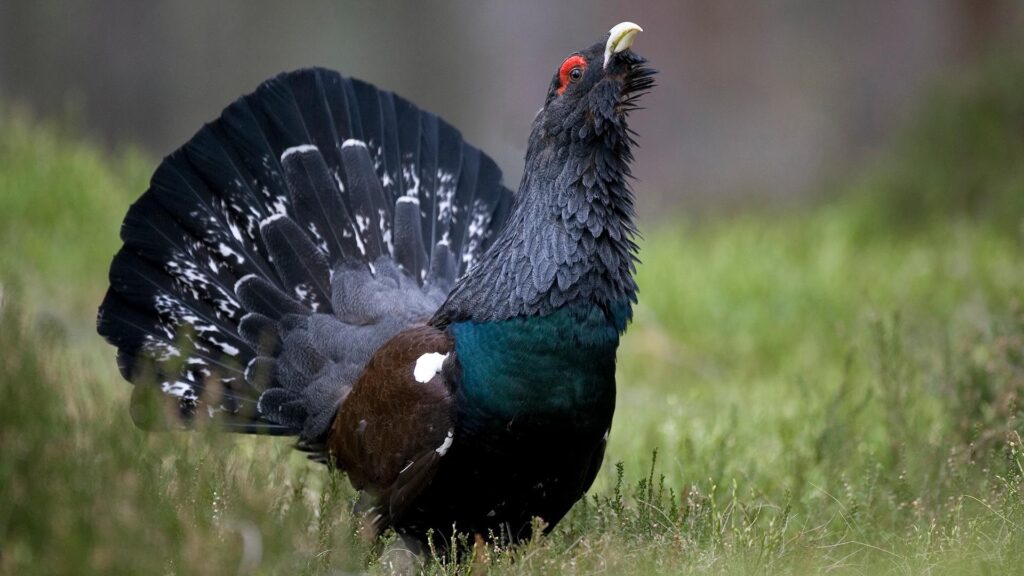
As we embark on a journey to explore the world of avian wonders, our attention is drawn to a bird species that has captivated the hearts of many with its enchanting songs and intriguing characteristics. Say hello to the Gallo Cendrone, also known as the Urogallo, a member of the tetraonid family that will leave you in awe.
What Makes the Gallo Cendrone Special?
The name ‘Gallo Cendrone’ is derived from the Greek words ‘tetrazo’, meaning “schiamazzo”, and ‘urus’, meaning “wild bull”. This unique nomenclature already hints at the bird’s distinctive features. But what truly sets it apart? Let’s delve into its fascinating characteristics.
Characteristics of the Gallo Cendrone
The Gallo Cendrone is an original species from the cold northern boreal regions, making it well-suited for these climate conditions. Its strong, feathered legs with three toes and sharp nails are a testament to its adaptability. The partially developed fourth toe adds to its unique appearance.
Above the eye, there’s a red-colored growth called caruncola, which gives the bird a severe look. The beak is robust and white ivory-colored, while the tail is fan-shaped. Under the chin, thick feathers create a beard-like appearance, making the Gallo Cendrone a striking figure. Males and females differ in size and plumage color; males measure approximately 74-90 cm and can weigh up to 5 kg, while females are smaller and weigh around 2 kg.
The Gallo Cendrone’s Unique Features
One of the most distinctive features of the male Gallo Cendrone is its tendency to prance with open tail feathers during the mating season. This display of plumage is a clear signal to attract females. Additionally, males emit a characteristic sound that can be heard for several kilometers, allowing them to establish their territory.
During the mating season, some male birds engage in fierce battles to win the favor of females, eventually pairing up with the most suitable partner. The Gallo Cendrone’s unique characteristics have captivated the hearts of many bird enthusiasts and scientists alike.
Habitat and Distribution
The Gallo Cendrone lives in most of Europe up to Western Siberia, making it a widespread species. It is present in Italy, mainly in the Alps and Pre-Alps. This non-migratory species inhabits mountainous habitats, coniferous and deciduous forests, at altitudes between 1,200-1,700 meters.
The Gallo Cendrone’s Dietary Needs
The Gallo Cendrone primarily eats berries, seeds, fruits such as strawberries, raspberries, blackberries, blueberries, pine cones, leaves, and insects or small invertebrates. In winter, it may also consume conifer needles or when it snows, it eats pinecones.
To sustain its energy needs, the Gallo Cendrone tends to ingest small stones or pebbles that aid digestion. This unique dietary behavior is a testament to the bird’s adaptability and ability to thrive in various environments.
Breeding and Conservation
For those interested in breeding Gallo Cendrones, obtaining the necessary permit from your province’s faunistic office is essential. The birds must be fitted with non-removable metal rings, approximately 20 cm long for males and 16 cm long for females. Enclosures should have adequate dimensions, be clean, and well-drained.
Summer months require shade to prevent overheating, making high-altitude environments ideal for breeding. However, the Gallo Cendrone is sensitive to hot and dry climates, requiring careful consideration when planning a breeding program.
The “Gallo Cendrone” Film: A Comedy Classic
In 1998, Carlo Verdone released a comedy film called “Gallo Cendrone”. The movie tells the story of an Italian who joins the Red Cross in a Middle Eastern country and is later imprisoned and sentenced to death. Italian media begins to investigate his life, revealing an innocent man who loves women and is naive.
Verdone chose this bird as the title of his film to represent a particular type of person: the simpleton. The name “Gallo Cendrone” was also given to him by his mother due to his hair color, adding another layer of meaning to the title.
The Gallo Cendrone’s Unique Song
Listen to the Gallo Cendrone’s enchanting song here. Its melodious tune is a treat for bird enthusiasts and nature lovers alike.
The Gallo Cendrone’s Flight Capabilities
As a sedentary bird, the Gallo Cendrone spends most of its life on the ground searching for food. However, when night falls, it flies short distances to rest. Given its morphological characteristics, the Gallo Cendrone has limited flying ability.
Interesting Facts About the Gallo Cendrone
- The Gallo Cendrone is a rare sight: Due to its limited range and specific habitat requirements, spotting a Gallo Cendrone in the wild can be a thrilling experience.
- Gallo Cendrones are excellent parents: Both males and females take turns incubating eggs and caring for their young, demonstrating strong parental bonds.
- The Gallo Cendrone’s feathers have unique properties: The bird’s feathers have special oils that help to waterproof its plumage, keeping it dry in wet conditions.
- Gallo Cendrones are social birds: They often form small flocks and engage in playful interactions with other birds of the same species.
Conservation Efforts
The Gallo Cendrone is listed as a species of “Least Concern” on the IUCN Red List, but habitat destruction and human activities can still pose threats to its survival. Conservation efforts focus on protecting its natural habitats and addressing human impact on its environment.
Interesting Cultural Significance
The Gallo Cendrone has been featured in various artworks, literature, and music throughout history. In Italian culture, the bird is often depicted as a symbol of protection and fertility. In other cultures, it represents strength and courage.
Research and Study
Researchers have conducted extensive studies on the Gallo Cendrone’s behavior, habitat requirements, and population dynamics. These findings provide valuable insights into the conservation of this unique species.
Interesting Comparisons to Other Birds
The Gallo Cendrone is often compared to other tetraonid birds, such as the grouse and the ptarmigan. However, its unique characteristics set it apart from these relatives.
Comparison with Similar Species
In comparison to similar bird species, the Gallo Cendrone has a distinct call that can be heard for several kilometers. Its feathers also have special properties that help to protect it in wet conditions.
Interesting Adaptations
The Gallo Cendrone’s adaptations allow it to thrive in its specific environment. Its strong legs and sharp nails enable it to dig for food, while its water-repellent feathers keep it dry during wet weather.
Conclusion: The Allure of the Gallo Cendrone
The Gallo Cendrone is a bird species that continues to fascinate us with its unique characteristics, habits, and behaviors. From its distinctive plumage to its melodious songs, every aspect of this bird species tells a story about adaptation, survival, and beauty.
As we conclude our journey into the world of the Gallo Cendrone, we are reminded of the importance of preserving biodiversity and protecting these incredible creatures and their habitats.
Frequently Asked Questions: The Gallo Cendrone
- What is the average lifespan of a Gallo Cendrone?
The Gallo Cendrone has an average lifespan of about nine years. - How do male Gallo Cendrones attract females?
Male Gallo Cendrones attract females through their display of plumage and distinctive calls. - What is the primary diet of the Gallo Cendrone?
The Gallo Cendrone primarily eats berries, seeds, fruits, pine cones, leaves, and insects or small invertebrates.
Additional Resources
For more information on the Gallo Cendrone, visit the following websites:
- The International Union for Conservation of Nature (IUCN)
- The Italian National Institute for Research on Agriculture and Food (ISPA)
- The European Union’s BirdLife Programme
Note: The content provided above is based on general knowledge about the Gallo Cendrone. For specific information, please consult reliable sources or experts in the field.


