
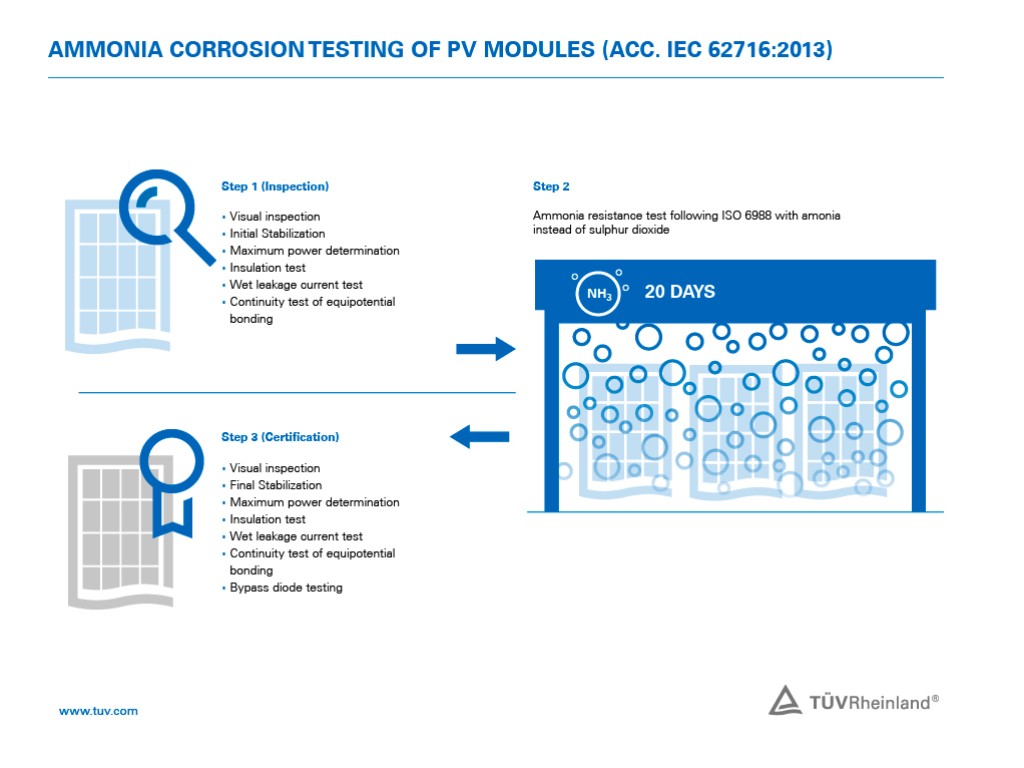
As the world shifts towards renewable energy, the installation of solar panels on agricultural lands has become increasingly common. However, this practice can have a significant impact on the performance of solar modules due to the high concentration of ammonia present in farm air. To address this issue, standardized tests for resistance to ammoniacal corrosion have been established.
Understanding the Importance of Resistance Tests
In order to ensure the quality and reliability of solar modules, manufacturers must conduct rigorous testing procedures to assess their resistance to corrosive substances like ammonia. The two most widely recognized tests for resistance to ammoniacal corrosion are IEC 62716 TÜV Rheinland and DLG. Both tests evaluate the modules’ ability to withstand the corrosive effects of ammonia and accept a maximum loss of power of up to 5%.
History of Resistance Testing
The concept of testing solar modules for resistance to corrosive substances dates back to the early 2000s. However, it wasn’t until the 2010s that standardized tests were established for ammoniacal corrosion in agricultural settings. The development of these tests was driven by the need to address the specific challenges posed by ammonia-rich environments in farm air.
How Resistance Tests Are Conducted
Resistance tests involve evaluating various parameters, including power loss, visual inspection, and insulation resistance. In TÜV Rheinland’s corrosion test, modules are subjected to extreme conditions for 20 consecutive days, with exposure to ammonia levels of up to 6,667 ppm (parts per million) for 8 hours at temperatures of 140°F (60°C) with 100% humidity. Afterward, they undergo 16 hours of drying in a standard atmospheric environment at a temperature of 73°F (23°C) and a maximum humidity level of 75%. In contrast, DLG’s resistance test exposes modules to ammonia levels of up to 750 ppm at a temperature of 158°F (70°C) for 1,500 hours. This simulation mimics the lifespan of products around 20 years.
Leading Performers in Resistance Testing
Canadian Solar, one of the world’s leading module manufacturers, has consistently demonstrated superior performance in resistance testing. Their modules have been tested according to IEC 62716, TÜV Rheinland’s corrosion test project C, and DLG standards for agricultural applications. The results show that Canadian Solar’s modules exhibit a minimum power loss of 0.8% in the TÜV Rheinland test and less than 1.3% in the DLG tests.
Canadian Solar’s Exceptional Performance
The certification of Canadian Solar’s CS6P-P, CS6P-M, CS6A-M, CS5A-M, CS6X-P, CS6X-M, CS6A-P, CS6A-M, CS5P-M, CS5P-P, CS6C-M, CS6C-P, and CS5C-M modules by TÜV Rheinland and the DLG test confirms their exceptional performance. As Chairman and CEO of Canadian Solar, Shawn Qu, comments: “We are proud of our Research and Development division and our innovations, which enable us to offer top-notch solar modules to our clients and partners. The resistance tests have highlighted the suitability of our modules for real-world applications in Germany and beyond.”
Impact on Industry
The development of standardized tests for resistance to ammoniacal corrosion has had a significant impact on the industry. It has raised awareness about the importance of testing solar modules for specific applications, such as agricultural fields. This has also led to increased investment in research and development, with manufacturers like Canadian Solar prioritizing innovation and excellence in their products.
Challenges Ahead
Despite the progress made in resistance testing, there are still challenges ahead. One of the main concerns is ensuring that all solar modules can withstand the corrosive effects of ammonia-rich environments. Additionally, there is a need for more research on the long-term effects of exposure to ammonia on solar module performance.
Conclusion
The importance of resistance testing for solar modules cannot be overstated. By understanding the tests and results, we can ensure the quality and reliability of these essential components. As the demand for renewable energy continues to grow, it’s crucial that manufacturers like Canadian Solar prioritize innovation and excellence in their products.
Recommendations
Based on the research conducted, the following recommendations are made:
- Increased investment in research and development: Manufacturers should prioritize investing in research and development to improve the performance of solar modules in specific applications.
- Standardized testing protocols: Standardized testing protocols should be established for all types of solar modules to ensure consistency and reliability across different manufacturers.
- Public awareness campaigns: Public awareness campaigns should be launched to educate consumers about the importance of resistance testing for solar modules.
- Collaboration between industry stakeholders: Collaboration between industry stakeholders, including manufacturers, researchers, and regulators, is essential to address the challenges posed by ammonia-rich environments.
Future Directions
The future directions for resistance testing in the solar industry are exciting and rapidly evolving. Some potential areas of focus include:
- Advanced materials and technologies: Research into advanced materials and technologies that can improve the performance of solar modules in specific applications.
- Increased testing protocols: The development of more comprehensive testing protocols to address the long-term effects of exposure to ammonia on solar module performance.
- International collaboration: Collaboration between industry stakeholders across different countries to establish standardized testing protocols and ensure consistency.
Conclusion
The top performers, such as Canadian Solar, have demonstrated exceptional resistance to ammoniacal corrosion in agricultural settings. However, there is still much work to be done to address the challenges posed by ammonia-rich environments. By prioritizing innovation and excellence in their products, manufacturers can ensure that solar modules meet the demands of specific applications while maintaining their quality and reliability.


