
Introduction
After explaining the differences between C3 and C4 plants, it’s time to dive into the fascinating world of CAM (Crassulacean Acid Metabolism) plants. Also known as succulents, these plants have evolved a unique way of photosynthesis that allows them to thrive in arid environments with limited water availability.
The concept of CAM has been widely studied and understood for decades, but there is still much to be learned about this complex metabolic pathway. In this article, we will delve into the world of CAM plants, exploring their anatomy, metabolism, and unique characteristics that set them apart from other types of plants.
What is CAM?
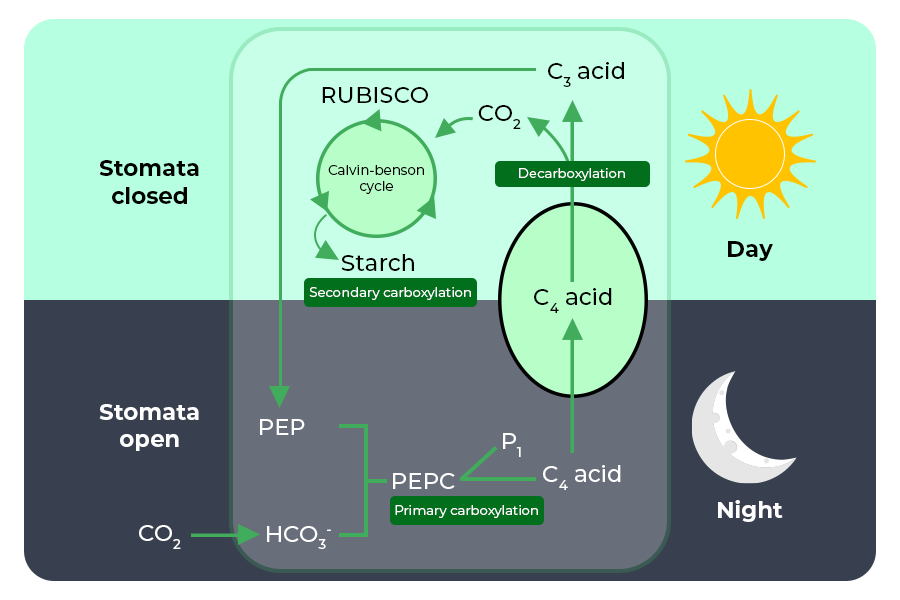
The term CAM refers to a metabolic pathway first observed in the Crassulacean family of plants. This pathway involves the uptake of CO2 at night and storage of it in organic acids, which are then released during the day through the stomata.
CAM metabolism is characterized by the separation of day and night processes, allowing plants to conserve water while maximizing CO2 uptake and photosynthesis. This adaptation enables CAM plants to thrive in environments with limited water availability, such as deserts and arid regions.
Anatomy of CAM Plants
CAM plants have distinct anatomical features that distinguish them from C3 and C4 plants. Their parenchyma tissue contains non-photosynthetic cells with large vacuoles responsible for water storage. This adaptation allows CAM plants to conserve water in environments where precipitation is scarce.
In addition, CAM plants have thickened cell walls, reduced leaf area, and increased surface area of the stomata, which helps to reduce transpiration and increase CO2 uptake. These structural adaptations enable CAM plants to optimize their photosynthetic activity while minimizing water loss.
The CAM Metabolism
In arid regions, CAM plants have developed mechanisms to limit transpiration (the loss of water through the epidermal surface) and increase CO2 availability at night. During the day, when stomata are closed, the stored CO2 is used by the Rubisco enzyme to produce glucose through the Calvin cycle.
The CAM metabolism involves several key steps:
- CO2 Uptake: CO2 enters the leaf cells through the stomata during the night.
- Organic Acid Synthesis: The CO2 is converted into organic acids like malate or citrate, which are stored in the vacuoles.
- Decarboxylation: During the day, the stored malate is transported to the chloroplasts, where it’s decarboxylated by the enzyme malate dehydrogenase, releasing CO2.
- Photosynthesis: The released CO2 is used by the Rubisco enzyme to produce glucose through the Calvin cycle.
The Separation of Day and Night
In CAM plants, there’s a clear separation between day and night processes. At night, stomata open, allowing CO2 uptake, while during the day, stomata are closed, preventing water loss.
This separation allows CAM plants to conserve water by limiting transpiration and increasing CO2 availability at night. By releasing stored CO2 through decarboxylation during the day, CAM plants can maximize their photosynthetic activity while minimizing water loss.
CO2 Uptake and Storage
During the night, CO2 enters the leaf cells through the stomata, where it’s converted into organic acids like malate or citrate. These acids accumulate in the vacuoles and can be used as a carbon source during the day.
The stored CO2 is then released through decarboxylation during the day, allowing the Rubisco enzyme to produce glucose through the Calvin cycle. This process is essential for CAM plant survival, as it enables them to conserve water while maximizing photosynthesis.
Decarboxylation and Photosynthesis
At night, the stored malate is transported to the chloroplasts, where it’s decarboxylated by the enzyme malate dehydrogenase, releasing CO2. This process allows the Rubisco enzyme to produce glucose through the Calvin cycle during the day.
The released CO2 is then used by the Rubisco enzyme to produce glucose through the Calvin cycle, which involves the fixation of CO2 into organic compounds like glucose and other sugars.
Key Differences with C4 Plants
While CAM plants share some similarities with C4 plants, they have distinct differences in their metabolism. C4 plants store CO2 in organic acids during the day, which are then converted into malate at night. In contrast, CAM plants release stored CO2 through decarboxylation during the day.
This difference is crucial, as it affects the overall metabolic pathway of each plant type. C4 plants rely on their ability to store CO2 during the day and convert it into malate at night, while CAM plants use a different strategy by storing CO2 in organic acids overnight and releasing it through decarboxylation during the day.
Examples of CAM Plants
CAM plants include succulents like aloe vera and agave, as well as some orchids and pineapples. These plants have adapted to thrive in environments with limited water availability by employing the CAM pathway.
Some common characteristics of CAM plants include:
- Thickened cell walls
- Reduced leaf area
- Increased surface area of the stomata
- Non-photosynthetic cells with large vacuoles for water storage
These adaptations enable CAM plants to optimize their photosynthetic activity while minimizing water loss in arid environments.
Conclusion
The CAM pathway is an fascinating example of plant evolution, allowing succulents and other Crassulacean plants to survive in arid environments. By separating day and night processes, these plants conserve water while maximizing CO2 uptake and photosynthesis.
Understanding the mechanisms of CAM metabolism can provide insights into plant adaptation strategies and help us develop more efficient methods for conserving water in agricultural settings. Additionally, studying CAM plants can inspire new approaches to water conservation in ecosystems, highlighting the importance of understanding the intricate relationships between plants, climate, and environment.
Frequently Asked Questions (FAQs)
- What is the main purpose of CAM metabolism?
The primary goal of CAM metabolism is to conserve water by limiting transpiration and increasing CO2 availability at night. - How do CAM plants adapt to arid environments?
CAM plants develop mechanisms to limit transpiration, such as closing stomata during the day, and increase CO2 uptake at night through open stomata. - What is the role of Rubisco in CAM metabolism?
Rubisco plays a crucial role in CAM metabolism by using stored CO2 from the previous night’s photosynthesis to produce glucose during the day. - How do CAM plants differ from C4 plants?
CAM plants store CO2 in organic acids overnight, whereas C4 plants convert CO2 into malate during the day and release it at night. - Can any plant use the CAM pathway?
Only a subset of Crassulacean plants have evolved the CAM pathway, including succulents like aloe vera and agave. - What is the benefit of CAM metabolism for plants?
CAM metabolism allows plants to conserve water while maximizing CO2 uptake and photosynthesis in arid environments. - Can CAM plants be cultivated in greenhouses or indoor settings?
Yes, some CAM plants can thrive in controlled environments with proper lighting, temperature, and watering conditions. - Are there any potential limitations or drawbacks to using the CAM pathway?
While the CAM pathway is effective for conserving water, it may limit plant growth rates compared to C3 or C4 plants in well-watered environments.
By understanding the mechanisms of CAM metabolism, we can unlock new opportunities for improving crop yields, conserving water resources, and promoting sustainable agriculture practices.


