
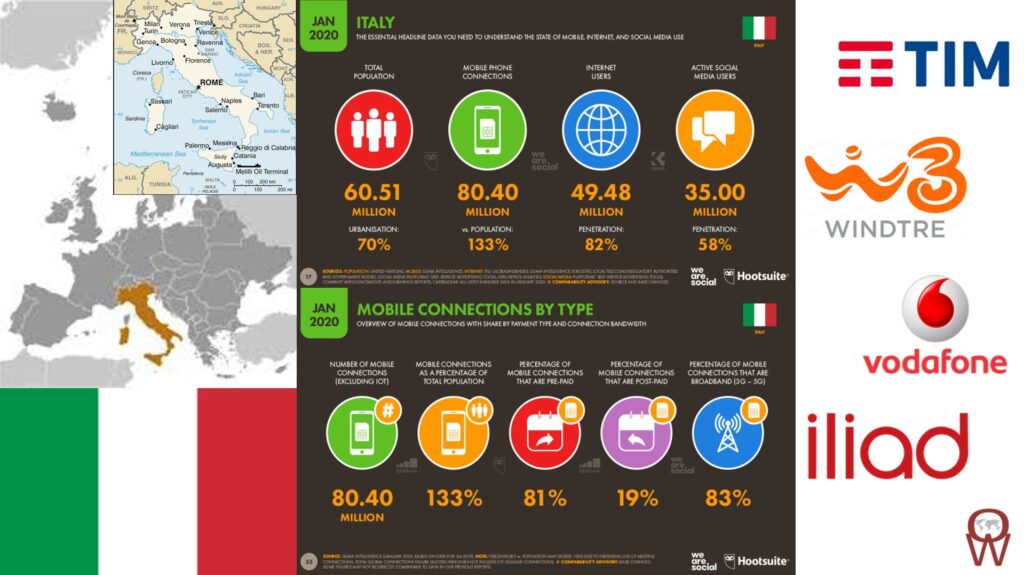
Italy Shines in Europe: Broadband and Mobile Telephony
The digital divide in Italy remains a significant issue, with a large gap between those who have access to broadband and those who do not. According to a report by the European Commission, there is still much work to be done to bridge this gap. Despite investments from various operators, the growth of fiber-optic networks for broadband is slower than the average in Europe.
However, the report does highlight an important aspect that benefits Italy: mobile telephony. In the field of mobile broadband, Italy is leading the way with a penetration rate of 66.3%, double that of 2011 and higher than the EU average of 61.1%. This means that while people may struggle to get online at home or at work, smartphones and tablets are flying through broadband networks thanks to 3G HSDPA, 4G, LTE technology.
The Italian passion for mobile phones and similar devices is undeniable, which has contributed to this impressive growth in mobile broadband penetration. The country’s strong tradition of innovation and technological advancements has played a significant role in driving the development of modern telecommunications infrastructure.
The Rise of Mobile Broadband in Italy
This means that while people may struggle to get online at home or at work, smartphones and tablets are flying through broadband networks thanks to 3G HSDPA, 4G, LTE technology. This is not surprising, given the Italian passion for mobile phones and similar devices.
Mobile broadband has become an essential part of daily life in Italy, with many people using their smartphones and tablets to stay connected on-the-go. The latest advancements in mobile broadband have made it possible for users to access high-speed internet anywhere, anytime, which has revolutionized the way people live, work, and communicate.
The Latest Development: LTE Advanced
At the recent Telecom event in Turin, the latest evolution of digital mobile networks was announced: LTE Advanced, available experimentally on Tim’s 4G network. This new technology can transmit data at speeds of up to 180 Mbps per download.
LTE Advanced is a significant step forward in mobile broadband technology, offering faster data transfer rates and improved performance compared to previous generations of 3G and 4G networks. The availability of this technology on commercial networks will undoubtedly lead to increased adoption and usage among consumers, businesses, and governments.
Goodbye Tethering and Hello Streaming
Do you remember the days when connecting via smartphone tethering meant a hefty price tag, slow internet, and constant buffering? And don’t forget those ancient Internet chips that were your only hope for online connectivity when ADSL wasn’t available? Well, those days are long gone. With the latest advancements in mobile broadband, it’s now possible to stream high-definition videos with no interruptions or lag.
Mobile broadband has also made it easier for people to access a wide range of online services and applications, including streaming platforms, social media, online banking, and e-commerce sites. The convenience and flexibility of mobile broadband have transformed the way we live, work, and interact with each other.
The Future of Mobile Broadband
Today, Italy is playing a significant role in this mobile broadband revolution and is not taking things lying down. With 97% coverage of the population and a growth rate of 131% for LTE networks, the country is well on its way to achieving full-fledged broadband capabilities.
However, there’s still one area where Italy lags behind: offering competitive pricing plans. Use online comparison tools to find the best deals for your mobile phone and internet services.
Competitive Pricing Plans
Offering competitive pricing plans is crucial for driving adoption and usage of mobile broadband in Italy. The current market offers a range of pricing options, from prepaid to postpaid plans, but consumers often struggle to find affordable and flexible options that meet their needs.
To address this issue, operators are exploring innovative pricing models, such as data-sharing plans, bundled services, and streaming packages. These new pricing strategies aim to make mobile broadband more accessible and affordable for a wider audience.
Government Initiatives
The Italian government has recognized the importance of mobile broadband in driving economic growth, job creation, and social development. To address the digital divide, the government has launched initiatives aimed at increasing access to broadband infrastructure, improving internet speeds, and promoting digital literacy among citizens.
One notable initiative is the “Bando digitale” program, which provides funding for operators to build out their networks and improve coverage in underserved areas. The program also includes measures to promote digital inclusion and awareness-raising campaigns to encourage people to adopt mobile broadband technologies.
In conclusion, Italy has made significant strides in developing its mobile broadband infrastructure, with impressive growth rates and a leading penetration rate in Europe. While challenges persist, such as the digital divide and competitive pricing plans, the country’s strong tradition of innovation and technological advancements will undoubtedly help address these issues.
Mobile broadband has become an essential part of daily life in Italy, offering faster data transfer rates, improved performance, and increased accessibility compared to previous generations of 3G and 4G networks. As the technology continues to evolve, it’s likely that mobile broadband will play an increasingly important role in shaping the country’s digital future.
Other Relevant Articles You Might Enjoy
- What ADSL Plan Should I Choose?
- Fiber Optic vs. ADSL: Which is Better?
- Top 5 Mobile Phones for Streaming High-Definition Videos
- How to Choose the Best Internet Service Provider (ISP) for Your Needs


