
The introduction of Popillia japonica, a new beetle species, has posed a significant threat to Italian crops. First introduced in Italy in 2014, this insect’s feeding habits have caused considerable damage during hot summer periods when it emerges from the soil to feed on leaves, flowers, and stems of plants.
To fully comprehend how to eliminate Popillia japonica, we will delve into its life cycle.
Identifying Popillia Japonica
Popillia japonica is a distinctive beetle with an oval shape, measuring 8-11 mm in length and 5-7 mm in width. Its greenish-blue body coloration and bronze-colored wings (elytra) make it easily recognizable. A key identifying feature is the presence of small white hairs around its abdomen, which are visible on both sides and at the rear.
Identifying Infested Plants
Infested plants exhibit distinctive symptoms: their leaves take on a skeletal appearance and retain only the vascular tissue. Popillia japonica feeds on various plant parts, including leaves, fruits, and flowers. It starts feeding from the top of the plant, gradually moving down to lower leaves.
In groups, if the number of individuals is high, the plant’s health is severely compromised.
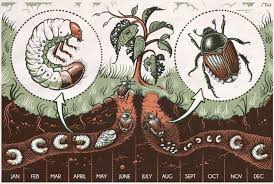
The Life Cycle of Popillia Japonica
Females deposit individual eggs in the soil, marking the beginning of two vital stages for the insect. Popilla japonica emerges from the ground around late May, as temperatures begin to rise. In northern Italy, where this pest is most prevalent, it emerges between June and July.
The egg hatching process gives birth to larval stages that can reach 20-25 cm in length. These larvae are transparent with a white-creamy color and feed on the roots of herbaceous plants. For extended periods, these larvae stay underground, surviving the harsh winter by going into dormancy and adopting a characteristic “C” shape. During this phase, they grow and feed until the arrival of spring, when they resume activity.
As the larvae mature, they transform into pupae, marking the penultimate stage in the insect’s life cycle. These 15 mm-long pupae are confined to underground cells and will eventually give rise to adult beetles. The cycle begins anew around May in southern Italy, as new adults emerge from the ground, mate, and reproduce at the expense of plant foliage.
Biological Control: Eliminating Popillia Japonica
Detailed information on how to eliminate Popillia japonica can be found in the article: “Lotta alla popillia japonica”. Through biological control methods, we target the Popillia japonica during its most vulnerable phase – the larval stage.
Let’s dive deeper into each of these stages:
- Larval Stage: This is where biological control methods can effectively eliminate Popillia japonica.
- Adult Stage: While biological control targets the larval stage, understanding the adult stage is still essential for effective management.
- Egg and Pupal Stages: Understanding these stages helps in developing a comprehensive strategy to control Popillia japonica.
The life cycle of Popillia japonica, while intricate, holds the key to understanding how to effectively manage this invasive pest species.
Understanding the Importance of Crop Rotation
Crop rotation is an essential component of integrated pest management (IPM) strategies for Popillia japonica. By rotating crops and incorporating certain plant species into the rotation, farmers can reduce the likelihood of infestation by making it less favorable for the beetle to feed on plants.
Some recommended practices include:
- Planting legumes in rotation with non-legume crops
- Incorporating grasses or other perennial herbaceous plants into the rotation
- Using cover crops or green manures during off-seasons
Integrated Pest Management (IPM) Strategies
To effectively manage Popillia japonica, farmers should adopt a holistic approach that incorporates multiple strategies. Some recommended IPM approaches include:
- Biological control: Targeting the larval stage to eliminate the beetle population
- Cultural controls: Managing crop rotation, planting specific crops, and reducing soil disturbance
- Chemical controls: Using targeted insecticides or systemic pesticides as a last resort
Innovative Solutions: Developing New Control Methods
Researchers are continually working on developing new control methods for Popillia japonica. Some innovative approaches include:
- Genetic modification: Breeding plants that are resistant to beetle feeding
- Biological pesticides: Using biological agents to control the beetle population
- Advanced traps: Developing more effective traps to capture adult beetles
By staying up-to-date with these emerging technologies, farmers can make informed decisions about which methods to use and when.
Conclusion:
In conclusion, the life cycle of Popillia japonica is complex and crucial for effective management. By understanding each stage, from egg hatching to pupation, we can develop targeted strategies to eliminate this destructive pest species. Biological control methods offer a promising approach by targeting the vulnerable larval stage.
FAQs:
- What are the distinctive features of Popillia japonica, making it easily recognizable?
- The beetle’s oval shape, greenish-blue body coloration, and bronze-colored wings (elytra) make it easily identifiable.
- How do infested plants exhibit symptoms?
- Infested plants take on a skeletal appearance with only vascular tissue remaining.
- What stages of the Popillia japonica life cycle are most vulnerable to biological control methods?
- The larval stage is most susceptible to biological control, making it an effective target for elimination.
- When do new adults emerge from the ground in southern Italy, marking the beginning of a new cycle?
- New adults emerge around May in southern Italy, initiating a new life cycle and allowing Popillia japonica to reproduce at the expense of plant foliage.
- How long can larvae stay underground before resuming activity?
- Larvae remain underground for extended periods, surviving harsh winters by going into dormancy, only to resume growth and feeding when spring arrives.
- What is the primary cause of damage caused by Popillia japonica to infested plants?
- When Popillia japonica attacks in groups, it can severely compromise plant health due to its voracious appetite for foliage, stems, and other plant parts.
- In what region does Popillia japonica primarily thrive and reproduce?
- This insect is most prevalent in northern Italy but also reproduces in southern Italy during the spring months.
By understanding these intricacies of the Popillia japonica life cycle and its impact on Italian crops, we can develop effective strategies for managing this invasive pest species.


