
Introduction to Behavioral Economics
As the Nobel Prize in Economics was recently awarded to a new branch of economic thought, few people knew what it was all about. However, this field has been around for some time, and its influence is growing rapidly. Behavioral economics is an important area that reminds us that we are human beings, unpredictable and often irrational. This also applies when making financial decisions.
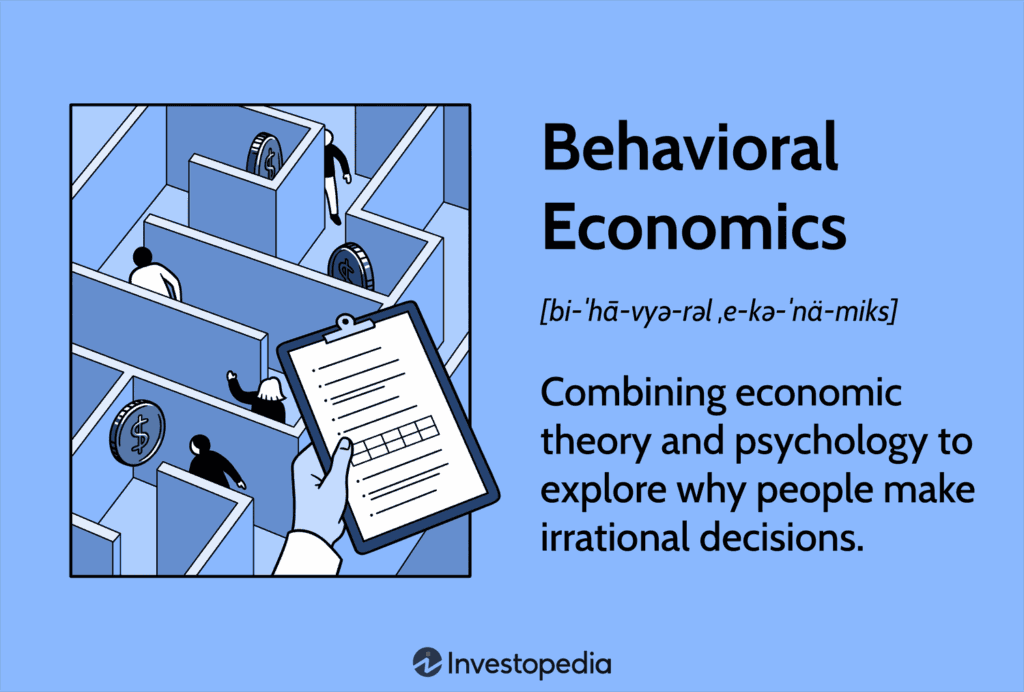
Behavioral economics seeks to explain why individuals make the economic choices they do, rather than simply following traditional economic theories. It acknowledges that people do not always act rationally or in their own best interests, but instead, are influenced by a range of psychological and emotional factors.
What is Behavioral Economics?
Behavioral economics describes the way financial phenomena unfold by applying principles borrowed from psychology. In a sense, it contaminates rigid market laws with a touch of humanity, making them more authentic and true to reality. There are human factors that cannot be codified in equations and influence individual decisions and market outcomes.
Behavioral economics is a multidisciplinary field that draws on insights from psychology, neuroscience, sociology, anthropology, and philosophy to understand how people make economic decisions. It recognizes that people’s choices are influenced by a range of cognitive biases, emotional responses, and social factors, which can lead to suboptimal decision-making.
The Book that Opened the Door
A book titled “Economia comportamentale” (Behavioral Economics) by Erik Angner is a comprehensive guide to theory of choice. It provides an introduction to behavioral economics and its applications in various fields, including finance, marketing, and public policy. The book is written for economists, business professionals, and policymakers who want to understand the principles of behavioral economics and how they can be applied to real-world problems.
Examples of Behavioral Economics in Action
The behavioral economics field has managed to change the mindset of some businesses that have realized the need to consider human factors when making decisions. Human attitudes influence economic behavior and are more powerful than theoretical laws.
For instance, we often want to save for retirement or invest in a particular sector due to unforeseen events or disasters. Studying behavioral economics means stimulating citizens to make conscious and positive choices, such as conserving energy and recycling waste.
Another example of behavioral economics in action is the use of nudges in public policy. Nudges are subtle changes to the environment that influence people’s behavior without limiting their freedom of choice. For instance, a study found that when people were offered a free dessert with every purchase at a restaurant, they were more likely to order healthy food options.
Cognitive Economics: A New Perspective
Another branch of economic thought is cognitive economics, which emerged after the Nobel Prize was awarded in 2003 for Vernon Smith and Daniel Kahneman. Like behavioral economics, it adds a touch of humanity to traditional theoretical models.
Cognitive economics recognizes that people’s thoughts, feelings, and experiences influence their economic decisions. It emphasizes the importance of understanding how people process information, make decisions, and respond to incentives.
For example, cognitive economics teaches us that the level of satisfaction achieved by an individual does not depend on the amount of goods they possess but rather on the difference between their initial and final conditions. This may seem simple, yet it was previously overlooked and ignored in most economic theories.
Behavioral Economics in Universities
Both behavioral economics and cognitive economics are now taught at universities that offer courses on economics, including those focused on psychology. The Nobel Prize has certainly helped these branches of economics gain acceptance even among the most traditional academic institutions.
Many top business schools, such as Harvard Business School and Stanford Graduate School of Business, have established behavioral economics programs to teach students how to apply behavioral economics principles in their careers.
The Nobel Prize Winner: Richard H. Thaler
In 2017, Richard H. Thaler, from the University of Chicago, received the Nobel Prize for his studies that revolutionized standard economic theory, which was too rigid and detached from reality.
Thaler urges us to observe individual choices and how they are often irrational. Generally, people tend to simplify financial decisions by making isolated calculations and ignore the overall impact of their single decision on the broader picture. What happens is that we tend to value goods more or less based on whether they belong to us or not. This is because we have an innate aversion to loss.
Thaler’s work challenges traditional economic theories, such as the Efficient Market Hypothesis and the Rational Choice Model. He argues that these models are too simplistic and do not account for the complexities of human behavior.
The Role of Emotions in Behavioral Economics
Emotions play a significant role in behavioral economics. People make financial decisions based on their emotions, rather than just rational calculations. For instance, people tend to invest in assets when they feel good about their prospects, but avoid investing when they are uncertain or fearful.
This is because emotions influence our decision-making processes and can lead us to take risks that we might not have taken otherwise. Understanding the role of emotions in behavioral economics is essential for developing effective policies and strategies that promote financial well-being.
The Impact of Social Norms on Behavioral Economics
Social norms also play a significant role in behavioral economics. People are more likely to adopt certain behaviors or attitudes when they feel that others around them are doing the same.
For example, if most people around us prioritize saving for retirement, we are more likely to do the same. This is because social norms influence our behavior and can lead to a kind of “social proof” where we follow the crowd rather than making our own decisions.
Behavioral Economics in Practice
Behavioral economics has numerous applications in various fields, including finance, marketing, public policy, and healthcare.
In finance, behavioral economics is used to develop strategies that help individuals make better financial decisions. For example, researchers have developed financial education programs that use simple, easy-to-understand language to explain complex financial concepts.
In marketing, behavioral economics is used to design products and services that appeal to customers’ emotions and desires rather than just their rational preferences. For instance, companies may use emotional appeals in advertising campaigns to create a positive brand image.
Conclusion
Behavioral economics is a rapidly growing field that recognizes the importance of understanding human behavior when making financial decisions. By applying principles from psychology and neuroscience, behavioral economists can develop more effective policies and strategies that promote financial well-being.
The Nobel Prize has helped raise awareness about the importance of behavioral economics, and it is now widely accepted as an essential part of economic thought. As we continue to navigate complex financial challenges, understanding human behavior will be crucial for developing effective solutions.
Related Articles
- Environmental Low-Impact Economy
- Circular Economy


