
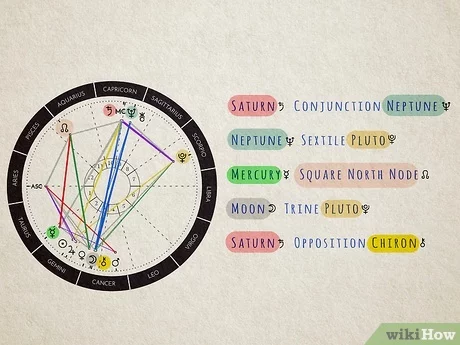
Understanding Conjunction Astral: The Significance of Celestial Alignments
As the saying goes, “congiunzione astrale” is a way of speaking that belies its actual meaning as a real astronomical phenomenon with significant implications. Not every day we observe conjunctions between celestial bodies; otherwise, they wouldn’t be considered conjunctions at all.
What is Conjunction Astral in Astronomy?
In astronomy, a conjunction occurs when two planets, observed from Earth’s center, share the same longitude or right ascension. Let’s take our planet and the Moon as examples. At the new moon, the Moon appears between the Earth and the Sun, displaying its far side to us.
When two celestial bodies align on opposite sides of the Sun, we refer to it as an opposition. Conjunction astrale typically involves multiple celestial bodies coming together in alignment. This phenomenon can be observed not only from our planet but also from other planets and even other planetary systems.
Understanding Conjunction Astral in Different Planetary Movements
Conjunction astral can be explained in various ways, depending on whether we’re dealing with inner or outer planets. In cases involving inner planets like Mercury and Venus, there are two possible configurations: when a planet is positioned between the Earth and the Sun (inferior conjunction), or when it’s situated between the Sun and the Earth (superior conjunction).
For outer planets, a conjunction occurs when one of them aligns with the opposite side of the Sun. This is referred to as opposition if only one planet is involved; however, if two planets are aligned or a planet and a star are involved, we speak of a conjunction.
The Term Conjunction Astral
When two or more celestial bodies come together in alignment, we refer to it as a conjiuction astrale. This term can also be used in everyday conversation to describe favorable coincidences that seem almost inevitable. In this context, the phrase “congiunzione astrale” has nothing to do with actual astronomical events.
In astrology, conjunctions are often seen as significant events that hold meaning for those born under certain zodiac signs. By analyzing the involved planets and their positions, astrologers attempt to uncover deeper insights into human affairs.
Music and Conjunction Astral
Even artists like Nek have incorporated themes of conjunction astrale into their music. Take a look at the lyrics from one of his songs:
“It’s for how you looked at me,
for your serious silences,
for the desire to live and let me be,
for what I’ve learned without ever knowing,
for the desire to laugh and un-dramatize,
we’re never far apart,
moving forward together, this love can’t be stopped,
it’s a congiunzione astrale…”
In his song, Nek weaves a narrative that emphasizes the connection between two people. The concept of conjunction astrale is used as a metaphor for their deep bond and shared understanding.
Conjunction Astral in Astrology
Astrologers pay close attention to planetary conjunctions because they believe these events hold significant meaning for those born under certain zodiac signs. By analyzing the involved planets and their positions, astrologers attempt to uncover deeper insights into human affairs.
For example, when Venus aligns with Mars, it is often seen as a sign of passion and energy in relationships. On the other hand, when Saturn combines with Jupiter, it may indicate a period of stability and growth.
In conclusion, conjunction astrale is more than just a catchy phrase; it’s a legitimate astronomical phenomenon that deserves our attention. Whether we view it as a way to describe coincidences in everyday life or a deeper, cosmic reality, understanding conjunctions helps us appreciate the intricate workings of our universe.
Frequently Asked Questions (FAQs)
- Q: What is the difference between an opposition and a conjunction astrale?
A: An opposition occurs when two celestial bodies align on opposite sides of the Sun. Conjunction astrale typically involves multiple celestial bodies coming together in alignment. - Q: Can any planet participate in a congiunction astrale?
A: Yes, any two or more planets can be involved in a conjunction astrale. It’s not limited to specific types of celestial bodies. - Q: How often do conjunctions astrale occur?
A: The frequency and timing of conjunction astrale events vary depending on the specific celestial bodies involved and their orbital patterns. - Q: What is the significance of congiunzione astrale in everyday life?
A: While it’s not a direct influence, conjunction astrale can be seen as a metaphor for coincidences that may shape our lives in meaningful ways. - Q: Can conjunction astrale be predicted using astronomical methods?
A: By analyzing celestial movements and positions, astronomers can anticipate when and where conjunction astrale events will occur. - Q: How does astrology utilize congiunzione astrale to gain insight into human affairs?
A: Astrologers use the positions of planets and other celestial bodies to understand their interactions and potential effects on individuals born under specific zodiac signs. - Q: Are conjunction astrale events exclusive to Earth’s vicinity?
A: While conjunction astrale occurs within our solar system, it can also be observed in other planetary systems and galaxies.


