
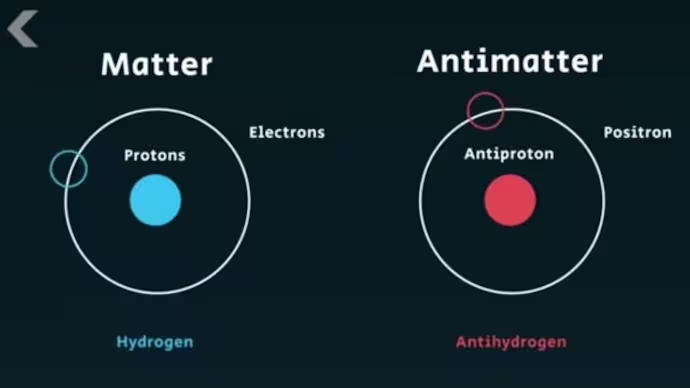
Antimatter has long been a staple of science fiction, but in reality, it has numerous applications that are being explored by scientists and researchers around the world. To understand the concept of antimatter, let’s delve into its history, properties, and significance.
What is Antimatter?
Matter, as we know it, consists of particles with mass, such as electrons and protons. Antimatter, on the other hand, is composed of antiparticles that have identical masses but opposite charges. The concept of antimatter was first proposed by Arthur Schuster in 1898.
The Principle of Symmetry
Antimatter exhibits symmetrical properties, similar to those of matter. When particles and antiparticles interact, they cancel each other out, a process known as annihilation. This phenomenon is governed by the principle of conservation of mass-energy.
The Birth of Antimatter
In 1965, scientists at CERN produced the first nucleon of antideuterium using an accelerator particle (Proton Synchrotron). Since then, numerous experiments have been conducted to study antimatter and its properties.
CERN’s Contributions to Antimatter Research
- In 1997, researchers created the first atoms of anti-hydrogen at CERN.
- In 2010, the experiment ALPHA produced a record-breaking 38 atoms of antihydrogen for 10 milliseconds.
- In 2011, the same experiment produced 300 atoms of antihydrogen for 1000 seconds.
- In 2014, ASACUSA at CERN created the first beam of antihydrogen and detected 80 atoms.
The Significance of Antimatter
Despite its elusive nature, antimatter has potential applications in various fields, such as medicine and technology. For example, positron emission tomography (PET) uses antimatter to diagnose cancer and other diseases.
Paul Dirac’s Discovery
In 1928, physicist Paul Dirac proposed the existence of antiparticles as a solution to the relativistic equation of Schrödinger. His work laid the foundation for modern particle physics.
Conclusion
Antimatter is a fascinating field that continues to captivate scientists and researchers. Its unique properties and potential applications make it an exciting area of study.
Frequently Asked Questions (FAQs)
- What is antimatter?
Antimatter is composed of antiparticles with identical masses but opposite charges. - How was antimatter discovered?
Paul Dirac proposed the existence of antiparticles in 1928, while Arthur Schuster first used the term “antimatter” in 1898. - What are some applications of antimatter?
Antimatter has potential uses in medicine, technology, and space exploration. - Can we create antimatter in a laboratory?
Yes, scientists have successfully produced and stored antimatter particles at CERN and other research facilities. - Is antimatter abundant in the universe?
No, antimatter is extremely rare in the universe, with only a few particles known to exist. - Can we harness the power of antimatter?
Researchers are exploring ways to utilize antimatter energy for propulsion systems in space travel. - What are some challenges associated with working with antimatter?
Antimatter is highly unstable and requires specialized equipment and storage facilities to maintain its integrity.
References
- CERN: The official website of the European Organization for Nuclear Research (CERN).
- Nature: A scientific journal that has published numerous articles on antimatter research.
- ScienceDirect: An online platform that provides access to scientific and technical journals, including those related to antimatter.
Further Reading
- “The Antimatter Handbook” by David J. Griffiths
- “Antimatter: A Very Short Introduction” by John Gribbin
Theoretical Background of Antimatter
- Matter-Antimatter Symmetry
Matter and antimatter are related to each other through a mathematical concept known as the isospin symmetry. - Quark Model
The quark model explains how particles like protons and neutrons combine to form atomic nuclei, which play a crucial role in understanding antimatter properties. - Higgs Mechanism
The Higgs field and mechanism provide a way to explain why some particles acquire mass while others do not, an essential aspect of antimatter research.
Experimental Methods for Antimatter Production
- Particle Accelerators
Particle accelerators accelerate charged particles to high energies, allowing scientists to study their properties and interactions. - Antiproton Decay Experiment
The antiproton decay experiment studies the decay of antiprotons into other particles, providing insights into antimatter physics.
Current Status of Antimatter Research
- CERN’s Antimatter Program
CERN is at the forefront of antimatter research, with ongoing experiments and initiatives to study its properties and applications. - NASA’s Antimatter Research Initiative
NASA is exploring ways to utilize antimatter energy for propulsion systems in space travel.
Future Prospects for Antimatter Research
- Quantum Computing and Cryptography
Antimatter-based quantum computing and cryptography have the potential to revolutionize fields like data security and processing. - Nuclear Power Generation
Researchers are exploring ways to harness the power of antimatter reactions for sustainable energy production.
Open Questions in Antimatter Research
- Antimatter Abundance
Scientists continue to study the distribution of antimatter particles in the universe, seeking answers to this fundamental question. - Antimatter Stability and Storage
Researchers face challenges in storing antimatter particles for extended periods due to their high reactivity.
Conclusion
The mysteries surrounding antimatter continue to captivate scientists and researchers alike. As we delve deeper into its properties and applications, new breakthroughs and discoveries are emerging. The ongoing research at CERN, NASA, and other institutions holds great promise for unlocking the secrets of antimatter.


