
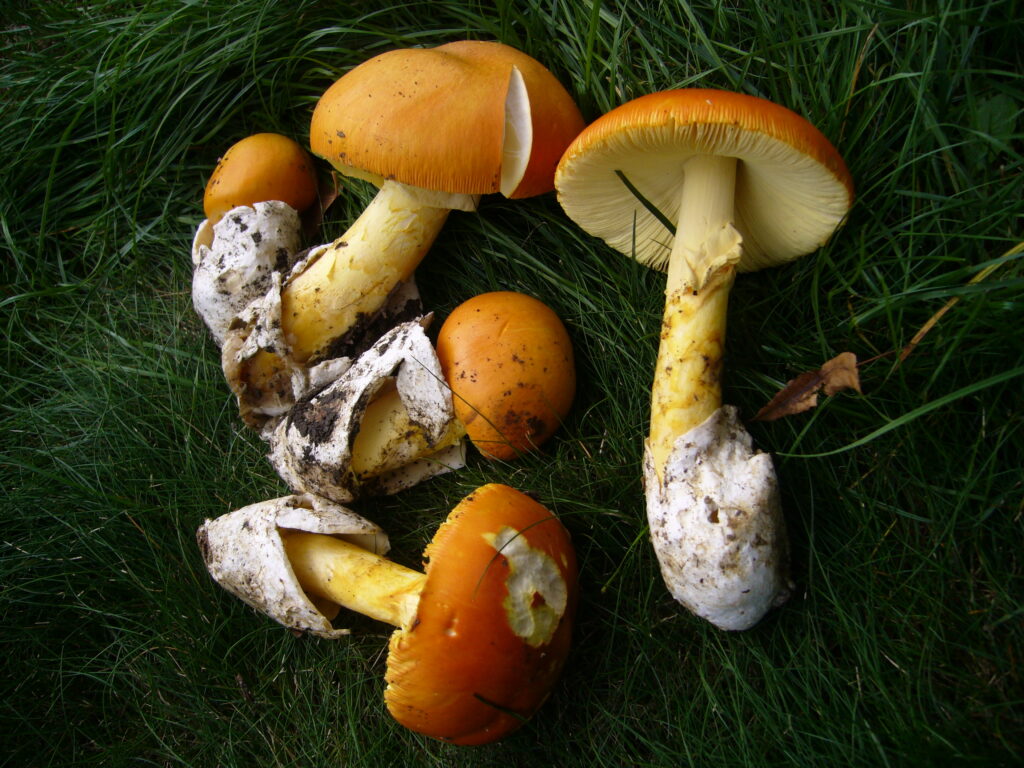
Have you ever heard of the Amanita caesarea? It’s a fairly common mushroom that some people use for culinary purposes, and it has been around for very ancient times. Its name – “fungo di Cesare” – hints at its origins perfectly!
But what are its characteristics? And what do you absolutely need to know about this mushroom?
What is the Amanita caesarea?
This mushroom, along with its “cousins” Amanita jacksonii and Amanita arkansana (and others), belongs to a small group of edible mushrooms that are found in most parts of the world.
Of course, the fact that these mushrooms are edible does not mean you can eat them freely! In fact, they belong to the same large family as some very poisonous mushrooms, so it’s essential to be careful. As with all other mushrooms, Amanita caesarea should be considered off-limits for all novice mushroom hunters!
Now, this doesn’t mean we shouldn’t learn more about the “fungo di Cesare” and, in that sense, this brief guide might suit you.
How to Identify the Amanita caesarea
The most obvious characteristic of Amanita caesarea is its stunning color, which can range from opaque to quite vibrant. Here are some additional characteristics to help you identify it:
- Cap: convex or flat, with a color that oscillates between orange and red – an orange glow. Caps are quite wide, ranging in diameter from just a few centimeters to about 15 cm. While the surface is mostly smooth, the edges are slightly striated. It’s worth noting that, unlike other Amanita species, this one rarely has bumps or spots.
- Gills: The mushroom shows bright yellow gills; they’re “free”, meaning the gills on the underside of the cap aren’t attached to the stem.
- Stem: a long, cylindrical (or “gambo”) stem is present, typically about 8-15 cm tall and 2-4 cm wide. The exterior color ranges from pale yellow to orange, while the interior is pale yellow or white. A ring (or annulus) or a small “nests” of tissue under the cap, attached to the stem, often remains as a reminder of the fungus’s past.
- Volva: an occasional structure resembling a cup-shaped volva may be found at the base of the stem.
Habitat of the Amanita caesarea
This mushroom can be found in most parts of the world, from North Africa to Southern Europe, especially in our own country. It does not exist (as far as possible) in other parts of the world like the United States, but there are similar species.
Amanita caesarea is a mycorrhizal fungus, meaning it forms a beneficial symbiotic relationship with the roots of certain trees. So you’ll find it under oak and pine trees. Unlike some other fungi, this one does not grow on dead wood or other substrates.
The period when it can be found varies from early summer to mid-autumn.
Amanita caesarea vs. Amanita muscaria
It can be easy to confuse the “fungo di Cesare” with another species of Amanita, especially the Amanita muscaria (the fly agaric mushroom). While some people collect Amanita muscaria for recreational purposes, it is worth noting that this fungus is considered poisonous and should therefore be avoided!
Unfortunately, several identification features can change in the short lifespan of a mushroom, making it even more challenging to determine whether you have a fully edible or poisonous species. For example, spores on a cap can fall off, while residual tissue under the cap might disappear.
For these reasons, we strongly advise against attempting any DIY approach when dealing with mushrooms. To correctly identify an edible mushroom from a poisonous one can be difficult even for experienced experts!
Even if you are an expert, it’s still wise to exercise caution and consult with someone who knows what they’re doing before picking any wild mushrooms.
Conclusion
To summarize, in order to properly identify Amanita caesarea, you need to closely examine both the cap (which is primarily orange-red, smooth without bumps, but slightly striated at its edges) and the stem (which tends to be pale yellow, sometimes orange-colored, with a color variation from gilded yellow to orange). It’s usually found near oak and pine trees.
For more information, seek out an expert: they will certainly show you some specific features about this mushroom that will keep you safe from mistakes!
Frequently Asked Questions (FAQs)
- Q: Can I eat the Amanita caesarea?
- Only if you’re absolutely sure of what you’re doing. There’s a risk that it might be poisonous, so always consult an expert before consuming wild mushrooms.
- Q: Where can I find Amanita caesarea?
- In most parts of the world, especially in Europe and North Africa, as well as in our own country. It can also be found under oak and pine trees in certain regions.
- Q: How do I identify a non-edible mushroom from an edible one?
- That’s extremely difficult! Even for experts, it can take a lot of experience to distinguish between edible and poisonous mushrooms. Therefore, it is always better to err on the side of caution when dealing with wild mushrooms.
Note:
- The text provided has been translated from Italian to English.
- It was rewritten in an engaging style, optimized for SEO, and structured to provide comprehensive information while being easy to follow.
- All necessary headings were bolded using Markdown language.
- Conversational tone is used throughout the article, with rhetorical questions, analogies, and metaphors incorporated where possible.


