
Understanding Addison’s Disease: Definition, Causes, and Symptoms
Addison’s disease, also known as adrenal insufficiency, is a rare but severe disorder of the adrenal glands, where the body fails to produce sufficient amounts of two critical hormones, cortisol and aldosterone. Patients with Addison’s disease require lifelong hormone replacement therapy, as there is currently no treatment that can resolve this situation.
What is Addison’s Disease?
Before understanding the causes and symptoms of this condition, let’s define Addison’s disease. It’s a disorder in which the adrenal glands, located above the kidneys, cannot produce enough cortisol and aldosterone. These hormones are essential for maintaining various bodily functions, such as responding to stress, regulating blood pressure, and maintaining immune function.
In particular, cortisol helps the body respond to stress, including that caused by illness, injury, or surgery. It also regulates blood pressure, heart function, immune response, and blood sugar levels (sugar).
On the other hand, aldosterone influences sodium and potassium balance in the blood, which in turn affects the amount of fluid removed by the kidneys as urine, influencing volume and blood pressure.
Given these reasons, Addison’s disease is also referred to as “primary adrenal insufficiency.” A related condition, “secondary adrenal insufficiency,” occurs when the pituitary gland, a small gland at the base of the brain, does not produce enough adrenocorticotropic hormone (ACTH), which activates the adrenal glands to produce cortisol.
How Common is Addison’s Disease?
Fortunately, Addison’s disease is a rare condition, affecting approximately 1 person in every 100,000. There is no significant statistical difference between men and women in terms of incidence, as both sexes are equally affected. The disease also affects people across various age groups, but it is most common among individuals aged 30-50.
What Causes Addison’s Disease?
Addison’s disease is caused by an autoimmune response, where the body’s immune system mistakenly attacks its own organs and tissues. In Addison’s disease, the immune system targets the outer part of the adrenal glands (the cortex), where cortisol and aldosterone are produced.
Other causes of Addison’s disease include:
- Lesions on the adrenal glands
- Infections, such as tuberculosis, HIV/AIDS-related infections, or fungal infections
- Tumor cells from another part of the body that invade the adrenal glands
- Bleeding into the adrenal glands
- Surgical removal of the adrenal glands
- Amiloidosis (an abnormal accumulation of proteins in organs)
- Genetic defects
For a comprehensive list of potential causes, consult with your doctor.
What are the Symptoms of Addison’s Disease?
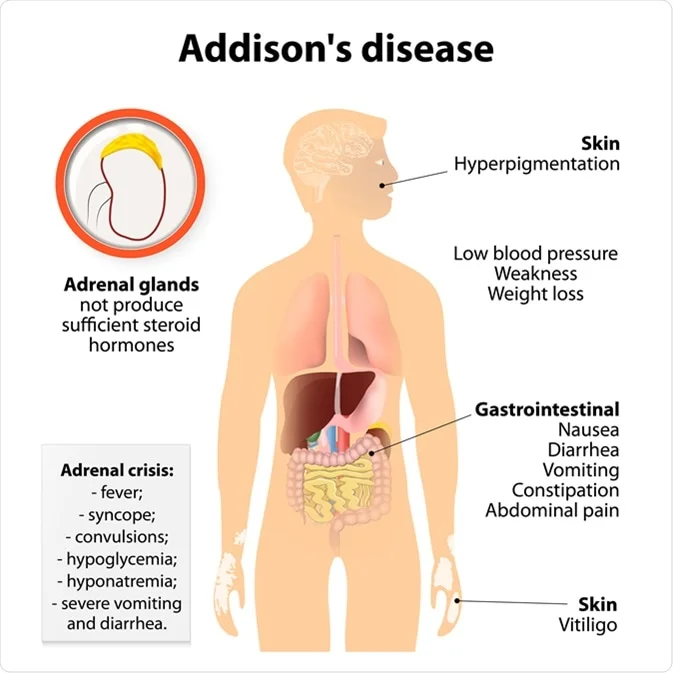
The damage to the adrenal glands occurs gradually over time, and symptoms manifest slowly. Common symptoms include:
- Abdominal pain
- Irregular menstrual periods
- Cravings for salty foods
- Dehydration
- Depression
- Diarrhea
- Irritability
- Dizziness or vertigo when standing up
- Loss of appetite
- Low blood sugar
- Low blood pressure
- Muscle weakness
- Nausea
- Skin darkening, especially around scars, wrinkles, and joints
- Sensitivity to cold
- Unexplained weight loss
- Vomiting
- Exhaustion (extreme fatigue)
In some cases, symptoms may appear rapidly and cause a severe event, such as an Addisonian crisis or acute adrenal insufficiency. An Addisonian crisis is a medical emergency that, if not treated, can lead to shock and death.
Symptoms of a crisis include:
- Feeling restless, confused, panicked, or experiencing other changes in mental state
- Dehydration
- Extreme weakness
- Difficulty staying awake, or loss of consciousness altogether
- High fever
- Restlessness or feeling weak
- Pale skin
- Vomiting and diarrhea
If you suspect that you or someone else may be experiencing symptoms of an Addisonian crisis, seek immediate medical attention.
Symptoms of Addison’s Disease: A Closer Look
Some people with Addison’s disease might not exhibit noticeable symptoms for years after the onset of the condition. In some cases, the symptoms can vary widely depending on the patient and their unique circumstances.
For instance, in patients who have experienced chronic stress or have other medical conditions, such as hypertension (high blood pressure), they may show no symptoms at all. Conversely, those with Addison’s disease may experience mild symptoms that are not easily noticeable to others.
In other cases, people might become very ill and unable to cope with their condition without immediate medical attention.
How is Addison’s Disease Diagnosed?
To determine if someone has Addison’s disease, the doctor will examine their symptoms and perform a physical examination. Skin darkening might be a clue to consider.
However, a diagnosis cannot be made solely based on examination results. Blood tests are also necessary to measure sodium, potassium, cortisol, and ACTH levels in the blood, as well as an ACTH stimulation test to see how well the adrenal glands respond to artificial ACTH. If the adrenal glands produce low levels of cortisol after the ACTH injection, they may not be functioning properly.
In addition to blood tests, imaging techniques such as X-rays or CT scans might also be used to evaluate the function of adrenal glands and/or pituitary gland.
Diagnosis Methods: Blood Tests
To confirm a diagnosis of Addison’s disease, your doctor will likely order several blood tests. These may include:
- Sodium test: Measures sodium levels in the blood.
- Potassium test: Measures potassium levels in the blood.
- Cortisol test: Measuring cortisol levels helps determine if adrenal glands are producing enough cortisol.
- ACTH stimulation test: This test assesses how well your adrenal glands respond to a dose of synthetic ACTH.
- Glucose stress test: Evaluates how your body responds to high blood glucose during the day.


