
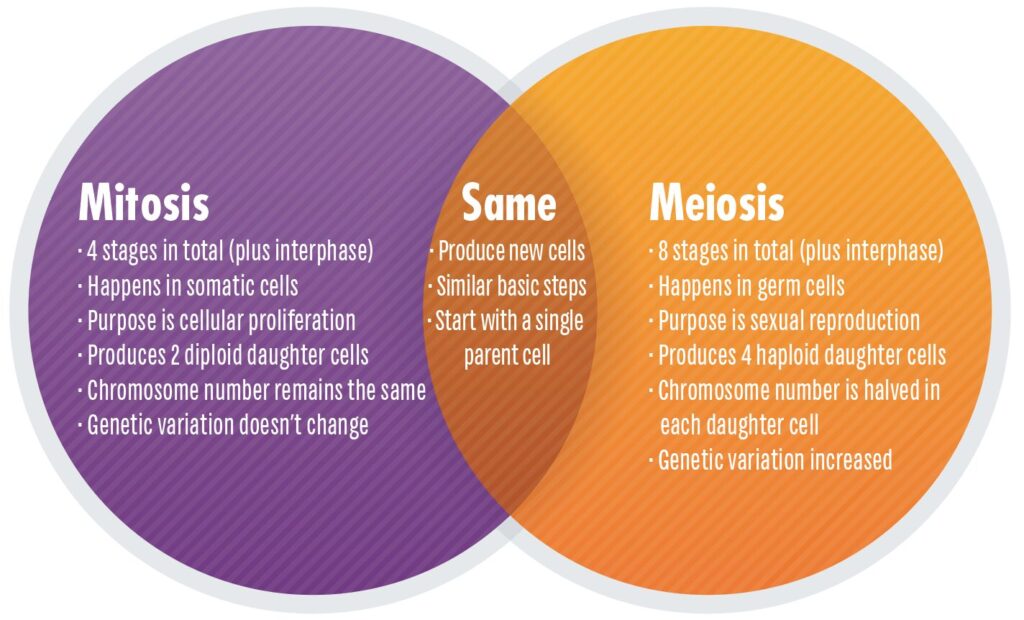
As students, it’s no surprise that understanding the difference between mitosis and meiosis is a challenge. But fear not! With a solid grasp of basic concepts, you’ll be able to crack this topic in no time.
When Does Mitosis Occur? When Does Meiosis?
Our bodies are constantly regenerating cells, thanks to mitosis. On the other hand, meiosis only occurs in cells with reproductive function (gametocytes). It’s not a coincidence that these processes happen separately!
Mitosis is essential for growth, repair, and maintenance of tissues throughout our lives. Our body has millions of cells, and all of them undergo mitosis to regenerate and replace damaged or old cells. Meiosis, on the other hand, only occurs in reproductive cells with 46 chromosomes, making it a critical process for sexual reproduction.
What’s the Difference Between Mitosis and Meiosis?
In simple terms:
- Mitosis creates 2 genetically identical daughter cells from a single parent cell.
- Meiosis produces 4 haploid daughter cells from a diploid parent cell, making them distinct from the parent cell.
Mitosis: All Cells, All the Time
Mitosis applies to all somatic cells in our body. These cells are responsible for growth, repair, and maintenance of tissues. Our skin cells, muscle fibers, and nerve cells all undergo mitosis to regenerate and replace damaged or old cells.
Imagine a tree with roots that grow from its trunk. The roots represent the stem cells, which undergo mitosis to produce new root cells. This process continues throughout the tree’s life, allowing it to grow taller and stronger.
Meiosis: The Reproductive Process
Meiosis is the process of reproduction through which diploid cells produce haploid gametes (sperm or egg cells). In humans, meiosis occurs only in reproductive cells with 46 chromosomes. After meiosis, these cells combine to form a single cell with 23 chromosomes – the foundation for our individual development.
In animals like birds and fish, meiosis also occurs in the gonads (ovaries and testes) where gametes are produced. In humans, meiosis starts at puberty and continues throughout life, producing millions of sperm or egg cells every day.
Understanding Meiosis
Meiosis is the division of a diploid cell into four haploid daughter cells, reducing the number of chromosomes by half. This process ensures that each gamete receives an equal amount of genetic material from both parents.
In humans, meiosis occurs in two stages: meiosis I and meiosis II. During meiosis I, homologous chromosomes separate, resulting in four non-sister chromatids. These chromatids then undergo further division during meiosis II to produce haploid gametes with 23 chromosomes each.
Understanding Mitosis
Mitosis is the reproduction of a single diploid cell into two genetically identical daughter cells. This process also reduces the number of chromosomes from 46 to 46 but produces genetically identical cells, not haploid ones like meiosis.
Think of it like a photocopy machine. The parent cell (diploid) makes a copy of itself, resulting in two genetically identical daughter cells that have the same number of chromosomes as the original cell.
Meioses I and II: A Key Difference
While mitosis is identical in both meioses I and II, there’s a crucial difference between the two. Meiosis I reduces the chromosome number from 46 to 23, resulting in four haploid daughter cells. In contrast, meiosis II simply duplicates existing chromosomes, producing two genetically identical sister chromatids.
For example, if a parent cell has 46 chromosomes, meiosis I would result in four non-sister chromatids with 23 chromosomes each. Meiosis II would then duplicate these chromatids to produce haploid gametes with 23 chromosomes each.
In Conclusion
Mitosis and meiosis are distinct processes that occur separately. While mitosis applies to all somatic cells, meiosis is essential for sexual reproduction and occurs only in reproductive cells with 46 chromosomes.
Understanding the difference between mitosis and meiosis will help you appreciate the complexities of cell biology and reproduction. By grasping these fundamental concepts, you’ll be better equipped to tackle more advanced topics in biology and beyond.
Frequently Asked Questions (FAQs)
- What is the main difference between mitosis and meiosis?
Mitosis produces genetically identical daughter cells from a single parent cell, while meiosis produces haploid daughter cells from a diploid parent cell. - When does mitosis occur in our bodies?
Mitosis occurs continuously to regenerate somatic cells throughout our lives. - What triggers the transition from mitosis to meiosis?
Meiosis is triggered by the fusion of gametes (sperm and egg) during fertilization, which sets off a chain reaction that leads to cell division through mitosis. - How many chromosomes does a human cell have after meiosis?
A human cell has 23 chromosomes after meiosis, as it combines with another haploid cell during fertilization. - What is the role of meiosis in reproduction?
Meiosis plays a critical role in sexual reproduction by producing gametes with half the number of chromosomes, ensuring genetic diversity and proper pairing during fertilization. - Can mitosis occur without meiosis?
No, mitosis cannot occur without meiosis. Meiosis sets off the chain reaction that leads to cell division through mitosis. -
Why is it necessary for cells to undergo meiosis before mitosis?
Meiosis produces haploid gametes with half the number of chromosomes, allowing them to combine and form a diploid zygote – the foundation of our individual development. -
Can you provide an example of how mitosis occurs in our bodies?
Cell division through mitosis occurs continuously to regenerate tissues, repair damaged cells, and maintain overall cellular homeostasis in our body. -
What is the significance of meiosis in reproduction?
Meiosis ensures that each gamete receives an equal amount of genetic material from both parents, increasing the chances of successful fertilization and healthy offspring. - Can you explain the difference between mitosis and meiosis using a simple analogy?
Imagine a tree with roots growing from its trunk. Mitosis is like the growth of new root cells from the stem cells, while meiosis is like the production of seeds from the fruit of that tree – each seed contains half the genetic material of the parent cell.
By understanding the difference between mitosis and meiosis, you’ll be able to better appreciate the intricacies of cell biology and reproduction. Whether it’s in your studies or everyday life, grasping these fundamental concepts will serve as a solid foundation for exploring more complex topics in science and beyond.


