
Introduction to the Ancient Greek Mythology
In ancient Greek mythology, the Titans were the most ancient deities, their sister-wife counterparts being known as Titanids. The term “Titan” originates from Greek because it comes from the mythological and religious heritage of Greece, in ancient Greek, their name sounded like “Τιτάνες”, which means “They who hold up the sky”. According to various theories, including that of Esiodus, the word derives from titanein (“to produce force” or “to stretch”) and tisis (“vengeance” or “punishment”). It would be an expression coming out of the mouth of their father Urano, manifesting his disdain towards them.
The Titans played a crucial role in the creation of the universe and were considered to be the primordial forces that governed the world before the Olympians took control. These powerful deities were said to have been born from the void of chaos, and their stories are deeply rooted in Greek mythology.
The Primordial Forces
As existent before the Olympians, the Titans are often considered as the primordial forces of the universe, dominating the world before the Olympians took control. These creatures of Greek mythology have made their appearance soon after the creation of the universe, in total there are twelve but only six are male: Oceano, Ceo, Crio, Iperione, Giapeto, and Crono. The six females are perhaps less known, but depending on cases, they are named Tea, Rea, Temi, Teti, Febe, and Mnemosine.
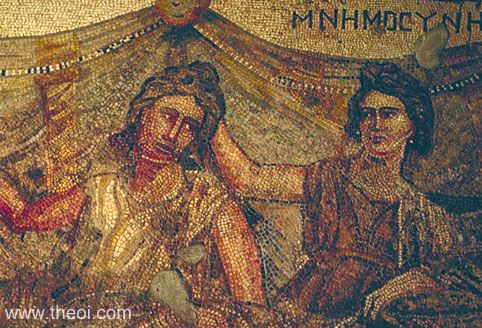
Mnemosine, in particular, is a Titanid who plays a significant role in Greek mythology. She is often associated with memory and the power of recollection, and her story is deeply intertwined with that of Zeus.
Brotherly Love
Over time, the Titans formed couples: Rea and Crono, Oceano and Teti, Iperione and Tea, Ceo and Febe. Let’s return to the couple Gea – Urano, the two deities didn’t finish having children but generated the three Cyclopi (Bronte, Sterope, and Arge) and Ecatonchiri (Centimani): Cotto, Briareo, and Gige with terrible strength.
The Cyclopi were known for their incredible physical strength and were often depicted as being strong enough to rival the gods themselves. However, they were also known for their ugliness, which may have contributed to their exclusion from society.
Mythology
In stories that can be read also in the article dedicated to Cronos, we find the three Ecatonchiri and Cyclopi imprisoned by Urano, father, according to some because of their ugliness, others because they might cause the fall of his kingdom and take his place. Gea, their mother, intervened asking the Titans, always her children, to intervene for freeing the brothers. She also built a toothed flail to arm them but only Crono was willing to answer her call.
Cronos, armed with a toothed flail, set a trap for his father Urano and managed so as to castrate him. This is the moment when begins the reign of Cronos. As we’ve seen before, Cronos is one of the Titans who marries a sister, specifically chooses Rea and with her generates Estia, Demetra, Hera, Ade, and Ennosigeo.
Unfortunately, these children don’t have a pretty ending as they are devoured by Cronos himself. Why this ferocity? It’s believed that Cronos was aware of the prophecy that his offspring would ultimately overthrow him, and he took drastic measures to prevent this from happening.
The Curse
All the blame of the curse that Cronos knew through which he was aware that his offspring would depose him. This cruel action of Cronos led Gea to hide her last child Zeus and make him survive, and made it grow in secret, entrusting it to a goat. Cronos, instead of Zeus, ate a stone, convinced that it was the newborn, and while young Zeus grew up he returned to defeat his father and free the brothers who for recognition would give him precious gifts: thunder, lightning, and light.
The story of Cronos and Zeus is one of the most famous in Greek mythology, and it serves as a reminder of the power of fate and the consequences of one’s actions. The conflict between Cronos and Zeus ultimately led to the downfall of the Titans and the rise of the Olympian gods.
The Titanomachy
This name is used to indicate the battle between Titans residing on Mount Otri and the Olympian gods children of Cronos and Rea. The battle was tough and put two powerful and varied groups against each other. Zeus, from his side, had Cyclopi and Ecatonchiri, oltretutto, and managed to defeat the Titans with their help.
These creatures were then segregated in Tartarus, imprisoned between bronze walls built by Poseidon and watched over by the same three Ecatonchiri. The Titanomachy was a pivotal event in Greek mythology, marking the end of the Titans’ reign and the beginning of the Olympian era.
Oceano
Let’s dive deeper into two of the most interesting Titans. Oceano, for example, was called by Homer the origin of gods and the origin of all. We are in front of a sea god with an endless generative power so that even before marriage Greek girls would bathe in his waters.
Oceano is also mentioned by several classical Greek authors, including Pindar and Eschilus, and it is one of the protagonists of the poem La Trasimenide by Matteo dall’Isola. The sea god’s significance extends beyond mythology, as it represents a powerful symbol of the ocean’s power and mystery.
Mnemosine
Mnemosine is, in fact, a Titanid who plays a significant role in Greek mythology. She is often associated with memory and the power of recollection, and her story is deeply intertwined with that of Zeus.
According to legend, Zeus fell deeply in love with Mnemosine and, to have her, presented himself in the form of a shepherd, managing to sleep with her for nine nights on Mount Pieria. After one year Mnemosine gave birth to the Muses.
The Muses were the goddesses of the arts and sciences, and their story is closely tied to that of Mnemosine. The Muses are believed to have been born from Zeus’s love for Mnemosine, and they went on to play a crucial role in the development of art, literature, and music.
Teti
Teti among Titans plays a central role in myths related to creation but she is not often found in Greek texts or religious practices and even cults. In few myths where her name is mentioned, they are those relative to the great goddess Hera still a child at the time of the war between Titans and Olympians.
For its safety, Hera was sent to the extremities of the world, near Oceano and Teti, and was raised by them as an adopted daughter. The story of Hera’s upbringing highlights the importance of family and protection in Greek mythology, even for those who are considered to be gods themselves.
Conclusion
In conclusion, the Titans played a crucial role in ancient Greek mythology, serving as the primordial forces that governed the world before the Olympians took control. Their stories are deeply intertwined with those of other gods and goddesses, including Zeus, Cronos, Oceano, and Mnemosine.
The Titanomachy was a pivotal event in Greek mythology, marking the end of the Titans’ reign and the beginning of the Olympian era. The significance of the Titans extends beyond mythology, as it represents a powerful symbol of the ocean’s power and mystery.
Mnemosine’s role in Greek mythology is particularly significant, as she is often associated with memory and the power of recollection. Her story is deeply intertwined with that of Zeus, and her legacy lives on through the Muses, who were born from their love.
The Titans will forever be remembered as the primordial forces of the universe, shaping the world in which we live today. Their stories serve as a reminder of the power of fate and the consequences of one’s actions, and continue to captivate us with their mystique and wonder.


