
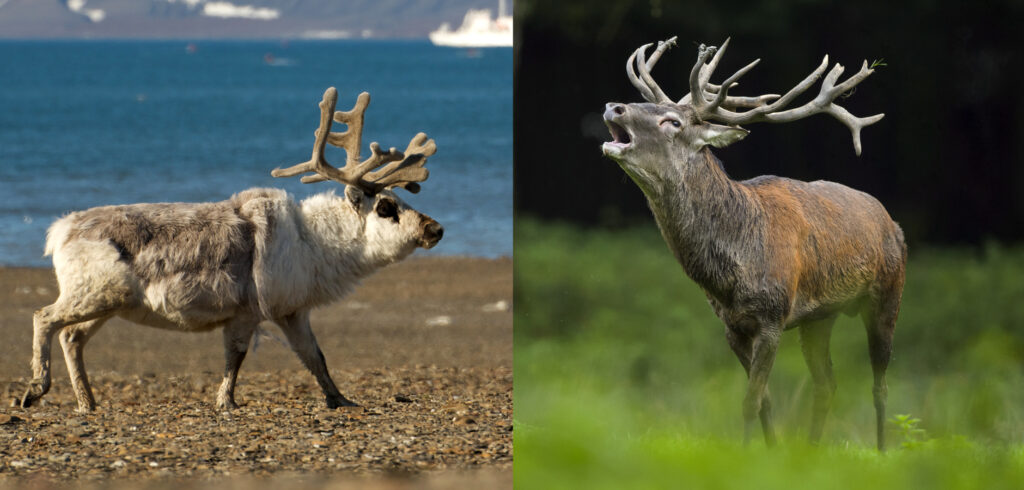
Reindeer and deer are two popular members of the Cervidae family that often get confused with one another. In this article, we will delve into their scientific classification, physical characteristics, habitats, diets, life expectancy, and domestication.
Contents
- Hide
- Scientific Classification
- Reindeer (Caribou)
- Deer (such as Red Deer)
- Physical Characteristics of Reindeer and Deer
- Geographical Distribution of Reindeer and Deer
- Diet of Reindeer and Deer
- Expectation of Life of Reindeer and Deer
- Domestication
- Scientific Classification
Classification Scientific of Reindeer and Deer
Scientific classification is a system used to organize and categorize species based on common characteristics and evolutionary relationships. In this article, we will explore the differences between reindeer and deer from a scientific classification standpoint.
Reindeer (Caribou)
* Domain: Eukaryota
* Kingdom: Animalia
* Phylum: Chordata
* Class: Mammalia
* Order: Artiodactyla
* Family: Cervidae
* Genus: Rangifer
* Species: R. tarandus
Deer (such as Red Deer)
* Domain: Eukaryota
* Kingdom: Animalia
* Phylum: Chordata
* Class: Mammalia
* Order: Artiodactyla
* Family: Cervidae
* Genus: Cervus
* Species: C. elaphus
These two animals belong to different genera within the Cervidae family, with Reindeer belonging to the genus Rangifer and Deer belonging to various genera.
Physical Characteristics of Reindeer and Deer
One of the most noticeable differences between Reindeer and other species of cervids is their horns. In most species of cervids, only males develop horns. However, in Reindeer, both males and females develop horns, which represents an exception within the Cervidae family.
Reindeer horns are also denser and heavier than those of other cervid species.
Geographical Distribution of Reindeer and Deer
Both Reindeer and Deer have specific habitats that adapt to their survival needs.
Habitat of the Reindeer
Reindeer are primarily cold-weather animals and can be found in the northern regions of the planet, including tundra and taiga. These include:
- Scandinavia
- Northern Russia
- Alaska
- Canada
- Greenland
They have specialized adaptations to deal with extreme cold temperatures, such as a thick coat of dense fur and a subcutaneous fat layer for insulation.
Habitat of Deer
Deer habitats are much more varied, as the term “deer” refers to many species within the Cervidae family. They can be found in various environments, including forests, prairies, wetlands, and even mountainous regions.
For example:
- White-tailed Deer
- Are widely distributed across North America and adapt to a variety of environments, from forests to meadows and even suburban areas.
- Red Deer
- Are found primarily in Europe, Asia Minor, Iran, northern Africa, and some parts of North America. They prefer mixed forests, prairies, and mountainous regions.
Diet of Reindeer and Deer
Reindeer and deer are both herbivorous ruminants, meaning their diet consists mainly of plant material and they have a complex digestive system divided into four compartments to aid digestion. However, there are significant differences in their diets due to different nutritional needs and habitats.
-
Diet of Reindeer
- Deer feed on a variety of plant materials, including lichens, leaves, buds, grasses, and mosses.
- During winter, when most plants are covered with snow, they primarily feed on lichen type Cladonia, also known as “lichen for reindeer,” which can scrape from the surface of rocks and soil using their sharp hooves.
-
Diet of Deer
- Deer diets vary depending on the species and habitat.
- In general, deer are opportunistic herbivores that feed on a wide range of plant materials, including grasses, leaves, buds, fruits, nuts, and tree bark.


